
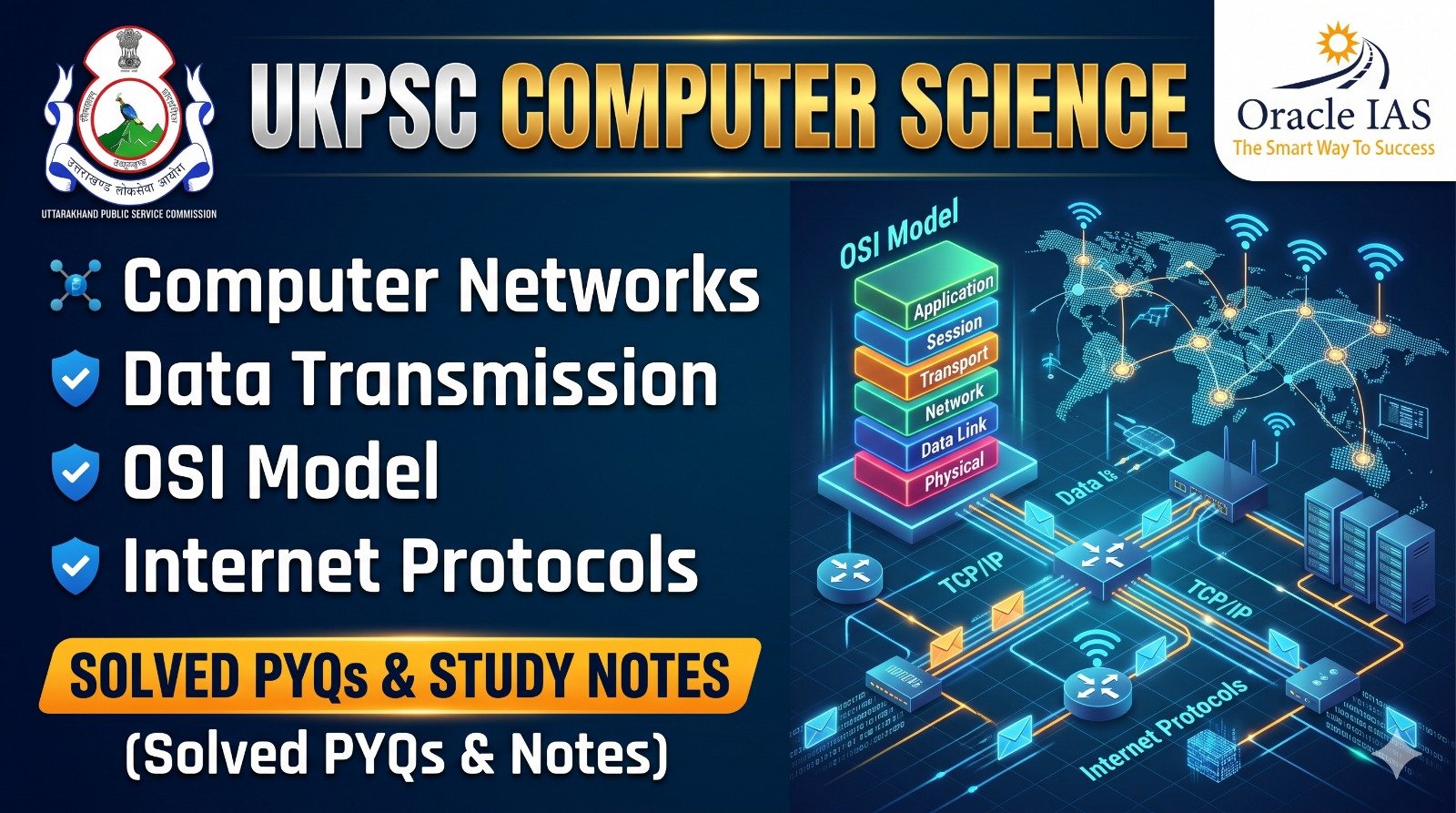
UKPSC Computer Science Unit 6: Computer Networks, Data Transmission & Internet Protocols
Part of the UKPSC General Science & Technology Revision Series.
1.High-Yield Micro-Notes
- Network Topography & Scope Classifications:
- Local Area Network (LAN): Interconnects computers and peripherals across a geographically restricted perimeter (such as an office room, school laboratory, or single building), commonly using Ethernet cabling or Wi-Fi (WLAN).
- Metropolitan Area Network (MAN): Spans a broader municipal geographic footprint (such as a citywide cable television network or municipal broadband system).
- Wide Area Network (WAN): Connects computers and networks across large geographical distances, spanning regions, nations, or continents using telecommunications lines, satellite uplinks, microwave relays, and undersea fiber-optic backbones. The Internet is the global “Network of Networks”.
- Layered Network Architectures:
- OSI 7-Layer Reference Model: Developed by the International Organization for Standardization (ISO) to standardize network communication:
- Physical Layer: Binary bitstream transmission, pin voltages, cabling specifications.
- Data Link Layer: Node-to-node frame delivery, hardware MAC addressing, error detection.
- Network Layer: Host-to-host packet routing, logical IP addressing, and path determination.
- Transport Layer: End-to-end process-to-process delivery, segmentation, flow control (TCP, UDP).
- Session Layer: Establishes, manages, and terminates presentation sessions between applications.
- Presentation Layer: Data translation, encryption/decryption, and compression.
- Application Layer: Network interfaces for end-user software (HTTP, FTP, SMTP, DNS).
- TCP/IP 4-Layer Model: The operational protocol suite of the internet, consolidated into:
- Network Access / Link Layer (Combines OSI Physical and Data Link functions).
- Internet Layer (Implements IPv4/IPv6 packet addressing and routing).
- Transport Layer (TCP connection-oriented transmission and UDP connectionless delivery).
- Application Layer (Combines OSI Session, Presentation, and Application services).
- Core Internet & Telecommunications Protocols:
- Internet Protocol Version 4 (IPv4): A connectionless network layer protocol using 32-bit logical addresses, typically represented as four decimal octets (each ranging from 0 to 255) separated by dots (e.g., 192.168.1.1).
- Transmission Control Protocol (TCP): A reliable, connection-oriented transport protocol that uses a three-way handshake to manage data packet sequencing, acknowledgments, and flow control.
- File Transfer Protocol (FTP): An application layer client-server protocol used to transfer files between computers over a network.
- Simple Mail Transfer Protocol (SMTP): The standard application protocol used to push and relay outgoing electronic mail (E-mail) messages between mail servers across the internet.
- Modulation & Hardware Devices:
- Modem (Modulator-Demodulator): Converts digital signals from a computer into analog signals for transmission across telephone lines, and demultiplexes incoming analog signals back into digital data for the receiver.
- Router: An intelligent network layer device that reads destination IP addresses on data packets, determines the optimal path using routing tables, and forwards packets between distinct networks.
- Circuit Switching vs. Packet Switching: The legacy Public Switched Telephone Network (PSTN) uses dedicated physical communication circuits established for the duration of a call (Circuit Switching); the Internet breaks data streams into addressed, independently routed packets (Packet Switching).
- High-Speed Transmission Media:
- Fiber-Optic Cable: Uses thin strands of ultra-pure silica glass or plastic to transmit data pulses as light waves via Total Internal Reflection. It offers higher transmission speeds and bandwidth than metallic copper media (such as unshielded twisted pair, UTP, and coaxial cables) and is immune to electromagnetic interference (EMI).
- World Wide Web & Navigation:
- The World Wide Web was invented in 1989–1991 by British computer scientist Sir Tim Berners-Lee at CERN, who developed HyperText Markup Language (HTML), the HyperText Transfer Protocol (HTTP), the first web browser, and Uniform Resource Locators (URLs).
- Web Browsers: Client applications that interpret HTML markup, style sheets, and scripts to fetch and display web pages (e.g., Google Chrome, Mozilla Firefox, Apple Safari, Microsoft Edge, Netscape Navigator).
- Search Engines & SEO: Specialized web indexers that crawl and index web documents for keyword queries (e.g., Google, Bing, Yahoo). Search Engine Optimization (SEO) is the process of structuring web content to improve its visibility in organic search engine results.
2. Important facts you should know:
| Protocol / Network Technology | Layer / Model | Operating Mechanism | Primary Functional Application |
| IPv4 Address | Network Layer (OSI) | 32-bit address; 4 dotted-decimal octets | Uniquely identifies hosts on an IP network. |
| TCP | Transport Layer | Connection-oriented, packet sequencing | Reliable end-to-end data delivery across networks. |
| SMTP | Application Layer | Text-based push transmission | Sending and relaying email between mail servers. |
| FTP | Application Layer | Dual port client-server communication | Uploading and downloading files across remote hosts. |
| Modem | Physical / Data Link | Analog-to-digital signal conversion | Connects digital computers over analog telecommunication lines. |
| Router | Network Layer | Reads packet IP headers; table routing | Routes traffic between separate local and wide area networks. |
| Fiber-Optic Cable | Physical Layer | Total internal reflection of light | High-speed, long-distance data transmission with low signal loss. |
| PSTN | Physical / Data Link | Dedicated physical circuit connection | Conventional telephone voice networks. |
3. Master Questions
Q1. An Internet Protocol Version 4 (IPv4) address is composed of how many total bits?
[UKPSC RO/ARO Pre 2023] [Direct Fact]
(a) 16 bits
(b) 32 bits
(c) 64 bits
(d) 128 bits
Q2. Which layer of the seven-layer OSI reference model manages logical device addressing and packet routing across networks?
[UKPSC Pre 2006-07] [Direct Fact]
(a) Network Layer
(b) Application Layer
(c) Transport Layer
(d) Data Link Layer
Q3. A hardware device that converts outgoing digital computer signals into analog signals for transmission across telephone lines, and reverses the process for incoming signals, is a:
[UKPSC Pre 2002-03 | UKPSC RO/ARO Pre 2022 | UKPSC RO/ARO Mains 2006 | UKPCS Lower Pre 2010] [Direct Fact]
(a) Packet Multiplexer
(b) Modem
(c) Terminal Emulator
(d) Optical Repeater
Q4. Which of the following transmission media provides the highest data transfer speeds and bandwidth by transmitting information as pulses of light?
[UKPSC RO/ARO Pre 2022 | UKPSC CFO 2021] [Direct Fact]
(a) Unshielded Twisted Pair (UTP) cable
(b) Coaxial copper cable
(c) Fiber-optic cable
(d) Category-6 Ethernet cable
Q5. The network application layer protocol used to transmit electronic mail (E-mail) messages between different mail servers is:
[UKPSC Draftsman 2023] [Direct Fact]
(a) File Transfer Protocol (FTP)
(b) Remote Procedure Call (RPC)
(c) Simple Network Time Protocol (SNTP)
(d) Simple Mail Transfer Protocol (SMTP)
Q6. The set of four functional layers defined in the standard TCP/IP reference model includes:
[UKPSC Junior Assistant 2022] [Statement-Based]
(a) Application, Host-to-Host Transport, Internet, and Network Access
(b) Transport, Control, Internet, and Application
(c) Physical, Session, Transport, and Presentation
(d) Network, Routing, Transmission, and Service
Q7. Which of the following represents a valid dotted-decimal IPv4 network address?
[UKPSC Forest Guard 2022] [Direct Fact]
(a) 132.64.8.255
(b) 13.260.3.255
(c) 24.0.300.0
(d) 192.168.1.305
Q8. A client software program designed to fetch, parse HTML, and display web pages from the Internet is a:
[UKPSC RO/ARO Pre 2022 | UKPSC Forest Ranger Pre 2015 | UKPSC Forest Guard 2022] [Direct Fact]
(a) Web Browser
(b) Database Compiler
(c) System Linker
(d) File Assembler
Q9. The Public Switched Telephone Network (PSTN) historically operates using which transmission switching technology?
[UKPSC AE 2013] [Direct Fact]
(a) Packet Switching
(b) Message Switching
(c) Circuit Switching
(d) Distributed Cell Relaying
Q10. The process of optimizing web page structure, metadata, and keywords to improve its ranking in organic search engine results is known as:
[UKPSC CFO 2021] [Direct Fact]
(a) Chief Executive Officer indexing
(b) Search Engine Optimization (SEO)
(c) Web Bandwidth Compression
(d) Domain Name Resolution
4. Master Explanations & Answer Key
- Ans. (b)
- Direct Answer: An IPv4 address is 32 bits long, divided into four 8-bit octets separated by dots (e.g., 172.16.254.1).
- Exam Trap / Distractor Alert: IPv4 uses 32-bit addresses (providing roughly 4.3 billion unique addresses); IPv6 uses 128-bit addresses (written in hexadecimal notation) to accommodate global device growth.
- High-Yield Extra Facts: IPv4 addresses are divided into classes based on their leading bits: Class A (large networks), Class B (medium networks), Class C (small networks), Class D (multicast groups), and Class E (experimental use).
- Ans. (a)
- Direct Answer: The Network Layer (Layer 3 of the OSI model) handles host-to-host logical IP addressing, packet forwarding, internetworking, and dynamic route determination.
- Exam Trap / Distractor Alert: The Data Link Layer (Layer 2) handles physical MAC addresses and local frame delivery; the Network Layer handles logical IP addresses and routing across different networks.
- High-Yield Extra Facts: Routers operate primarily at the Network Layer, reading destination IP headers to forward packets between networks.
- Ans. (b)
- Direct Answer: A Modem (Modulator-Demodulator) modulates digital computer signals into analog audio tones for transmission across telephone lines, and demodulates received analog tones back into digital data.
- Exam Trap / Distractor Alert: A router directs network packets between subnets; a modem converts signals between analog transmission media and digital computer interfaces.
- High-Yield Extra Facts: Early dial-up modems used audio frequency-shift keying (FSK) and phase-shift keying (PSK) over twisted-pair copper telephone lines, achieving speeds up to 56 kbps (V.90 standard).
- Ans. (c)
- Direct Answer: Fiber-optic cables provide higher transmission speeds and bandwidth than copper cables, carrying data as pulses of light through glass cores via total internal reflection.
- Exam Trap / Distractor Alert: Copper cables (such as coaxial and UTP Ethernet) transmit electrical signals that suffer from higher attenuation, resistance, and electromagnetic interference over long distances; fiber-optic cables carry light signals with minimal attenuation.
- High-Yield Extra Facts: Fiber-optic cables come in two main types: single-mode fiber (narrow core, uses laser light for long-distance telecommunications) and multi-mode fiber (wider core, uses LEDs for shorter campus and data-center links).
- Ans. (d)
- Direct Answer: SMTP (Simple Mail Transfer Protocol) is the standard application-layer protocol used to send and relay email messages between mail servers across the internet.
- Exam Trap / Distractor Alert: SMTP is used to send and relay outgoing email; POP3 (Post Office Protocol) and IMAP (Internet Message Access Protocol) are used by email clients to retrieve email from a mailbox server.
- High-Yield Extra Facts: SMTP traditionally operates over TCP port 25, while secure encrypted email connections commonly use TCP port 587 (with STARTTLS) or port 465 (SMTPS).
- Ans. (a)
- Direct Answer: The four layers of the standard TCP/IP protocol suite are the Application Layer, Host-to-Host Transport Layer, Internet Layer, and Network Access (Link) Layer.
- Exam Trap / Distractor Alert: Do not confuse the 4 layers of the TCP/IP model with the 7 layers of the OSI model; TCP/IP combines the functions of the OSI Physical and Data Link layers into the Network Access layer, and merges the Session, Presentation, and Application layers into the Application layer.
- High-Yield Extra Facts: The TCP/IP model was developed by the Defense Advanced Research Projects Agency (DARPA) in the 1970s and served as the foundational networking protocol for ARPANET, the precursor to the modern Internet.
- Ans. (a)
- Direct Answer: An IPv4 address consists of four decimal octets separated by dots, where each octet must fall within the numerical range of 0 to 255; therefore, 132.64.8.255 is a valid IPv4 address.
- Exam Trap / Distractor Alert: Options (b), (c), and (d) contain octet values exceeding 255 (260, 300, and 305), which violates the 8-bit octet boundary ($2^8 – 1 = 255$).
- High-Yield Extra Facts: An octet value of 255 is often used as a broadcast address within a local subnet, while 0 typically designates the network identifier itself.
- Ans. (a)
- Direct Answer: A Web Browser is an application software program that requests resources over HTTP/HTTPS, parses HTML, CSS, and JavaScript, and renders formatted web pages on screen.
- Exam Trap / Distractor Alert: Search engines (like Google) are web-based indexing services; a web browser (like Chrome, Firefox, or Safari) is the local application software used to navigate and view websites.
- High-Yield Extra Facts: Tim Berners-Lee created the first web browser (named WorldWideWeb, later renamed Nexus) in 1990; the NCSA Mosaic browser (released in 1993) popularized the web by displaying images directly inline with text.
- Ans. (c)
- Direct Answer: The Public Switched Telephone Network (PSTN) uses Circuit Switching, which establishes a dedicated, continuous physical communication channel between two callers for the duration of the call.
- Exam Trap / Distractor Alert: The Internet uses packet switching, where data is split into packets that can travel along different paths; traditional telephone voice networks use circuit switching, which reserves a dedicated path.
- High-Yield Extra Facts: Circuit switching guarantees consistent bandwidth and zero transmission jitter once connected, but it ties up channel capacity even during silences in conversation; packet switching shares bandwidth more efficiently by interweaving data packets from multiple sources.
- Ans. (b)
- Direct Answer: Search Engine Optimization (SEO) is the process of improving a website’s content, technical structure, and backlink profile to increase its organic ranking and visibility in search engines like Google and Bing.
- Exam Trap / Distractor Alert: SEO refers to organic search visibility; paid placement is called Search Engine Marketing (SEM) or Pay-Per-Click (PPC) advertising.
- High-Yield Extra Facts: SEO practices include on-page optimization (keyword placement, heading hierarchy, mobile-friendly design) and technical optimization (fast page load speeds, clean URL structures, and valid sitemap indexing).
Contact Oracle IAS:
Call/WhatsApp 9997453844 for details
Join Our Preparation program:
He is a bibliophile,accomplished writer and a fitness enthusiast.
- UKPSC Computer Science: Cybersecurity, Malware, IT Act 2000 & Cloud Computing (Solved PYQs & Notes) - November 28, 2026
- UKPSC Computer Science: Computer Networks, Data Transmission, OSI Model & Internet Protocols (Solved PYQs & Notes) - November 28, 2026
- UKPSC Computer Science: Programming Languages, Compilers & Database Systems (DBMS) (Solved PYQs & Notes) - November 28, 2026