
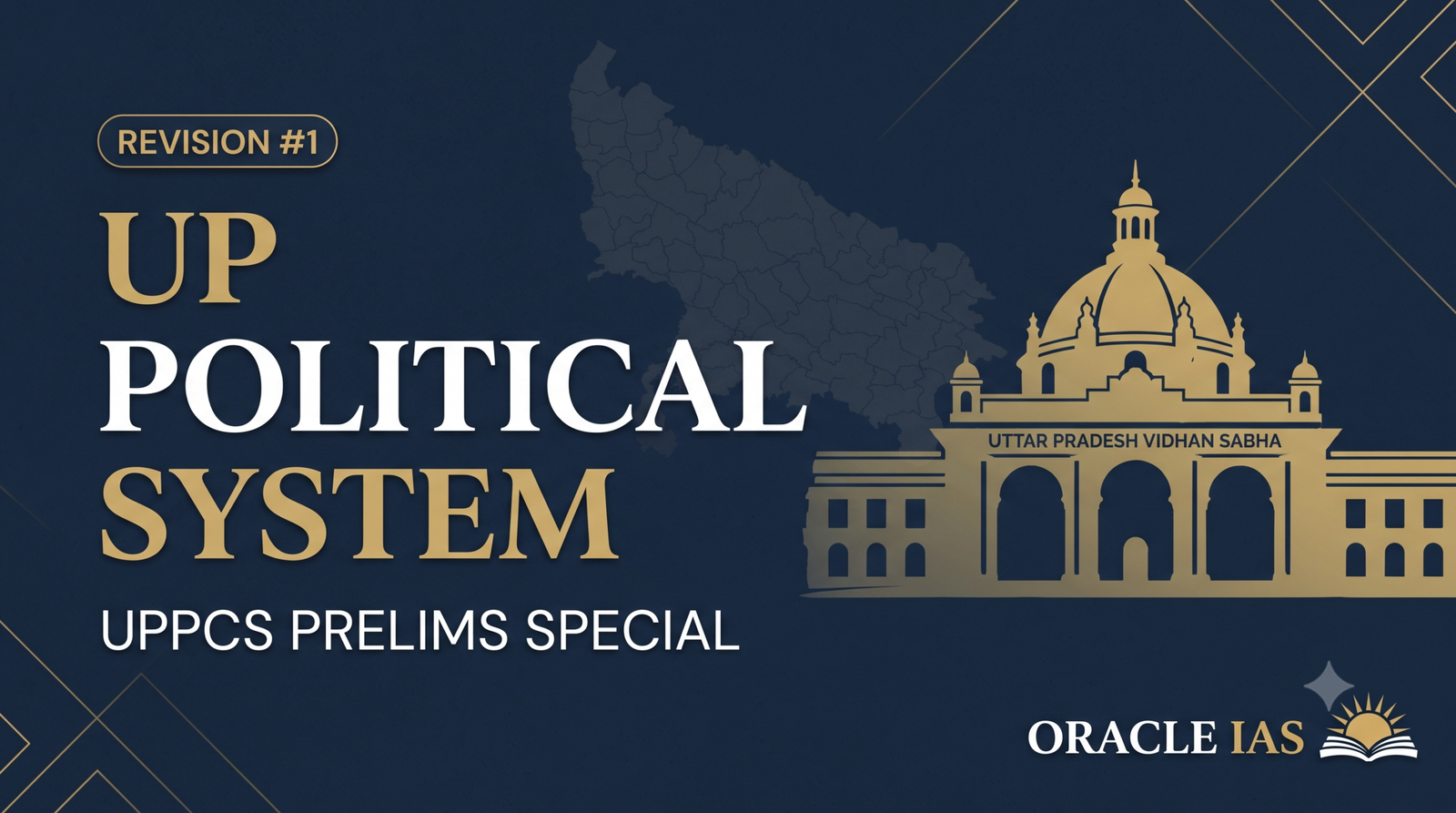
The Uttar Pradesh Political System and State Executive form a high-yield section of the UPPCS Prelims General Studies (GS Paper 1) syllabus. Many a times, questions are framed around a blend of core constitutional provisions and specific UP political history, notable personalities, firsts, and milestones.
To clear UPPCS, studying abstract Constitutional Articles is not enough—you must master UP-specific facts alongside statutory limits and constitutional traps. This master revision guide covers both layers in a single place.
1. Quick Revision Table: UP State Executive at a Glance
| Feature / Topic | Key Provision / Fact | Constitutional Article / Source |
| Constitutional Head of State | Governor | Article 153 & 154 |
| Real Executive Head | Chief Minister & Council of Ministers | Article 163 & 164 |
| Appointing Authority of Governor | President of India | Article 155 |
| Appointing Authority of CM | Governor | Article 164(1) |
| Collective Responsibility | Legislative Assembly (Vidhan Sabha) | Article 164(2) |
| Pardoning Power of Governor | Extends to State Executive Scope | Article 161 |
| Ordinance-Making Power | Promulgated when House is in recess | Article 213 |
| Duties of CM towards Governor | Administrative & Legislative info | Article 167 |
| Maximum Size of Council | 15% of Assembly Strength (UP: Max 60) | Article 164(1A) (91st Amendment) |
| Minimum Number of Ministers | 12 Ministers | Article 164(1A) |
| Non-Legislator Minister Limit | Must gain election within 6 Months | Article 164(4) |
2. Powers & Discretionary Functions of the Governor
Executive & Legislative Powers
- Appoints the Chief Minister, Council of Ministers, Advocate General of UP (Article 165), and State Election Commissioners.
- Acts as Chancellor of State Universities in UP.
- Summons, prorogues, and dissolves the UP Legislative Assembly.
- Nominated Members: Following the 104th Constitutional Amendment Act (2019), the reservation for Anglo-Indian nomination in state assemblies was discontinued.
Discretionary Powers
- Constitutional Discretion: Reserving a Bill for the President’s consideration (Article 200); recommending President’s Rule under Article 356.Situational Discretion: Selection of Chief Minister during a Hung Assembly; dismissal of the ministry when it fails to prove majority on the floor; dissolution of the Assembly when the Council loses its majority.Floor Test Principle: Established in S.R. Bommai v. Union of India (1994)—majority must be tested on the floor of the House, not by subjective opinion.
3. UP Political History: Essential Firsts & Milestones
UPPCS frequently asks direct matching/factual questions on UP political personalities.
Detailed Historical Personalities
- First Premier of United Provinces: Nawab Muhammad Ahmad Said Khan (Nawab of Chhatari) (Assumed office on April 3, 1937).
- First Chief Minister of UP: Govind Ballabh Pant (Served as Premier of United Provinces from 1937–39 and 1946–50; took oath as CM of UP on January 26, 1950).
- First Woman Chief Minister: Sucheta Kriplani (Took office on Oct 2, 1963; India’s first woman CM).
- First Non-Congress Chief Minister: Chaudhary Charan Singh (Bharatiya Kranti Dal, 1967).
- First Dalit Woman Chief Minister: Mayawati (First sworn in June 1995). She was also CM the maximum times in the state(4 times), followed by 3 tenures each of Mulayam Singh Yadav, Chandrabhanu Gupta and N D Tiwari.
- Youngest Chief Minister: Akhilesh Yadav (Sworn in 2012 at age 38).
- Yogi Adityanath: Sworn in on March 19, 2017. He became the first CM of Uttar Pradesh in 37 years to serve a full 5-year term. He is also the longest serving CM of the state. He is also the longest continuous serving CM of the state.
- Jagdambika Pal: Had the shortest tenure of 31 hours(February 21–23, 1998). The Allahabad HC stayed his dismissal by the Governor and Kalyan Singh was reinstated.
- Chandra Bhanu Gupta: He in 1967 had the shortest regular term of 20 days.
- There have been 10 periods of President’s rule in UP, with first in February 25, 1968 – February 26, 1969 and last in March 8, 2002 – May 3, 2002.
4. Governors of Uttar Pradesh: Key Fact Checks
- First Post-Independence Governor: Sarojini Naidu (August 15, 1947 – March 2, 1949). She was also the first female Governor of any Indian State.
- Pre-Independence Distinction: British Governors served before 1947. First Sir Spencer Harcourt Butler, who assumed office on January 3, 1921.
- Current Governor of UP: Anandiben Patel (In office since July 29, 2019).
Contact:
Call/WhatsApp 9997453844 for details
Join Our Preparation program:
Chief Mentor at Oracle IAS
Hemant Bhatt is a B. Tech from Pantnagar University and has studied Social Sciences at SciencesPo, Paris. He teaches at Oracle IAS, Dehradun. He has given 5 UPSC mains back to back along with 2 interviews.
He is a bibliophile,accomplished writer and a fitness enthusiast.
He is a bibliophile,accomplished writer and a fitness enthusiast.
Latest posts by Hemant Bhatt (see all)
- UPPCS Pre Revision #1 : UP Political System || Oracle IAS - October 6, 2026
- UKPSC Lower PCS 2024 Final Results: Celebrating Success with 100% Transparency at Oracle IAS - September 26, 2026
- UPPCS Interview 2026: Complete Interview Preparation Programme by Oracle IAS - September 23, 2026