
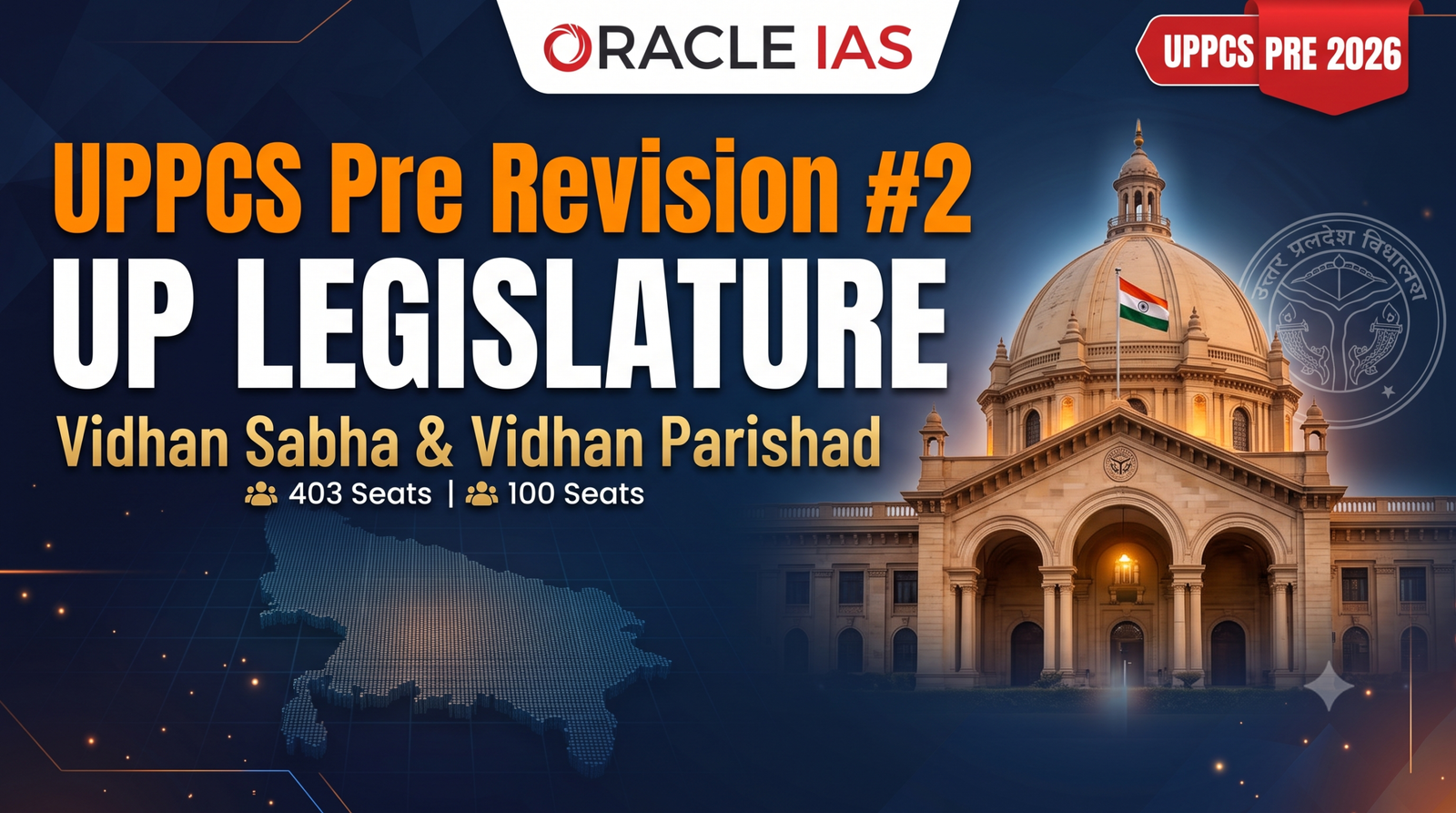
UPPSC consistently asks factual, numerical, and historical questions regarding the strength, composition, constitutional machinery, presiding officers, and committees of the UP State Legislature.
This document covers all constitutional provisions, historical milestones, memory tricks, and high-yield facts to help you score full marks in UP-specific polity questions.
UP Legislature at a Glance
| Feature / Institution | Key Facts & Historical Details |
| System | Bicameral Legislature (Articles 168–212) |
| Lower House | Legislative Assembly (Vidhan Sabha) |
| Upper House | Legislative Council (Vidhan Parishad) |
| Assembly Strength | 403 directly elected seats |
| Council Strength | 100 seats |
| Assembly Term | 5 years (unless dissolved earlier) |
| Council Term | Permanent House (1/3rd members retire every 2 years; 6-year individual term) |
| First Assembly Meeting | 29 July 1937 |
| First Council Meeting | 8 January 1887 (Thornhill Memorial Hall, Allahabad) |
| First Assembly Speaker after independence | Purushottam Das Tandon |
| First Post-Independence Council Chairman | Chandra Bhal |
| Current Assembly Speaker | Satish Mahana (18th Assembly) |
| Current Council Chairman | Kunwar Manvendra Singh |
1. Why Does Uttar Pradesh Have a Bicameral Legislature?
Under Article 168 of the Constitution of India, states can have either a unicameral or bicameral legislature. Uttar Pradesh is one of the few states in India with a bicameral legislature, comprising:
- Legislative Assembly (Vidhan Sabha): The directly elected, popular Lower House.
- Legislative Council (Vidhan Parishad): The indirectly elected, permanent Upper House.
Constitutional provisions regarding the organization, composition, duration, officers, and procedures of state legislatures are detailed under Articles 168 to 212 in Part VI of the Constitution.
2. Historical Evolution of the UP Legislature
Understanding the pre-independence milestones is essential for UP-specific history and polity questions:
- 1887 (8 January): The first meeting of the Legislative Council of the North-Western Provinces and Oudh took place at Thornhill Memorial Hall, Allahabad. It initially consisted of just 9 members with a 2-year term.
- 1919 (Government of India Act): Elections were introduced for the Legislative Council.
- 1935 (Government of India Act): Created a bicameral legislature for the United Provinces (UP).
- 1937 (29 July): The Legislative Assembly met for the first time, marking the official start of UP’s modern bicameral legislature.
3. UP Legislative Assembly (Vidhan Sabha)
Key Historical & Presiding Officer Facts
- First Speaker: Purushottam Das Tandon (assumed office in 1937).
- First Deputy Speaker: Abdul Hakim.
- Longest Continuous Tenure as Speaker: Purushottam Das Tandon.
- Speakers Elected for Three Terms:
- Atmaram Govind Kher (1952–57, 1957–62, 1969–74)
- Keshari Nath Tripathi (1991–93, 1997–2002, 2002–04)
- Current Speaker: Satish Mahana (Elected on 29 March 2022 for the 18th Assembly).
UPPCS Prelims Trap:
Assembly Pro-tem Speakers (Recent Trend)
The Pro-tem Speaker is appointed by the Governor to administer oaths to newly elected MLAs and conduct the Speaker’s election.
| Assembly Election | Pro-tem Speaker |
| 2007 (15th Assembly) | Shyamdeo Rai Choudhury |
| 2017 (17th Assembly) | Fateh Bahadur |
| 2022 (18th Assembly) | Ramapati Shastri |
Historical Changes in Assembly Strength
Memorize this sequence to easily recall the evolution of seat capacity:
- 1952: 430 seats
- 1967: Reduced to 425 seats
- 2002 (Post-Uttarakhand Reorganisation): Reduced to 403 seats
What Happened to the Anglo-Indian Seat?
- Under Article 333, the Governor could nominate 1 Anglo-Indian member if underrepresented (making total seats 403 + 1 = 404).
- The 104th Constitutional Amendment Act, 2019 ended the provision for Anglo-Indian nominations in Lok Sabha and State Assemblies (effective 25 January 2020).
- Last Nominated Anglo-Indian Member in UP: Dr. Denzil John Godeen (17th Assembly).
4. UP Legislative Council (Vidhan Parishad)
The Legislative Council is the permanent Upper House of Uttar Pradesh. It cannot be dissolved.
- Individual Term: 6 years.
- Rotation: One-third (1/3) of its members retire every 2 years.
- Constitutional Limits (Article 171):
- Maximum: 1/3 of total Assembly strength ( 134).
- Minimum: 40 members.
- UP Legislative Council Strength: 100 seats (largest in India).
Seat Strength Historical Evolution
- 1950: 72 members
- 1958: Expanded to 108 members
- 2000 (Post-Uttarakhand Reorganisation): Re-fixed at 100 members
Composition & Election Breakdown of the 100 Seats
| Category / Electorate | Seats | Electoral Process / Authority |
| Local Authorities | 36 | Elected by members of Municipalities, Zila Panchayats, etc. |
| MLAs | 38 | Elected by members of the UP Legislative Assembly |
| Graduates | 8 | Elected by registered graduates residing in the constituency |
| Teachers | 8 | Elected by secondary/higher education teachers |
| Governor Nominees | 10 | Nominated for expertise in Literature, Science, Art, Co-operative Movement, or Social Service |
| Total | 100 | Formula: 36 + 38 + 8 + 8 + 10 = 100 |
Council Chairmen: Critical Historical Distinction
- First Presiding Officer (1937 Period): Sir Sitaram (Presided from 1925 to 1949).
- First Post-Independence Chairman: Chandra Bhal (Served 1949–1958).
- First Post-Independence Deputy Chairman: Nizamuddin (1952–1958).
- Current Chairman: Kunwar Manvendra Singh.
5. Comparative Quick Reference: Assembly vs. Council
| Feature | Legislative Assembly (Vidhan Sabha) | Legislative Council (Vidhan Parishad) |
| Type of House | Lower / Directly Elected | Upper / Indirectly Elected |
| Continuity | Subject to dissolution (5-year term) | Permanent House (No dissolution) |
| Current Seats | 403 | 100 |
| Minimum Age | 25 years | 30 years |
| Presiding Officer | Speaker / Deputy Speaker | Chairman / Deputy Chairman |
| Money Bills | Exclusive authority; final decision | Advisory role only (max delay: 14 days) |
| Ordinary Bills | Can override Council objections | Can delay up to 4 months total (3m + 1m) |
| Executive Accountability | Council of Ministers is collectively responsible | No direct executive accountability |
6. Key Committees of the UP Legislature
Legislative committees conduct detailed oversight over policy implementation, budgets, and public finances:
- Public Accounts Committee (PAC): Audits public accounts, government expenses, and CAG reports.
- Estimates Committee: Examines expenditure projections and suggests measures for administrative efficiency and economy.
- Committee on Public Undertakings (COPU): Monitors performance and financial integrity of state public sector units (PSUs).
- Business Advisory Committee: Allocates floor time for legislative bills and discussions.
- Rules Committee: Reviews and frames the Rules of Procedure and Conduct of Business in the House.
- Committee of Privileges: Investigates breaches of legislative privileges and immunity of members.
7. Crucial Constitutional Articles for UPPCS
| Article | Subject Matter |
| 168 | Constitution of Legislatures in States |
| 169 | Abolition or creation of Legislative Councils in States |
| 170 | Composition of Legislative Assemblies |
| 171 | Composition of Legislative Councils |
| 172 | Duration of State Legislatures |
| 173 | Qualifications for membership of State Legislature |
| 174 | Sessions, prorogation, and dissolution of State Legislature |
| 178 | Speaker and Deputy Speaker of the Legislative Assembly |
| 182 | Chairman and Deputy Chairman of the Legislative Council |
| 191 | Disqualifications for membership |
| 194 | Powers, privileges, and immunities of State Legislatures |
| 202 | Annual Financial Statement (State Budget) |
Contact:
Call/WhatsApp 9997453844 for details
Join Our Preparation program:
Chief Mentor at Oracle IAS
Hemant Bhatt is a B. Tech from Pantnagar University and has studied Social Sciences at SciencesPo, Paris. He teaches at Oracle IAS, Dehradun. He has given 5 UPSC mains back to back along with 2 interviews.
He is a bibliophile,accomplished writer and a fitness enthusiast.
He is a bibliophile,accomplished writer and a fitness enthusiast.
Latest posts by Hemant Bhatt (see all)
- UPPCS Pre Revision #2 : UP Legislature || Oracle IAS - October 7, 2026
- UPPCS Pre Revision #1 : UP Political System || Oracle IAS - October 6, 2026
- UKPSC Lower PCS 2024 Final Results: Celebrating Success with 100% Transparency at Oracle IAS - September 26, 2026
 WhatsApp us