
UKPSC Physics: Physical Quantities, Units & Measuring Instruments
Part of the UKPSC General Science & Technology Revision Series.
1. High-Yield Micro-Notes
- Astronomical & Maritime Scales: Distance across deep space is gauged in Light Years (distance traversed by light in vacuum in one Julian year ≈ 9.46 × 10¹⁵ m) and Parsec (parallax of one arcsecond ≈ 3.26 light-years ≈ 3.08 × 10¹⁶ m). Marine navigation calculates distances in Nautical Miles (1 NM = 1.852 km = 1 minute of latitude arc), while bathymetric oceanic depth is measured in Fathoms (1 fathom = 6 feet = 1.8288 m).
- Atmospheric & Fluid Measurements: Columnar ozone layer thickness is expressed in Dobson Units (DU) (1 DU = 0.01 mm pure ozone layer at STP). Sound intensity, loudness, and urban noise pollution thresholds are indexed logarithmically in Decibels (dB) (>45 dB exceeds residential comfort; >80 dB risks permanent auditory damage). Fluid discharge rate in canals and barrages is quantified in Cusecs (cubic feet per second ≈ 28.317 liters/sec).
- Kinematics & Vector Classification: Scalar quantities possess magnitude only (distance, speed, mass, time, volume, density, temperature, pressure, work, electric current, energy). Vector quantities require both magnitude and direction (displacement, velocity, acceleration, force, weight, momentum, electric field intensity). Nanoparticles operate within a spatial envelope of 1 nm to 100 nm (classified as zero-dimensional nanomaterials).
- Pressure & Atmospheric Indications: Pressure equals Force / Area with the SI unit Pascal (N/m²); 1.0 bar = 10⁵ Pa ≈ 1.0 kg/cm² (precisely 1.0197 kg/cm²). In a mercury barometer, a sudden fall heralds an impending storm/cyclone; a gradual rise forecasts fair/dry weather; a gradual fall indicates steady rain. A geodetic Datum Line serves as the horizontal baseline from which altitudes and depths are calculated.
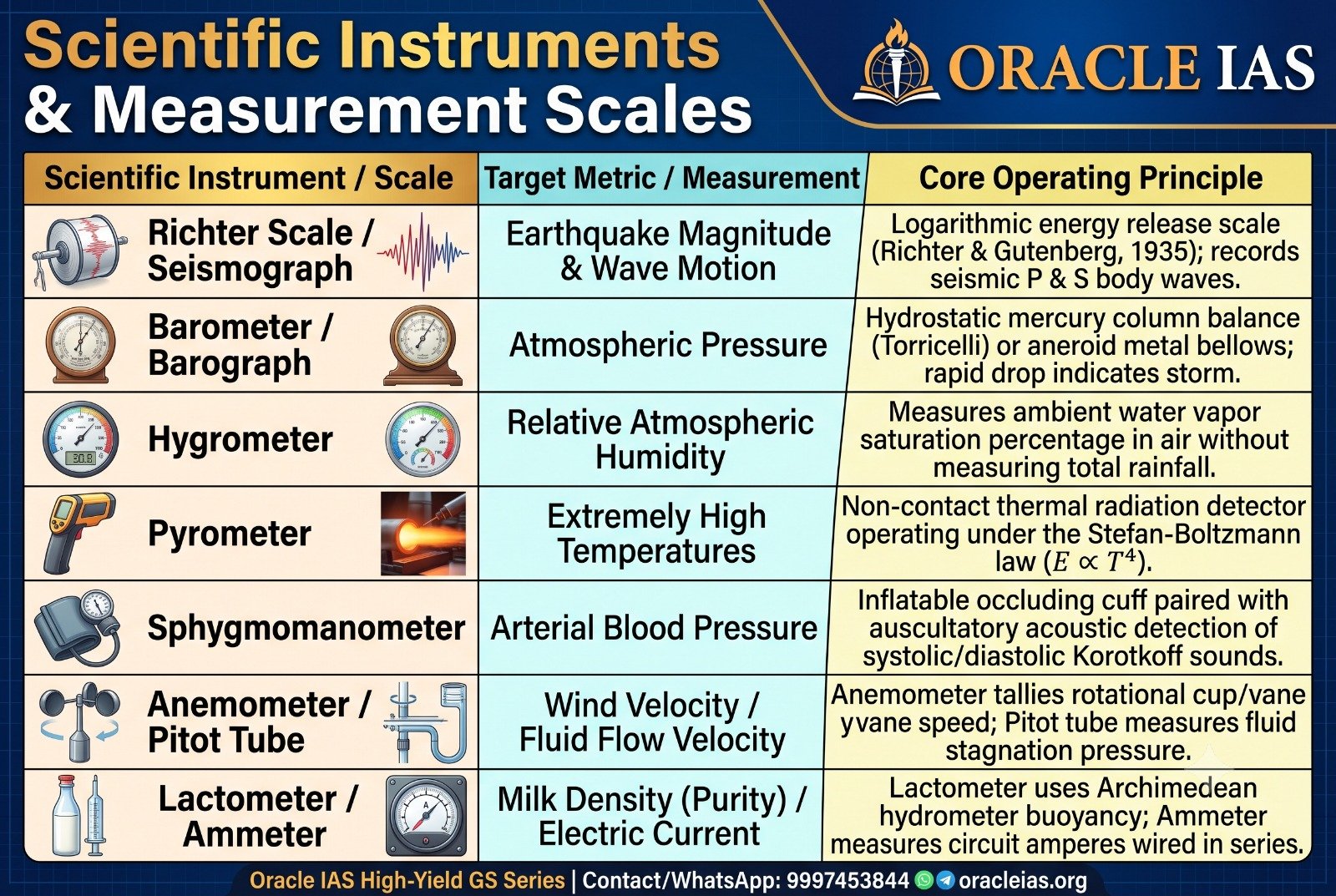
2. Scientific Instruments & Measurement Scales
| Scientific Instrument / Scale | Target Metric / Measurement | Core Operating Principle |
| Richter Scale / Seismograph | Earthquake Magnitude & Wave Motion | Logarithmic energy release scale (Richter & Gutenberg, 1935); records seismic P & S body waves. |
| Barometer / Barograph | Atmospheric Pressure | Hydrostatic mercury column balance (Torricelli) or aneroid metal bellows; rapid drop indicates storm. |
| Hygrometer | Relative Atmospheric Humidity | Measures ambient water vapor saturation percentage in air without measuring total rainfall. |
| Pyrometer | Extremely High Temperatures | Non-contact thermal radiation detector operating under the Stefan-Boltzmann law (E ∝ T⁴). |
| Sphygmomanometer | Arterial Blood Pressure | Inflatable occluding cuff paired with auscultatory acoustic detection of systolic/diastolic Korotkoff sounds. |
| Anemometer / Pitot Tube | Wind Velocity / Fluid Flow Velocity | Anemometer tallies rotational cup/vane speed; Pitot tube measures fluid stagnation pressure. |
| Lactometer / Ammeter | Milk Density (Purity) / Electric Current | Lactometer uses Archimedean hydrometer buoyancy; Ammeter measures circuit amperes wired in series. |
3. Master PYQs
Q1. The unit used for measuring distances between stars and deep cosmic bodies is:
[UKPSC Pre 2006-07 | UKPSC RO/ARO Pre 2016] [Direct Fact]
(a) Stellar mile
(b) Cosmic kilometer
(c) Galactic unit
(d) Light year
Q2. Which of the following units is used to measure the total columnar thickness of the stratospheric ozone layer?
[UKPSC Pre 2004-05 | UKPSC APO 2015] [Direct Fact]
(a) Decibel
(b) Dobson
(c) Pascal
(d) Weber
Q3. Which one of the following pairs is NOT correctly matched?
[UKPSC Pre 2002-03] [Direct Fact]
(a) Celsius – Temperature
(b) Kilowatt hour – Electricity
(c) Rh factor – Blood
(d) Richter scale – Humidity
Q4. Consider the following statements regarding the physical quantity ‘Pressure’:
- It is defined as the force acting perpendicularly per unit area (Force / Area).
- Its SI unit is Pascal (N/m²).
III. A pressure of 1.0 bar is approximately equivalent to 1.0 kg/cm².
Which of the statements given above are correct?
[UKPSC Pre 2002-03 | UKPSC FRO/ACF Pre 2021] [Statement-Based]
(a) I and II only
(b) II and III only
(c) I and III only
(d) I, II, and III
Q5. Which instrument is specifically utilized to record temperatures that are too high for conventional contact thermometers (such as inside metallurgical blast furnaces)?
[UKPSC Pre 2006-07 | UKPCS Lower Pre 2010] [Direct Fact]
(a) Aneroid Barometer
(b) Pyrometer
(c) Hygrometer
(d) Seismograph
Q6. The rate of volumetric water discharge in rivers, canals, and reservoirs is traditionally measured in:
[UKPSC Pre 2006-07] [Direct Fact]
(a) Purity index
(b) Fathoms
(c) Cusec
(d) Acre-feet depth
Q7. The Richter scale and Seismographs are standard earth-science tools used to detect and measure:
[UKPSC Mains 2002-03 | UKPSC Mains 2004-05 | UKPSC AE 2012] [Direct Fact]
(a) Intensity and magnitude of earthquakes
(b) Depth of oceanic trenches
(c) Velocity of wind vectors
(d) Relative humidity in atmosphere
Q8. A sudden, steep decline in the mercury level of a Torricellian barometer indicates:
[UKPSC Mains 2002-03] [Direct Fact]
(a) Clear, anticyclonic weather
(b) Impending severe storm or cyclone
(c) High probability of snowfall
(d) Steady light rainfall
Q9. Match List-I (Measuring Instrument) with List-II (Application / Measured Metric) and choose the correct code:
[UKPSC Mains 2004-05 | UKPCS Lower Pre 2010 | UKPSC AE 2012] [Match the Following]
List-I: A. Lactometer | B. Ammeter | C. Hygrometer | D. Anemometer
List-II: 1. Electric Current | 2. Relative Humidity | 3. Wind Velocity | 4. Purity/Density of Milk
Codes:
(a) A-4, B-1, C-2, D-3
(b) A-1, B-3, C-4, D-2
(c) A-4, B-2, C-1, D-3
(d) A-3, B-1, C-2, D-4
Q10. Clinical measurement of human arterial blood pressure is carried out using a:
[UKPSC Mains 2004-05 | UKPCS Lower Pre 2010] [Direct Fact]
(a) Glucometer
(b) Sine-wave Inverter
(c) Sphygmomanometer
(d) Hygrometer
Q11. In materials science and nanotechnology, the characteristic dimensional size of a nanoparticle ranges between:
[UKPSC Pre 2012] [Direct Fact]
(a) 0.01 nm to 0.1 nm
(b) 0.1 nm to 1 nm
(c) 1 nm to 100 nm
(d) 100 nm to 1000 nm
Q12. Sound intensity, auditory loudness levels, and environmental noise pollution are measured in:
[UKPCS Lower Pre 2010 | UKPSC AE 2013 | UKPSC Draftsman 2023] [Direct Fact]
(a) Fathoms
(b) Candela
(c) Decibel
(d) Joules
Q13. Which of the following groups consists EXCLUSIVELY of scalar physical quantities?
[UKPSC Forest Ranger Pre 2015 | UKPSC AE 2007] [Statement-Based]
(a) Momentum, Force, Acceleration
(b) Velocity, Displacement, Weight
(c) Time, Volume, Density
(d) Velocity, Momentum, Distance
Q14. The practical SI-derived unit of electrical capacitance of a capacitor is the:
[UKPSC APO 2015] [Direct Fact]
(a) Coulomb
(b) Gauss
(c) Henry
(d) Farad
Q15. The standard unit for measuring marine navigation distance, equal to one minute of latitude arc, is:
[UKPSC APO 2015] [Direct Fact]
(a) Naute
(b) Nautical mile
(c) Fathom
(d) Lambert
Q16. In geodetic surveying, leveling, and cartography, a ‘Datum Line’ represents:
[UKPSC AE 2012] [Direct Fact]
(a) A horizontal baseline from which elevation heights and bathymetric depths are measured
(b) The geomorphological boundary separating a plain from a plateau
(c) The International Date Line along the 180° meridian
(d) An imaginary line passing through the Earth’s center
Q17. A mechanical apparatus designed to generate electric current through electromagnetic induction is called a:
[UKPSC Junior Assistant 2022] [Direct Fact]
(a) Galvanometer
(b) Electric Motor
(c) Ammeter
(d) Generator / Dynamo
5. Master Explanations & Answer Key
- Ans. (d)
- Direct Answer: Light Year is an astronomical unit of length measuring the distance light travels through vacuum in one Earth year (approximately 9.46 × 10¹² km).
- Exam Trap / Distractor Alert: Candidates frequently confuse ‘Light Year’ with time due to the word “year”; Parsec is even larger (1 parsec ≈ 3.26 light-years).
- High-Yield Extra Facts: Parsec stands for “parallax of one arcsecond”; the mean Earth-Sun orbital separation is termed 1 Astronomical Unit (AU ≈ 1.496 × 10⁸ km).
- Ans. (b)
- Direct Answer: The Dobson Unit (DU) quantifies the physical thickness of columnar atmospheric ozone; 1 DU represents an ozone layer 0.01 mm thick compressed at standard temperature and pressure (0 °C, 1 atm).
- Exam Trap / Distractor Alert: Do not confuse Dobson with Decibel (sound intensity) or Weber (magnetic flux); an “ozone hole” is formally diagnosed when stratospheric readings plunge below 220 DU.
- High-Yield Extra Facts: Stratospheric ozone was discovered in 1913 by French physicists Charles Fabry and Henri Buisson; Gordon Dobson engineered the ground-based Dobson spectrophotometer.
- Ans. (d)
- Direct Answer: The Richter scale quantifies the seismic energy released during an earthquake, whereas atmospheric humidity is measured with a hygrometer.
- Exam Trap / Distractor Alert: The Richter scale measures magnitude (quantitative energy; logarithmic and open-ended), whereas the Mercalli scale evaluates intensity (observed destruction and qualitative surface impact; scale I to XII).
- High-Yield Extra Facts: Kilowatt-hour (kWh) is a commercial unit of electrical energy (1 kWh = 3.6 × 10⁶ Joules); Rh factor refers to an inherited Rhesus D antigen on human red blood cells.
- Ans. (d)
- Direct Answer: All three statements are physically accurate: Pressure = Force / Area; its SI unit is Pascal (1 Pa = 1 N/m²); and 1.0 bar (10⁵ N/m²) equals 1.0197 kg/cm² ≈ 1.0 kg/cm².
- Exam Trap / Distractor Alert: Keep the inverse relationship in mind: reducing surface contact area increases pressure for a constant applied force (e.g., sharp pins penetrate easier than blunt ones).
- High-Yield Extra Facts: Standard mean atmospheric pressure at sea level equals 1.01325 bar = 101.325 kPa = 760 mm of mercury = 760 Torr.
- Ans. (b)
- Direct Answer: Pyrometers are non-contact optical/infrared instruments used to measure elevated temperatures (generally above 800 °C) by capturing the emitted thermal radiation spectrum.
- Exam Trap / Distractor Alert: Liquid-in-glass mercury thermometers fail at high temperatures because mercury boils at 357 °C; Pyrometers avoid thermal contact breakdown by operating remotely.
- High-Yield Extra Facts: Radiation pyrometers operate on the Stefan-Boltzmann Radiation Law (total radiant energy E = σT⁴); Aneroid barometers measure air pressure mechanically without liquid columns.
- Ans. (c)
- Direct Answer: Cusec is an acronym for “cubic feet per second”, denoting the dynamic flow rate of water (1 cusec = 28.317 liters per second).
- Exam Trap / Distractor Alert: Distinguish Cusec (continuous flow rate per second) from TMC (thousand million cubic feet, a metric of static reservoir holding capacity).
- High-Yield Extra Facts: The metric counterpart of cusec is Cumec (cubic meter per second; 1 cumec ≈ 35.314 cusecs).
- Ans. (a)
- Direct Answer: The Richter scale and seismographs detect and evaluate the magnitude and waveform dynamics of seismic earthquakes.
- Exam Trap / Distractor Alert: Seismograph is the ground-motion measuring hardware; Seismogram is the recorded physical or digital trace; Richter is the mathematical calculation scale.
- High-Yield Extra Facts: Formulated in 1935 by Charles F. Richter and Beno Gutenberg; each whole-number step on the Richter scale indicates a ~31.6-fold surge in total released energy.
- Ans. (b)
- Direct Answer: A sudden and steep drop in the mercury column indicates an abrupt local low-pressure depression, signaling an impending storm, squall, or cyclone.
- Exam Trap / Distractor Alert: A slow, steady decrease indicates regular rainfall; a gradual, continuous rise indicates dry, anticyclonic, fair weather; stationary mercury indicates stable conditions.
- High-Yield Extra Facts: The mercury barometer was invented in 1643 by Italian physicist Evangelista Torricelli; liquid mercury is preferred due to its high density (13.6 g/cm³), allowing a compact tube height.
- Ans. (a)
- Direct Answer: Lactometer tests milk purity via specific gravity; Ammeter reads electric current; Hygrometer measures atmospheric relative humidity; Anemometer gauges wind speed (Code: 4-1-2-3).
- Exam Trap / Distractor Alert: Do not confuse an Ammeter (current in amperes) with a Voltmeter (potential difference in volts) or a Galvanometer (detection of minute currents and flow direction).
- High-Yield Extra Facts: Wind direction is determined by a Wind Vane / Weathercock, whereas wind velocity is tracked by an Anemometer; a Voltameter (spelled with an ‘a’) is an electrolytic cell, not a potential meter.
- Ans. (c)
- Direct Answer: A sphygmomanometer is a medical diagnostic apparatus comprising an inflatable cuff, manometer, and valve, used to measure arterial blood pressure in mm Hg.
- Exam Trap / Distractor Alert: A glucometer measures blood glucose concentration, not blood pressure; standard resting human blood pressure is typically referenced at 120/80 mm Hg (systolic/diastolic).
- High-Yield Extra Facts: The mercury sphygmomanometer was invented by Italian physician Scipione Riva-Rocci in 1896; Nikolai Korotkoff added the stethoscope auscultation technique in 1905.
- Ans. (c)
- Direct Answer: In physical chemistry and nanotechnology, a nanoparticle is defined as any microscopic particle having structural dimensions between 1 nm and 100 nm.
- Exam Trap / Distractor Alert: 1 nanometer equals 10⁻⁹ meters; structures smaller than 1 nm correspond to atomic or small molecular scales, while entities larger than 100 nm enter bulk colloidal realms.
- High-Yield Extra Facts: Nanoparticles display high surface-area-to-volume ratios, exhibiting distinct optical, catalytic, and quantum confinement properties; they are classified as zero-dimensional (0D) nanomaterials.
- Ans. (c)
- Direct Answer: Decibel (dB) is a dimensionless, logarithmic unit expressing sound pressure levels and acoustic intensity relative to the human auditory threshold (0 dB = 10⁻¹² W/m²).
- Exam Trap / Distractor Alert: Candela measures luminous intensity of visible light; Joules measure energy or work; Watts/m² measures absolute sound intensity, whereas Decibels measure relative sound level.
- High-Yield Extra Facts: Central Pollution Control Board (CPCB) ambient noise standards prescribe daytime limits of 75 dB for industrial zones, 65 dB for commercial zones, 55 dB for residential zones, and 50 dB for silence zones.
- Ans. (c)
- Direct Answer: Time, volume, and density are pure scalar quantities completely specified by magnitude alone without spatial orientation.
- Exam Trap / Distractor Alert: Momentum, velocity, acceleration, displacement, and weight (gravitational force) have defined directions and are strictly vector quantities.
- High-Yield Extra Facts: Electric current has both magnitude and direction, but is treated as a scalar quantity because it follows ordinary algebraic addition rather than vector triangle/parallelogram laws.
- Ans. (d)
- Direct Answer: Electric capacitance (the capacity of an isolated conductor or capacitor to store electric charge per unit potential, C = Q/V) is measured in Farads (F).
- Exam Trap / Distractor Alert: 1 Farad is an enormous unit of charge storage; practical electronic capacitors are rated in microfarads (µF = 10⁻⁶ F), nanofarads (nF = 10⁻⁹ F), or picofarads (pF = 10⁻¹² F).
- High-Yield Extra Facts: Henry is the SI unit of electrical inductance; Gauss is the CGS unit of magnetic flux density (1 Tesla = 10⁴ Gauss); Coulomb is the SI unit of electric charge (1 C = 1 A·s).
- Ans. (b)
- Direct Answer: The Nautical Mile (1852 meters) is the international standard unit for navigation across oceanic and aeronautical routes, defined as one minute of arc along a meridian of latitude.
- Exam Trap / Distractor Alert: A Fathom measures sea depth (1 fathom = 6 feet = 1.8288 meters), whereas a nautical mile measures horizontal navigational distance.
- High-Yield Extra Facts: Navigational speed across water or air is indexed in Knots (1 knot = 1 nautical mile per hour ≈ 0.514 m/s ≈ 1.852 km/h).
- Ans. (a)
- Direct Answer: In geodetic surveying, civil engineering, and hydrography, a datum line (or datum plane) is a standardized horizontal reference level from which vertical heights and depths are calculated.
- Exam Trap / Distractor Alert: Do not confuse a Datum line with the International Date Line (meridian of 180° longitude) or contour lines (lines connecting terrestrial points of equal elevation).
- High-Yield Extra Facts: Survey of India benchmarks across Uttarakhand and the rest of the country reference vertical elevations to the Great Trigonometrical Survey datum based on Mean Sea Level (MSL).
- Ans. (d)
- Direct Answer: An electric generator (dynamo) is a mechanical device that converts mechanical energy into electrical energy based on Michael Faraday’s law of electromagnetic induction.
- Exam Trap / Distractor Alert: An electric motor performs the opposite conversion—transforming electrical energy into mechanical rotational motion.
- High-Yield Extra Facts: A Galvanometer detects and indicates the presence and direction of minute currents; connecting a low-resistance shunt in parallel converts a galvanometer into an ammeter.
Contact:
Call/WhatsApp 9997453844 for details
Join Our Preparation program:

He is a bibliophile,accomplished writer and a fitness enthusiast.