
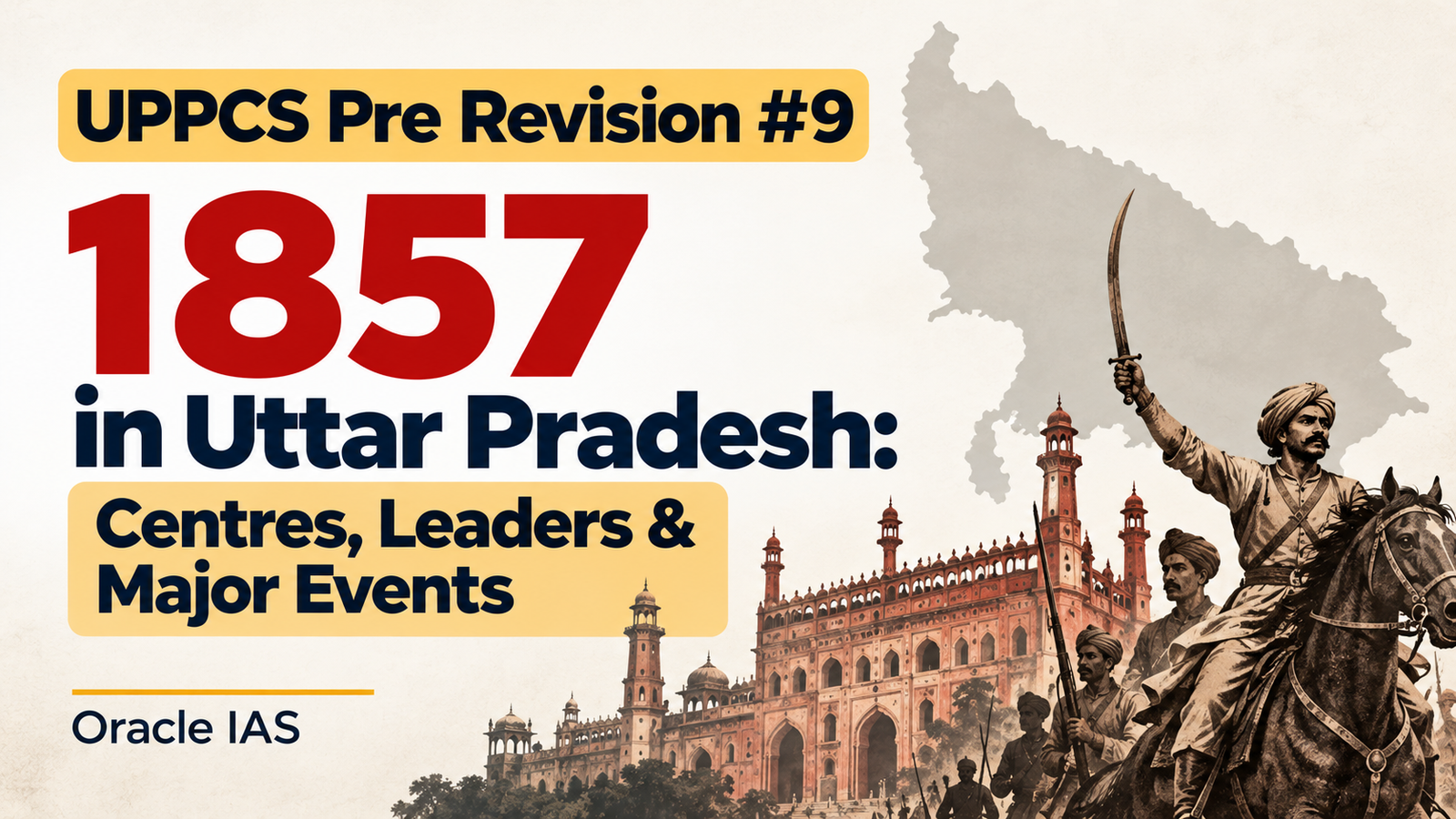
The Revolt of 1857 was one of the most significant uprisings against East India Company rule. Uttar Pradesh was at the heart of the rebellion: the military outbreak at Meerut spread to Delhi, Kanpur, Lucknow, Bareilly, Jhansi, Allahabad, Faizabad and numerous smaller towns and villages.
The revolt was not simply a military mutiny. In different parts of present-day Uttar Pradesh, sepoys were joined by peasants, zamindars, taluqdars, dispossessed rulers, artisans and religious leaders. Their grievances were not identical, and the uprising did not operate under one central command.
For UPPCS Prelims, the highest-value areas are:
- Centre–leader associations.
- Important battles and their dates.
- The role of Awadh and the annexation of 1856.
- Local leaders such as Shah Mal, Dhan Singh Gurjar, Mehndi Hasan and Maulvi Liaquat Ali.
- The distinction between the outbreak, expansion and suppression of the revolt.
- The consequences of the uprising for British administration.
1. Why was Uttar Pradesh central to the Revolt of 1857?
The present-day state of Uttar Pradesh contained several major political, military and social centres of the uprising. In 1857, however, the region was not a single administrative unit with its current boundaries. It included territories of the North-Western Provinces, the recently annexed kingdom of Awadh, and other areas under different administrative arrangements.
Major causes of discontent
1. Military grievances
Indian sepoys in the Bengal Army faced discrimination in pay, promotion and service conditions. The controversy surrounding the new Enfield rifle cartridges, believed by many soldiers to be greased with cow and pig fat, became the immediate trigger for the military outbreak.
2. Annexation of Awadh in 1856
The British annexed Awadh on the grounds of alleged maladministration. The removal of Nawab Wajid Ali Shah weakened the old ruling establishment and affected taluqdars, court officials, soldiers and others dependent on the former state.
3. Land revenue and agrarian grievances
In several areas, peasants and landholders resented revenue demands, the loss of customary rights and the influence of moneylenders. The uprising in the Baraut region under Shah Mal illustrates how military revolt could develop into a broader rural challenge to colonial authority.
4. Dispossession of rulers and nobles
The annexation policies and denial of certain claims to succession, pensions or privileges alienated sections of the ruling elite. Nana Sahib’s grievance over the refusal to continue the pension of his adoptive father, Peshwa Baji Rao II, was an important factor in Kanpur.
5. Social and religious anxieties
Rumours and fears about interference with established religious and social practices contributed to distrust of the colonial government. These anxieties interacted with military and economic grievances rather than operating as the only cause.
6. Local and regional factors
The causes differed by region. In Awadh, the annexation of 1856 was particularly significant. In Kanpur, Nana Sahib’s pension grievance mattered. In Jhansi, the dispute over succession and annexation formed part of the background. In rural western UP, land and revenue grievances helped mobilise peasants.
2. Chronology: important dates of the Revolt of 1857 in UP
| Date | Event | Significance |
|---|---|---|
| 1856 | Annexation of Awadh by the British | Major source of resentment in Awadh |
| 29 March 1857 | Mangal Pandey’s action at Barrackpore(Bengal) | Preceded the main outbreak at Meerut |
| 24 April 1857 | Troopers of the 3rd Bengal Light Cavalry at Meerut refused the cartridges | Immediate military crisis |
| 9 May 1857 | Imprisonment and public humiliation of 85 troopers at Meerut | Helped precipitate the outbreak |
| 10 May 1857 | Revolt broke out at Meerut | Starting point of the widespread uprising |
| 11 May 1857 | Rebel soldiers reached Delhi | Bahadur Shah Zafar was drawn into the uprising |
| Late May 1857 | Rebellion spread through western UP and other regions | Local military and popular resistance expanded |
| 30 May 1857 | Outbreak in Lucknow | Major phase of the Awadh rebellion |
| 3 June 1857 | Uprising at Azamgarh | Eastern UP became an important centre |
| 4–5 June 1857 | Rebellion spread in Jhansi and Kanpur | Major centres of resistance emerged |
| 6 June 1857 | Siege of the British position at Kanpur began | Nana Sahib became the principal rebel leader there |
| 30 June 1857 | Battle of Chinhat near Lucknow | British forces under Henry Lawrence were defeated |
| July 1857 | Shah Mal was killed during the fighting in the Baraut region | Major rural leader of western UP |
| July 1857 | British Residency at Lucknow remained under siege | Resistance in Awadh continued |
| 25 September 1857 | Havelock and Outram reached the Residency | Relief did not end the siege |
| 17 November 1857 | Colin Campbell’s forces relieved the Residency and evacuated the British garrison | British withdrawal from the Residency area |
| December 1857 | British forces defeated rebel forces at Kanpur | Major reversal for Nana Sahib’s forces |
| March 1858 | British campaign recaptured Lucknow | Major phase of organised resistance in Awadh was defeated |
| April 1858 | Jhansi fell to British forces under Hugh Rose | Rani Lakshmibai continued resistance elsewhere |
| June 1858 | Final major fighting in the Jhansi–Kalpi–Gwalior campaign | Rani Lakshmibai was killed on 18 June 1858 |
| 1 November 1858 | Queen Victoria’s Proclamation was issued | Announced the transfer of governance from the Company to the Crown |
3. Major centres and leaders: master revision table
This is the most important table for centre–leader matching questions.
| Centre in 1857 | Present-day district / location | Principal Indian leader(s) | Important association |
|---|---|---|---|
| Meerut | Meerut | Dhan Singh Gurjar; local sepoys and other leaders | Outbreak on 10 May 1857 |
| Baraut / Bijrol | Baghpat | Shah Mal | Mobilised villages and peasants in the Baraut region |
| Kanpur (Cawnpore) | Kanpur Nagar | Nana Sahib, Tantia Tope, Azimullah Khan | Siege of Kanpur and major military operations |
| Lucknow | Lucknow | Begum Hazrat Mahal, Birjis Qadr, Maulvi Ahmadullah Shah | Residency siege and resistance in Awadh |
| Faizabad | Ayodhya district in present-day UP | Maulvi Ahmadullah Shah | Major religious and military mobilisation |
| Jhansi | Jhansi | Rani Lakshmibai | Resistance in Bundelkhand |
| Bareilly | Bareilly | Khan Bahadur Khan | Main centre of resistance in Rohilkhand |
| Allahabad | Prayagraj | Maulvi Liaquat Ali | Rebel activity around Khusro Bagh |
| Azamgarh | Azamgarh | Local sepoys and rebel leaders; Kunwar Singh’s forces in 1858 | Major eastern UP centre |
| Sultanpur | Sultanpur | Mehndi Hasan | Resistance and battles around Chanda |
| Saharanpur region | Saharanpur | Local peasant and rural leaders | Gujjar, Rangar and Rajput participation |
| Bulandshahr / Malagarh | Bulandshahr | Walidad Khan | Local resistance in western UP |
| Farrukhabad | Farrukhabad | Tufzal Hasan Khan is associated with the uprising in historical accounts | Regional rebel leadership |
| Moradabad | Moradabad | Abdul Ali Khan | Rohilkhand resistance |
| Bijnor | Bijnor | Mohammad Mahmud / local rebel leadership in historical accounts | Regional revolt |
| Shahjahanpur | Shahjahanpur | Maulvi Ahmadullah Shah and local rebel forces | Later phase of resistance in 1858 |
| Fatehpur Chaurasi | Unnao district | Nana Sahib and his associates used the area as a refuge after Kanpur | Centre of subsequent rebel activity |
| Mathura region | Mathura | Local rebel leaders, including Devi Singh | Local resistance |
| Gorakhpur region | Gorakhpur | Local rebel leaders and rural groups | Wider eastern UP disturbances |
4. Meerut: where the widespread uprising began
Meerut was a major military station of the Bengal Army. The controversy over the Enfield rifle cartridges intensified the existing discontent among sepoys.
Events leading to the revolt
- On 24 April 1857, troopers of the 3rd Bengal Light Cavalry refused to use the cartridges.
- On 9 May, 85 troopers were sentenced to imprisonment and publicly humiliated.
- On 10 May, other soldiers rose in revolt, attacked symbols of British authority and released imprisoned comrades.
- The rebels then marched towards Delhi, reaching the city on 11 May.
The uprising quickly acquired a broader political character after the rebels reached Delhi and appealed to the Mughal emperor, Bahadur Shah Zafar, to provide symbolic leadership.
Dhan Singh Gurjar
Dhan Singh Gurjar, commonly remembered as the kotwal of Meerut, is associated with the local outbreak and the participation of people beyond the army. Accounts of his precise role vary in detail, but he remains an important figure in UP’s regional memory of 1857.
Why Meerut matters
- It marks the beginning of the widespread uprising on 10 May 1857.
- The revolt moved from Meerut to Delhi, helping transform a military mutiny into a wider challenge to Company rule.
- It shows the interaction of sepoy action and civilian participation.
5. Baraut and western UP: Shah Mal and the rural uprising
The uprising in the Baraut region of present-day Baghpat district is especially important for understanding the rural character of 1857.
Who was Shah Mal?
Shah Mal was a local peasant leader associated with Bijrol village and the Baraut area. He mobilised cultivators and village communities, drawing support from the network of villages commonly referred to in accounts as the Chaurasee Desh or the territory of 84 villages.
Nature of the movement
Shah Mal’s movement was not merely a military revolt. His followers:
- Attacked symbols of colonial authority.
- Disrupted communication and supply routes.
- Targeted records and institutions associated with the colonial state.
- Supported the broader rebel effort around Delhi.
- Created local arrangements for dispute settlement and authority.
The rebellion expressed opposition to colonial power and to the local economic structures associated with revenue collection, moneylending and the loss of customary rights.
Shah Mal was killed in fighting in July 1857.
6. Kanpur: Nana Sahib, Tantia Tope and Azimullah Khan
Kanpur was one of the major military and political centres of the rebellion.
Nana Sahib
Nana Sahib, whose personal name was Dhondu Pant, was the adopted son of Peshwa Baji Rao II, who lived at Bithoor after Third Maratha War. After the Peshwa’s death, the British refused to continue his pension to Nana Sahib.
This grievance contributed to Nana Sahib’s hostility towards Company rule.
Major events at Kanpur
- Rebel sepoys and local supporters gathered around Nana Sahib.
- The British garrison, commanded by Sir Hugh Wheeler, came under siege in June 1857.
- The British position eventually collapsed, and the subsequent events at Satichaura Ghat and Bibigarh became among the most controversial and violent episodes of the rebellion.
- British forces under Havelock returned to Kanpur in July.
- Rebel forces again challenged the British later in 1857.
- Sir Colin Campbell defeated the main rebel forces at Kanpur in December 1857.
Tantia Tope
Tantia Tope became one of the principal military commanders associated with Nana Sahib. He continued resistance after the initial defeat at Kanpur and later operated across central India, including the Kalpi and Gwalior campaigns.
Azimullah Khan
Azimullah Khan was a close associate and adviser of Nana Sahib. He had earlier been involved in efforts to pursue Nana Sahib’s pension claim in Britain.
7. Lucknow and Awadh: Begum Hazrat Mahal, Birjis Qadr and the Residency siege
Awadh was one of the strongest regions of resistance because the annexation of 1856 had affected a broad range of political and social groups.
Begum Hazrat Mahal
Begum Hazrat Mahal was the wife of the deposed Nawab Wajid Ali Shah. During the rebellion, she emerged as a principal leader of resistance in Awadh.
She supported the proclamation of her son, Birjis Qadr, as ruler of Awadh and helped organise opposition to the British.
Birjis Qadr
Birjis Qadr, the young son of Wajid Ali Shah and Begum Hazrat Mahal, was proclaimed ruler during the uprising. His position provided a focus for the restoration of Awadh’s former political order.
The Residency at Lucknow
The British Residency became the focus of a prolonged siege.
- The rebellion spread in Lucknow at the end of May 1857.
- On 30 June, British forces under Henry Lawrence were defeated at the Battle of Chinhat.
- The Residency then remained under siege.
- Henry Lawrence died from wounds on 4 July 1857.
- Havelock and Outram reached the Residency in September, but their arrival did not end the siege.
- Sir Colin Campbell relieved the Residency in November and evacuated the British garrison.
- British forces recaptured Lucknow in March 1858.
Sikandar Bagh
Sikandar Bagh was one of the important locations in the fighting during the British campaign to recapture Lucknow in November 1857. It is associated with intense combat and heavy casualties.
8. Faizabad: Maulvi Ahmadullah Shah
Maulvi Ahmadullah Shah was one of the most prominent leaders of the uprising in Awadh. He is associated with Faizabad and was known as Danka Shah, a name linked to his public preaching and the beating of a drum to announce his presence.
His role
- He opposed British rule and attracted followers through religious and political mobilisation.
- He was imprisoned in Faizabad before the uprising.
- After the outbreak, he emerged as a leader of rebel soldiers and supporters.
- He fought at Chinhat, where the British forces under Henry Lawrence were defeated.
- He continued resistance in Awadh and later operated in the Shahjahanpur region.
- He was killed at Powayan in June 1858 after Raja Jagannath Singh’s side turned against him.
9. Jhansi: Rani Lakshmibai and the Bundelkhand campaign
Jhansi became one of the most famous centres of the rebellion. Its history combined the succession dispute, British annexation policy and armed resistance.
Background
After the death of Raja Gangadhar Rao, Rani Lakshmibai’s adopted son was not accepted as the successor by the British authorities. The annexation of Jhansi under the Doctrine of Lapse became a major source of resentment.
The Rani’s role in the events of 1857 developed amid a complex local situation involving mutinous soldiers, the killing of Europeans and the struggle for control of the state.
Major events
- Rebel soldiers took control of Jhansi in June 1857.
- Rani Lakshmibai later became the principal leader of resistance against British military operations.
- General Hugh Rose led the campaign against Jhansi in 1858.
- Jhansi fell to the British in April 1858.
- The Rani escaped and continued resistance with allied forces, including Tantia Tope.
- Rebel forces fought at Kalpi and later moved towards Gwalior.
- Rani Lakshmibai was killed in battle near Gwalior on 18 June 1858, at Kotah-ki-Serai.
10. Bareilly and Rohilkhand: Khan Bahadur Khan
Bareilly was a major centre of resistance in Rohilkhand.
Khan Bahadur Khan
Khan Bahadur Khan was associated with the Rohilla ruling elite and became the principal rebel leader at Bareilly. He established rebel authority and attempted to organise administration in the region.
The Rohilkhand campaign
The rebellion in Rohilkhand included military resistance and broader opposition to British authority. British forces under Sir Colin Campbell recaptured Bareilly in May 1858.
Khan Bahadur Khan was later captured, tried and executed in 1860.
11. Allahabad: Maulvi Liaquat Ali and Khusro Bagh
Allahabad, now Prayagraj, witnessed a rebellion in June 1857.
Maulvi Liaquat Ali
Maulvi Liaquat Ali emerged as a major rebel leader in Allahabad. He was associated with the establishment of rebel authority in the city and used Khusro Bagh as an important headquarters.
The rebellion was eventually suppressed by British forces. Colonel James Neill became associated with the harsh repression that followed in Allahabad and along the route towards Kanpur.
12. Sultanpur: Mehndi Hasan and the Battle of Chanda
Sultanpur was another important centre of the Awadh uprising.
Mehndi Hasan
Mehndi Hasan, also known as Nazim Mehndi Hasan in historical accounts, had served in the administrative system of Awadh. He became a major leader of the uprising in Sultanpur and received support from local taluqdars.
He organised rebel forces and established his headquarters at Hasanpur.
Battle of Chanda
The area around Chanda became the site of important fighting between rebel forces and the British. A major engagement occurred in October 1857. A further battle took place on 19 February 1858, when Mehndi Hasan’s forces again faced British troops.
Although the rebel forces were defeated, resistance continued in the region.
13. Saharanpur and the rural uprising
The uprising in Saharanpur district demonstrates the participation of rural communities beyond the principal military cantonments.
Gujjars, Rangars and Rajputs, particularly in the south-western part of the district, including the Nakur, Gangoh and Deoband areas.
The rebels attacked symbols of colonial administration, including tehsils and police stations, and targeted financial records and moneylenders. British authorities used police and military force to suppress the uprising.
14. Bulandshahr and Malagarh: Walidad Khan
Walidad Khan is associated with the uprising around Malagarh in present-day Bulandshahr district.
His resistance formed part of the wider unrest in western Uttar Pradesh, where local chiefs, rural groups and rebel soldiers challenged British authority.
15. Azamgarh and eastern Uttar Pradesh
Azamgarh was an important centre of rebellion in eastern UP. The local uprising began on 3 June 1857, when Awadhi soldiers rebelled, killed British officers and took control of government funds. Local people supported the sepoys, and rebel forces pushed British authorities back towards Ghazipur.
In March 1858, Kunwar Singh, whose principal base was in Bihar, entered the Azamgarh region with a substantial force. Rebel forces held the city for a period, but British reinforcements eventually regained control.
16. Other local centres and leaders
Smaller centres help distinguish UPPCS state-specific history from general modern Indian history.
| Centre / region | Leader or group associated with the revolt | What to remember |
|---|---|---|
| Baraut, Baghpat | Shah Mal | Peasant mobilisation and disruption of communications |
| Meerut | Dhan Singh Gurjar and rebel sepoys | Outbreak on 10 May 1857 |
| Saharanpur | Gujjars, Rangars, Rajputs and other rural groups | Agrarian and anti-colonial mobilisation |
| Malagarh, Bulandshahr | Walidad Khan | Regional resistance in western UP |
| Sultanpur | Mehndi Hasan | Battle of Chanda and Awadh resistance |
| Allahabad | Maulvi Liaquat Ali | Khusro Bagh |
| Faizabad | Maulvi Ahmadullah Shah | Religious and military mobilisation |
| Kanpur | Nana Sahib and associates | Pension grievance and military campaign |
| Lucknow | Begum Hazrat Mahal and Birjis Qadr | Resistance after the annexation of Awadh |
| Bareilly | Khan Bahadur Khan | Rohilkhand resistance |
| Jhansi | Rani Lakshmibai | Resistance to annexation and the 1858 campaign |
| Mathura region | Local rebel leaders, including Devi Singh in some accounts | Local resistance and rural unrest |
| Farrukhabad | Tufzal Hasan Khan in some historical lists | Regional rebel leadership |
| Moradabad | Abdul Ali Khan in some historical lists | Rohilkhand-related resistance |
17. Important British officers associated with the suppression
Questions sometimes ask which British commander fought at a particular centre. These pairings are more useful than trying to memorise every officer involved in every operation.
| Centre / campaign | British officer(s) associated with the campaign | Key event |
|---|---|---|
| Meerut | Major-General William Hewitt was in command at Meerut | Outbreak on 10 May 1857 |
| Lucknow | Henry Lawrence, Henry Havelock, James Outram and Colin Campbell | Chinhat, Residency siege, relief and recapture |
| Kanpur | Hugh Wheeler, Henry Havelock and Colin Campbell | Siege and later recapture |
| Jhansi | Hugh Rose | Siege and capture of Jhansi in 1858 |
| Bareilly | Colin Campbell | British recapture in May 1858 |
| Allahabad | James Neill | Suppression and reprisals |
| Azamgarh | British forces under several commanders during the 1857–58 campaign | Repeated changes of control |
| Baraut region | British counter-insurgency forces | Suppression of Shah Mal’s movement |
| Awadh countryside | Colin Campbell and other British commanders | Campaigns against rebel forces in 1858 |
Important distinction: A British officer who participated in one phase of a campaign should not automatically be described as the sole suppressor of the entire regional revolt.
18. Major battles and military episodes: revision table
| Battle / episode | Date or period | Place | Main association |
|---|---|---|---|
| Meerut outbreak | 10 May 1857 | Meerut | Beginning of the widespread revolt |
| Arrival of rebels in Delhi | 11 May 1857 | Delhi | Bahadur Shah Zafar drawn into the uprising |
| Kanpur siege | June 1857 | Kanpur | Nana Sahib and rebel sepoys |
| Battle of Chinhat | 30 June 1857 | Near Lucknow | Defeat of British forces under Henry Lawrence |
| Lucknow Residency siege | June–November 1857 | Lucknow | Major prolonged confrontation |
| First relief of Residency | 25 September 1857 | Lucknow | Havelock and Outram reached the Residency |
| Evacuation of Residency | November 1857 | Lucknow | Colin Campbell’s operation |
| Later battle for Kanpur | December 1857 | Kanpur | British victory under Colin Campbell |
| Campaign against Jhansi | March–April 1858 | Jhansi | Hugh Rose’s campaign; Jhansi fell in April |
| Battle around Kalpi | May 1858 | Kalpi region | Continued resistance by rebel forces |
| Final battle of Rani Lakshmibai | 18 June 1858 | Kotah-ki-Serai, near Gwalior | Rani Lakshmibai was killed |
Queen Victoria’s Proclamation
The proclamation of 1 November 1858 from Allahabad fort announced the new framework of Crown rule and promised non-interference in religious beliefs, subject to the policies and conditions stated by the British government.
Contact:
Call/WhatsApp 9997453844 for details
Join Our Preparation program:
He is a bibliophile,accomplished writer and a fitness enthusiast.
- UPPCS Pre Revision #9: 1857 in Uttar Pradesh: Centres, Leaders & Major Events - October 16, 2026
- UPPCS Pre Revision #8: Important Cities, Rivers & District Associations of UP - October 15, 2026
- UKPSC Physics: Heat, Thermodynamics & Thermal Physics (Solved PYQs & Notes) - October 15, 2026