
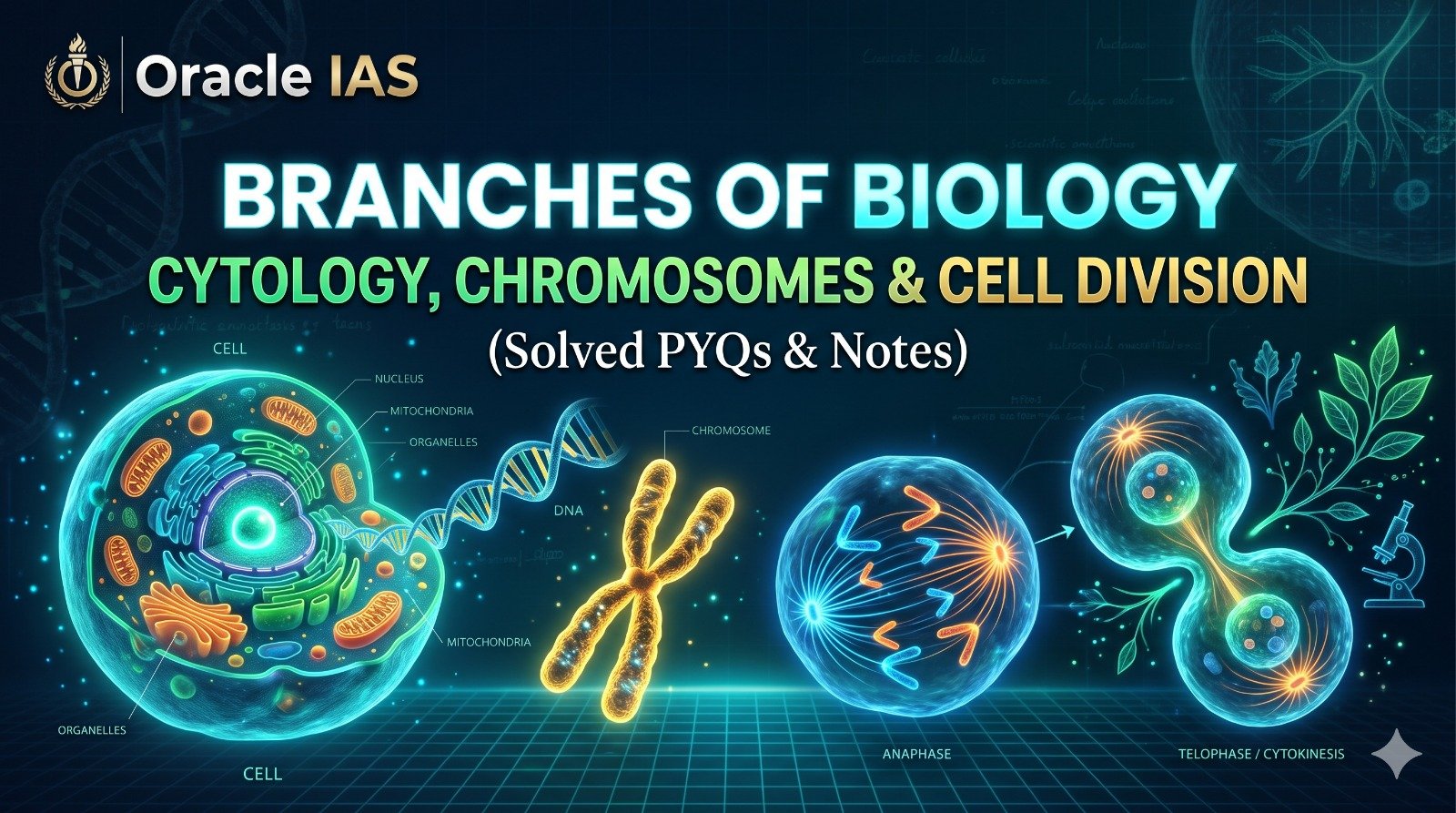
UKPSC Biology (Unit 1): Branches of Biology, Cytology, Chromosomes & Cell Division (Solved PYQs & Notes)
Part of the UKPSC General Science & Technology Revision Series.
1.High-Yield Micro-Notes
- Biological Disciplines & Zoological Branches: The scientific study of insects is designated as Entomology (sub-branch of Arthropodology). In comparison, Ichthyology is the biological study of fishes, Malacology covers molluscs (including snails, bivalves, and cephalopods), and Parasitology examines parasitic organisms and host-parasite dynamics. Paleontology explores prehistoric life through petrified fossils and organic impressions embedded in sedimentary rocks; its plant-specific counterpart is termed Paleobotany (pioneered in India by Prof. Birbal Sahni).
- Human Cytogenetics & Karyotype: Somatic cells of the human body contain 23 pairs of chromosomes (46 total chromosomes). The first 22 pairs are autosomes, displaying identical structural homology across both sexes. The 23rd pair constitutes sex chromosomes (allosomes/heterosomes), configured as XX in phenotypic females and XY in phenotypic males. Numerical aneuploidies yield disorders like Down syndrome (Trisomy 21), Klinefelter syndrome (47, XXY), and Turner syndrome (45, XO).
- Meiotic Phases & Genetic Recombination: Chiasmata (X-shaped cytological junction points representing sites of physical non-sister chromatid crossing over) become visible during Prophase-I of Meiosis (specifically during the diplotene substage, following pachytene crossing over). The substages of Prophase-I follow the strict chronological sequence: Leptotene → Zygotene (synapsis) → Pachytene (crossing over via recombinase) → Diplotene (chiasmata appearance) → Diakinesis (terminalization).
- Stem Cell Potency & Cellular Regeneration: Undifferentiated cells hold superior proliferative and regenerative capacity over terminally differentiated somatic cells (such as cardiac myocytes or mature neurons). Committed (adult/multipotent) stem cells retain elevated mitotic proliferation and targeted lineage differentiation to repair, regenerate, and replace damaged or senescent tissues (e.g., hematopoietic stem cells replenishing peripheral blood elements).
2. Important facts you should know:
| Biological Branch / Process | Primary Subject / Cytological Event | Key Identifying Characteristic |
| Entomology | Class Insecta (Arthropoda) | Jointed appendages, 3-part body (head, thorax, abdomen), 3 pairs of legs. |
| Ichthyology | True Fishes (Chondrichthyes & Osteichthyes) | Gills, paired fins, streamlined hydrodynamics, aquatic respiration. |
| Malacology | Phylum Mollusca | Soft-bodied, unsegmented coelomates, typically protected by a calcareous shell. |
| Paleontology | Fossilized organic remains in strata | Reconstructs evolutionary phylogenies via fossilized bones, shells, and casts. |
| Chiasmata Formation | Prophase-I (Diplotene substage) | Physical manifestation of genetic recombination between homologous chromosomes. |
| Autosomes vs. Allosomes | 22 Autosomal pairs + 1 Sex pair | Autosomes control somatic traits; 23rd pair determines genetic sex. |
| Stem Cells (Committed) | Lineage-restricted tissue regeneration | High mitotic turnover, capable of repairing damaged parenchymal tissues. |
3. Master Questions
Q1. The specialized branch of zoology devoted to the scientific investigation of insects is known as:
[UKPSC UDA/LDA Pre 2003] [Direct Fact]
(a) Ichthyology
(b) Entomology
(c) Parasitology
(d) Malacology
Q2. Paleontology as an earth and life science focuses fundamentally on the study of:
[UKPSC Pre 2004-05] [Direct Fact]
(a) Prehistoric animal and plant fossils preserved within geological rock strata
(b) Microscopic and macroscopic photosynthetic algae
(c) Saprophytic and pathogenic terrestrial fungi
(d) Marine coelenterates and cnidarian reefs
Q3. The diploid (2n) somatic cells of a healthy human being contain how many total pairs of chromosomes?
[UKPSC UDA/LDA Pre 2003 | UKPSC Mains 2004-05] [Direct Fact]
(a) 21 pairs
(b) 22 pairs
(c) 23 pairs
(d) 24 pairs
Q4. During which specific division phase of eukaryotic meiosis do homologous chromosomes visibly exhibit X-shaped junction points known as ‘chiasmata’?
[UKPSC FRO/ACF Pre 2021] [Direct Fact]
(a) Metaphase
(b) Anaphase
(c) Prophase
(d) Telophase
Q5. Among the following cellular categories, which cells demonstrate the greatest regenerative capacity to proliferate and rebuild damaged somatic tissues?
[UKPSC CFO 2021] [Direct Fact]
(a) Fully differentiated smooth muscle cells
(b) Mature adult terminal somatic cells
(c) Committed stem cells
(d) Post-mitotic differentiated cells
4. Master Explanations & Answer Key
- Ans. (b)
- Direct Answer: Entomology is the scientific study of organisms belonging to the class Insecta within the phylum Arthropoda.
- Exam Trap / Distractor Alert: Ichthyology focuses on true fishes; Malacology studies molluscs; Herpetology covers reptiles and amphibians; Ornithology studies birds.
- High-Yield Extra Facts: Insects represent over 70% of all recorded animal species on Earth; Myrmecology is the study of ants, while Apiology (Melittology) is the scientific study of honeybees.
- Ans. (a)
- Direct Answer: Paleontology reconstructs the history, paleoecology, and evolutionary lineage of life on Earth by analyzing petrified organic remains, impressions, and trace fossils embedded in sedimentary strata.
- Exam Trap / Distractor Alert: The study of algae is Phycology (or Algology); the study of fungi is Mycology; the study of ancient plant fossils specifically is Paleobotany.
- High-Yield Extra Facts: Fossils are dated primarily using radioactive isotope geochronology (Carbon-14 dating for organic specimens up to 50,000 years, and Potassium-Argon or Uranium-Lead dating for ancient fossiliferous rock strata).
- Ans. (c)
- Direct Answer: Humans have 23 pairs of chromosomes (46 individual chromosomes in total), comprising 22 pairs of autosomes and 1 pair of sex chromosomes (allosomes: XX in females, XY in males).
- Exam Trap / Distractor Alert: Carefully note whether the question asks for chromosome pairs (23) or total number of chromosomes (46). Down syndrome results from Trisomy of chromosome 21 (47, XX/XY, +21).
- High-Yield Extra Facts: Mature human gametes (spermatozoa and ova) are haploid (n = 23); mature mammalian erythrocytes (RBCs) lose their nucleus and possess zero chromosomes.
- Ans. (c)
- Direct Answer: Chiasmata form and become cytologically visible during Prophase-I of meiosis (specifically in the diplotene substage), marking the locations where non-sister homologous chromatids exchanged segments during crossing over.
- Exam Trap / Distractor Alert: While actual crossing over occurs enzymatically in Pachytene, the dissolution of the synaptonemal complex in Diplotene leaves the homologs joined strictly at chiasmata, which fully terminalize in Diakinesis.
- High-Yield Extra Facts: Meiosis-I is a reductional division (halving the chromosome number from 2n to n), whereas Meiosis-II is an equational division analogous to mitosis.
- Ans. (c)
- Direct Answer: Committed (progenitor/adult) stem cells retain high mitotic potential along with lineage-restricted pluripotency, allowing them to rapidly proliferate and regenerate injured somatic tissues.
- Exam Trap / Distractor Alert: Fully differentiated adult somatic cells (such as skeletal/smooth muscle fibers or neurons) enter the G₀ quiescent phase and exhibit low or negligible regenerative capacity upon injury.
- High-Yield Extra Facts: Pluripotent embryonic stem cells can form all three germ layers (ectoderm, mesoderm, endoderm); committed stem cells (like hematopoietic or satellite muscle cells) are multipotent and restricted to specific tissue lineages.
Contact Oracle IAS:
Call/WhatsApp 9997453844 for details
Join Our Preparation program:

He is a bibliophile,accomplished writer and a fitness enthusiast.
- UKPSC Biology: Biomolecules, Vitamins, Human Nutrition & Plant Minerals (Solved PYQs & Notes) - November 2, 2026
- UKPSC Biology: Branches of Biology, Cytology, Chromosomes & Cell Division (Solved PYQs & Notes) - November 2, 2026
- UKPSC Chemistry: Applied Chemistry, Polymers, Cement & Environmental Science (Solved PYQs & Notes) - October 29, 2026
 WhatsApp us