UKPSC Physics: Mechanics & Energy Transformations
1. High-Yield Micro-Notes
Energy Transducers & Electrical Machines: An Electric Motor converts electrical energy into mechanical energy (kinetic rotation), operating on Fleming’s Left-Hand Rule. Conversely, an Electric Generator (Dynamo) converts mechanical energy into electrical energy via electromagnetic induction (Fleming’s Right-Hand Rule). A Transformer alters alternating voltage/current levels without changing frequency or power; an Inductor stores energy within an induced magnetic field.
- Acoustic Ranging & Underwater Detection: SONAR (Sound Navigation and Ranging) utilizes ultrasonic waves (frequencies >20,000 Hz) to detect, locate, and measure the distance, depth, and speed of submerged objects or bathymetric terrain. In contrast, RADAR (Radio Detection and Ranging) relies on electromagnetic radio/microwaves to track airborne targets.
- Centrifugal Mechanics & Particle Separation: A household washing machine dryer and cream separator operate on the principle of Centrifugation. When spun rapidly along a curved path, an apparent outward centrifugal force (an inertial/pseudo force in a rotating frame) drives denser components away from the rotational center, separating water from wet fabric or cream from whole milk.
- Thermodynamic Principles & Historical Inventions: The First Law of Thermodynamics is a direct statement of the universal Law of Conservation of Energy (ΔU = Q – W), asserting that energy can neither be created nor destroyed, only transformed. The modern condenser-driven steam engine was developed by Scottish engineer James Watt in 1769 (improving Thomas Newcomen’s atmospheric engine).
2. Scientific Instruments & Measurement Scales
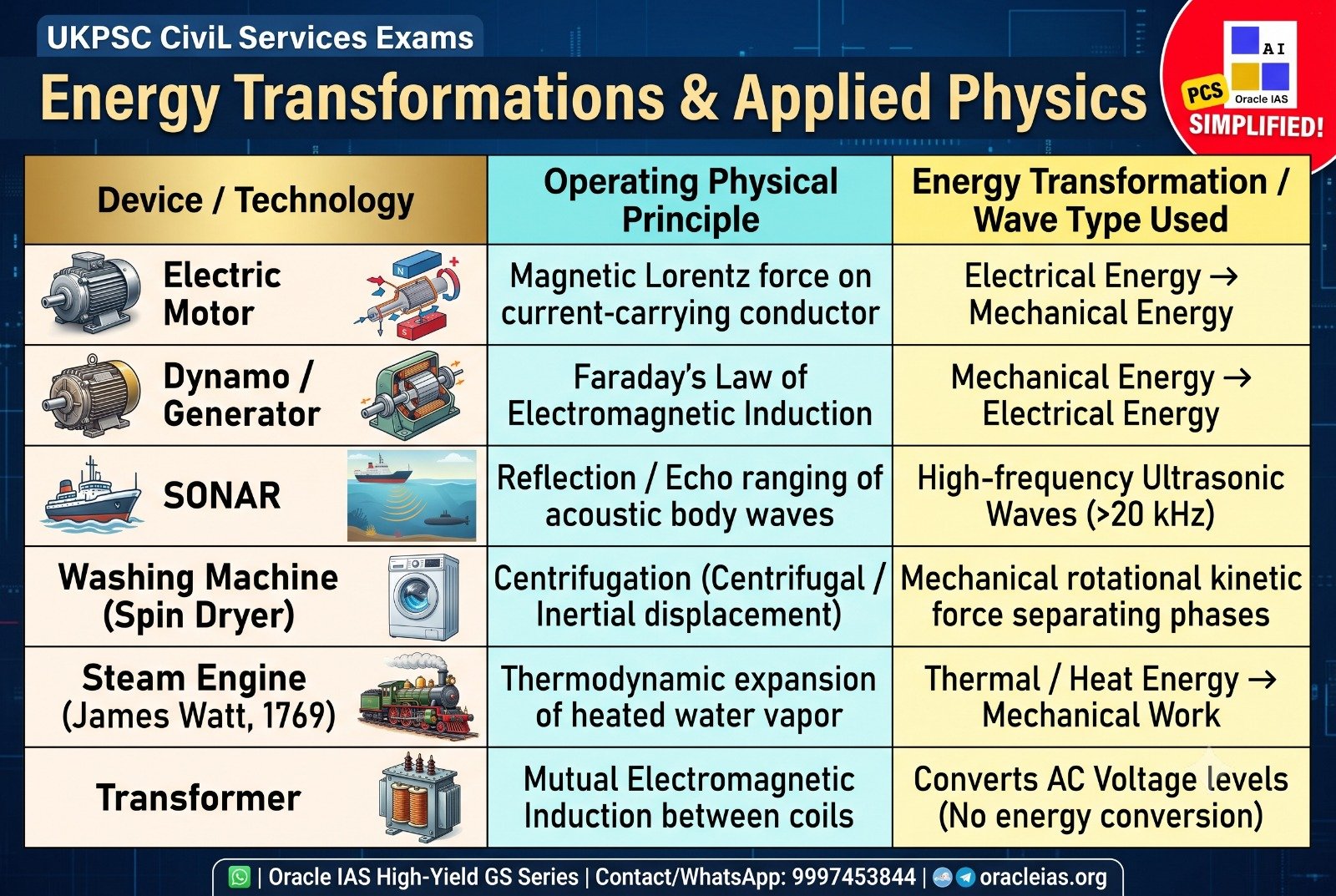
| Device / Technology | Operating Physical Principle | Energy Transformation / Wave Type Used |
| Electric Motor | Magnetic Lorentz force on current-carrying conductor | Electrical Energy → Mechanical Energy |
| Dynamo / Generator | Faraday’s Law of Electromagnetic Induction | Mechanical Energy → Electrical Energy |
| SONAR | Reflection / Echo ranging of acoustic body waves | High-frequency Ultrasonic Waves (>20 kHz) |
| Washing Machine (Spin Dryer) | Centrifugation (Centrifugal / Inertial displacement) | Mechanical rotational kinetic force separating phases |
| Steam Engine (James Watt, 1769) | Thermodynamic expansion of heated water vapor | Thermal / Heat Energy → Mechanical Work |
| Transformer | Mutual Electromagnetic Induction between coils | Converts AC Voltage levels (No energy conversion) |
3. Master Questions
Q1. An electromechanical device that converts electrical energy directly into mechanical energy is a:
[UKPSC Pre 2004-05] [Direct Fact]
(a) Dynamo
(b) Transformer
(c) Electric Motor
(d) Inductor
Q2. An underwater acoustic apparatus utilized by naval vessels and oceanographers to locate submerged obstacles, shipwrecks, and sea-floor contours is:
[UKPSC APS Mains 2017 | UKPSC APS Mains 2021] [Direct Fact]
(a) Radar
(b) Sonar
(c) Quasar
(d) Pulsar
Q3. SONAR systems deployed for underwater exploration and bathymetric mapping function primarily by transmitting:
[UKPSC APS Mains 2021] [Direct Fact]
(a) Infrasonic sound waves
(b) Ultrasonic sound waves
(c) Audible sound waves
(d) Polarized light rays
Q4. The condenser-driven commercial steam engine was patented and developed in 1769 by:
[UKPSC RO/ARO Pre 2006] [Direct Fact]
(a) Robert Watson
(b) James Watt
(c) William Harvey
(d) Thomas Edison
Q5. The First Law of Thermodynamics is an explicit restatement of which foundational scientific conservation principle?
[UKPSC RO/ARO Pre 2016] [Direct Fact]
(a) Conservation of Electric Charge
(b) Conservation of Linear Momentum
(c) Conservation of Energy
(d) Conservation of Mass/Matter
Q6. The spin-dryer cycle of a domestic washing machine and the separation of cream from milk operate on the mechanical principle of:
[UKPCS Lower Pre 2010] [Direct Fact]
(a) Centrifugation
(b) Hemodialysis
(c) Reverse Osmosis
(d) Molecular Diffusion
4. Master Explanations & Answer Key
- Ans. (c)
- Direct Answer: An electric motor converts electrical energy into mechanical rotational work using the magnetic Lorentz force exerted on a current-carrying armature coil.
- Exam Trap / Distractor Alert: Do not confuse an electric motor with a dynamo/generator (which does the reverse: mechanical into electrical); a transformer changes voltage levels without converting energy forms.
- High-Yield Extra Facts: The direction of coil deflection in an electric motor is determined by Fleming’s Left-Hand Rule; an inductor stores electrical energy in the form of a magnetic flux field ($E = \frac{1}{2} L I^2$).
- Ans. (b)
- Direct Answer: SONAR (Sound Navigation and Ranging) is an acoustic apparatus designed to detect, track, and measure the distance of submerged underwater objects.
- Exam Trap / Distractor Alert: RADAR operates via electromagnetic radio waves and cannot penetrate deep ocean water effectively; Quasars (quasi-stellar radio sources) and Pulsars (rotating neutron stars) are astrophysical cosmic bodies.
- High-Yield Extra Facts: SONAR works on the pulse-echo principle: distance $d = \frac{v \times t}{2}$, where $v$ is the speed of sound in seawater ($\approx 1500\text{ m/s}$) and $t$ is the two-way transit time.
- Ans. (b)
- Direct Answer: SONAR exclusively employs high-frequency ultrasonic sound waves (frequencies above $20,000\text{ Hz}$) because they travel long distances underwater with minimal beam divergence.
- Exam Trap / Distractor Alert: Infrasonic sound has frequencies below $20\text{ Hz}$ (generated by earthquakes, volcanic eruptions, and elephants); ordinary human audible sound spans $20\text{ Hz}$ to $20,000\text{ Hz}$.
- High-Yield Extra Facts: Ultrasonic waves are also utilized in medical sonography (ultrasound scans), bat echolocation, and non-destructive ultrasonic flaw detection in metallurgy.
- Ans. (b)
- Direct Answer: James Watt invented and patented the modern, efficient steam engine in 1769 by introducing a separate condenser that reduced thermal fuel waste.
- Exam Trap / Distractor Alert: Thomas Newcomen designed the earlier atmospheric engine in 1712, but Watt transformed it into a practical rotary engine; William Harvey discovered systemic blood circulation in 1628.
- High-Yield Extra Facts: The electrical and mechanical unit of power, the Watt ($1\text{ W} = 1\text{ J/s}$), was named in honor of James Watt; $1\text{ Horsepower (hp)} = 746\text{ Watts}$.
- Ans. (c)
- Direct Answer: The First Law of Thermodynamics states that the heat supplied to a closed system equals the change in its internal energy plus the work done ($Q = \Delta U + W$), which represents the Law of Conservation of Energy.
- Exam Trap / Distractor Alert: Do not confuse the First Law (Conservation of Energy) with the Second Law (Entropy / direction of spontaneous heat flow) or the Zeroth Law (concept of Temperature and thermal equilibrium).
- High-Yield Extra Facts: A perpetual motion machine of the first kind (PMM-1), which claims to produce mechanical work without energy input, is impossible because it violates this law.
- Ans. (a)
- Direct Answer: Centrifugation is the separation technique where rapid rotational spin creates an outward centrifugal inertial effect, forcing denser fluid or solid phases outward and drawing lighter phases toward the axis.
- Exam Trap / Distractor Alert: Centripetal force acts radially inward toward the rotation center to keep an object on a curved path, while Centrifugal force is the apparent outward reaction perceived in the rotating non-inertial frame.
- High-Yield Extra Facts: Centrifugation is also used in pathological laboratories for separating blood plasma from cellular components and in nuclear engineering for isotopic uranium enrichment via gas centrifuges.
Contact Oracle IAS:
Call/WhatsApp 9997453844 for details
Join Our Preparation program:

He is a bibliophile,accomplished writer and a fitness enthusiast.
- UKPSC Physics: Mechanics & Energy Transformations (Solved PYQs & Revision Notes) - October 13, 2026
- UPPCS Pre Revision #5: Governance in Uttar Pradesh|| Oracle IAS - October 12, 2026
- UKPSC Physics: Physical Quantities, Units & Measuring Instruments (Solved PYQs & Notes) - October 12, 2026