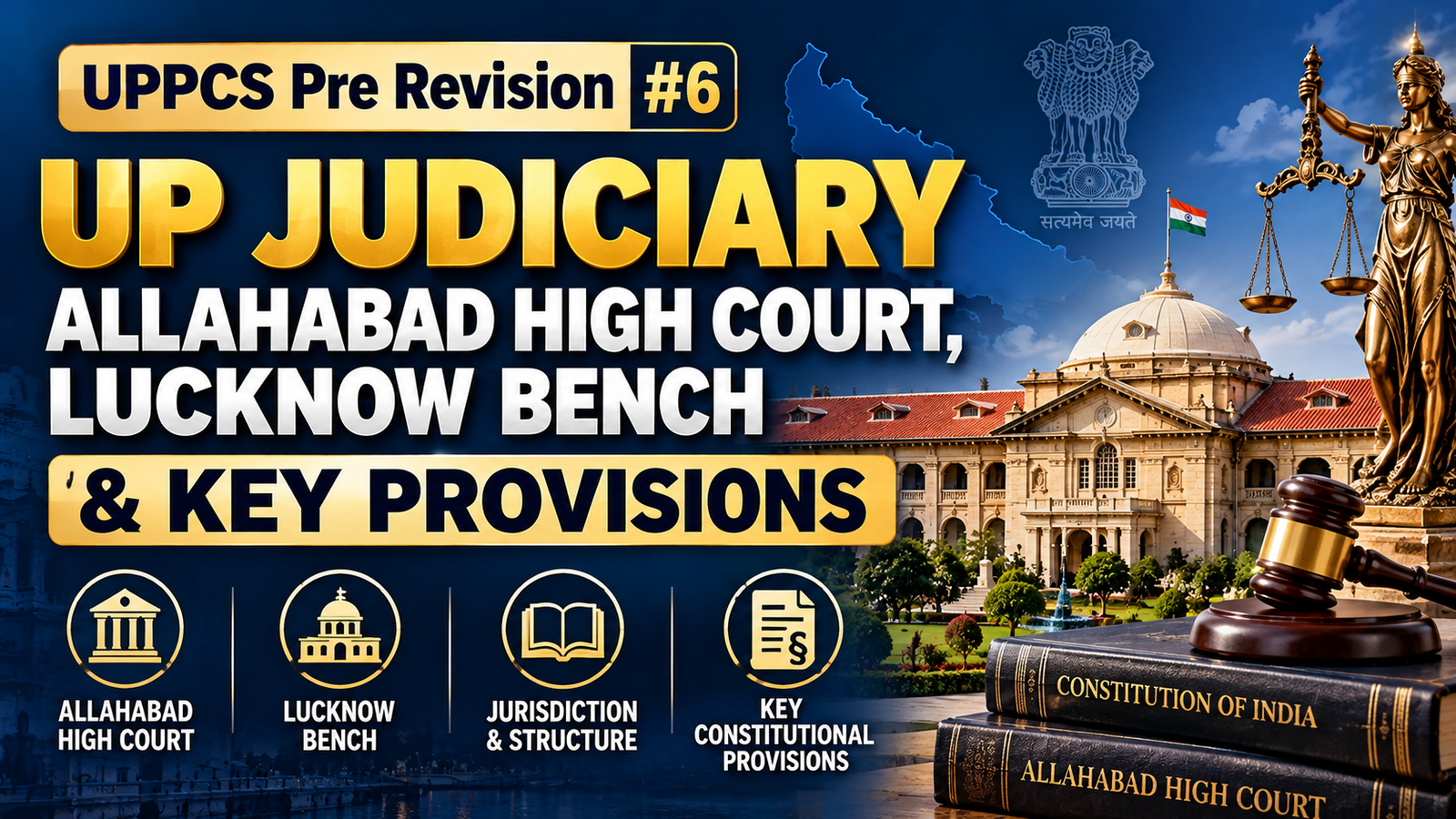
Questions on the Uttar Pradesh Judiciary are a recurring component of the UPPCS Prelims syllabus (Polity & UP Special). Examiners routinely design deceptive MCQs around the shifting of seats (Agra vs. Prayagraj), the Oudh Chief Court amalgamation date, the distinction between sanctioned vs. working strength, and constitutional articles governing High Courts.
This article aggregates the historical evolution, structural hierarchy, constitutional jurisdiction, and UP-specific judicial bodies into an exam-oriented framework.
Quick Reference: UP Judiciary at a Glance
| Parameter | Official Detail / Fact |
| Official Name | High Court of Judicature at Allahabad(Note: It is not called Prayagraj) |
| Original Seat Established | 17 March 1866 (Agra, under Letters Patent & Indian High Courts Act, 1861) |
| Shifted to Allahabad (Prayagraj) | 1869 |
| Name Change | 11 March 1919 (Redesignated as High Court of Judicature at Allahabad) |
| Oudh Chief Court Established | 2 November 1925 at Lucknow |
| Amalgamation Date | 26 July 1948 (United Provinces High Courts Amalgamation Order, 1948) with Lucknow as bench |
| Permanent Bench | Lucknow Bench |
| Sanctioned Judicial Strength | 160 Judges (119 Permanent + 41 Additional) — Largest in India |
| First Chief Justice (Pre-Independence) | Sir Walter Morgan (1866) |
| First Chief Justice (Post-Independence) | Justice B. Malik (1948) |
| Current Chief Justice (2026) | Justice Arun Bhansali (Appointed 5 Feb 2024) |
| Constitutional Articles | Articles 214 to 231 (Part VI) |
1. Historical Evolution of Allahabad High Court
    1866 (Agra)             1869 (Shift)            1919 (Rename)
┌──────────────────┐    ┌──────────────────┐    ┌──────────────────┐
│ North-Western    │───>│ Moved to         │───>│ High Court of    │
│ Provinces HC     │    │ Allahabad        │    │ Judicature at    │
└──────────────────┘    └──────────────────┘    │ Allahabad        │
                                                └────────┬─────────┘
                                                         │
    1925 (Lucknow)          1948 (Amalgamation)          │
┌──────────────────┐    ┌──────────────────────────┐     │
│ Oudh Chief Court │───>│ Merged into Allahabad HC │<────┘
│ Established      │    │ (26 July 1948)           │
└──────────────────┘    └──────────────────────────┘
2. Lucknow Bench & Territorial Distribution
- The Lucknow Bench is a permanent bench of the Allahabad High Court, inherited via the 1948 Amalgamation Order.
- Institutional Status: Uttar Pradesh has ONE High Court with its principal seat at Prayagraj and a permanent bench at Lucknow (It is not a separate High Court).
- Jurisdiction: The Lucknow Bench exercises jurisdiction over 12 districts of the Oudh region (including Lucknow, Ayodhya, Sitapur, Raebareli, Unnao, Hardoi, Lakhimpur Kheri, Sultanpur, Pratapgarh, Bara Banki, Amethi, and Bahraich). The Chief Justice retains administrative power to transfer cases between seats.
3. Sanctioned Strength & Leadership
- Largest High Court in India: Sanctioned strength stands at 160 Judges (119 Permanent Judges + 41 Additional Judges).
Sanctioned Strength  =  Total official posts approved by President (160)
Working Strength     =  Actual judges in office at a given date
Vacancies            =  Sanctioned Strength − Working Strength
Notable Judicial Career Milestones
- Some Famous Judges who became Chief Justice of India (CJI):
- Justice D. Y. Chandrachud: Served as Chief Justice of the Allahabad High Court (2013–2016) before elevation to the Supreme Court, later becoming the 50th CJI.
- Justice V. N. Khare: Served as a Judge at Allahabad High Court, later elevated as CJI (33rd CJI).
- Justice J. S. Verma: Served as Chief Justice of Allahabad High Court before elevation to the Supreme Court (27th CJI).
4. Key Constitutional Provisions (High Courts)
Article 214  --> High Court for each State
Article 215  --> High Court to be a Court of Record (Power to punish for contempt)
Article 216  --> Constitution of High Courts (Chief Justice + Other Judges)
Article 217  --> Appointment & conditions of office of a High Court Judge
Article 219  --> Oath or affirmation by High Court Judges (Before Governor)
Article 222  --> Transfer of a Judge from one High Court to another (By President)
Article 223  --> Appointment of Acting Chief Justice
Article 224  --> Appointment of Additional and Acting Judges
Article 226  --> Power of High Courts to issue Writs
Article 227  --> Power of Superintendence over all Subordinate Courts and Tribunals
Article 231  --> Establishment of a common High Court for two or more States
Critical Comparison: Article 226 vs Article 32
| Parameter | Article 32 (Supreme Court) | Article 226 (High Court) |
| Scope | Enforcement of Fundamental Rights ONLY | Enforcement of Fundamental Rights AND Any Other Legal Right |
| Territorial Reach | Entire Territory of India | Within State Jurisdiction / Where Cause of Action arises |
| Nature of Right | Article 32 is itself a Fundamental Right | Article 226 is a Constitutional Remedy (Discretionary) |
5. Subordinate Judiciary & Auxiliary Judicial Bodies in UP
UPPCS Prelims frequently tests administrative control over subordinate courts under Part VI, Chapter VI (Articles 233–237):
Article 233  --> Appointment of District Judges (By Governor in consultation with High Court)
Article 234  --> Recruitment of persons (other than district judges) to Judicial Service
Article 235  --> Control of High Court over Subordinate Courts (Postings, promotions, leave)
Key Auxiliary State Judicial Bodies
1. Uttar Pradesh State Legal Services Authority (UPSLSA)
- Statutory Basis: Established under the Legal Services Authorities Act, 1987.
- Patron-in-Chief: Chief Justice of the Allahabad High Court.
- Executive Chairman: A nominated Senior Judge of the High Court.
- Function: Provides free legal aid, organizes Lok Adalats, and promotes alternative dispute resolution (ADR) across UP.
2. Judicial Training and Research Institute (JTRI)
- Location: Lucknow.
- Established: 1987.
- Function: Apex institute for induction and in-service training of judicial officers in Uttar Pradesh.
3. National Law Universities
UP also has 2 National Law Universities:
- Dr. Ram Manohar Lohiya National Law University (RMLNLU Lucknow): Located in Lucknow, established in 2005/2006 as the state’s flagship NLU.
- Dr. Rajendra Prasad National Law University (RPNLU Prayagraj): Located in Prayagraj, established in 2020 (and renamed in 2023).
- By statutory design, the Chief Justice of the Allahabad High Court serves as the Chancellor for National Law Universities in the state.
Contact:
Call/WhatsApp 9997453844 for details
Join Our Preparation program:
Chief Mentor at Oracle IAS
Hemant Bhatt is a B. Tech from Pantnagar University and has studied Social Sciences at SciencesPo, Paris. He teaches at Oracle IAS, Dehradun. He has given 5 UPSC mains back to back along with 2 interviews.
He is a bibliophile,accomplished writer and a fitness enthusiast.
He is a bibliophile,accomplished writer and a fitness enthusiast.
Latest posts by Hemant Bhatt (see all)
- UPPCS Pre Revision #6: UP Judiciary – Allahabad High Court, Lucknow Bench & Key Provisions || Oracle IAS - October 13, 2026
- UKPSC Physics: Mechanics & Energy Transformations (Solved PYQs & Revision Notes) - October 13, 2026
- UPPCS Pre Revision #5: Governance in Uttar Pradesh|| Oracle IAS - October 12, 2026