
UKPSC Physics: Waves, Speed of Sound & Modern Particle Physics
1. High-Yield Micro-Notes
- Mechanical vs. Electromagnetic Waves: Sound waves are longitudinal mechanical waves that require a material medium (solid, liquid, or gas) to propagate via periodic compressions and rarefactions; they cannot travel through a vacuum. Conversely, radio waves, micro-waves, infrared, visible light, ultraviolet, X-rays, and gamma rays are transverse electromagnetic (EM) waves that propagate through a vacuum at the speed of light (3 × 10⁸ m/s).
- Speed of Sound Across Media: Sound velocity depends directly on the elasticity and density of the medium (v = √(E/ρ)). Its speed follows the strict hierarchical order: Solids (Metals) > Liquids > Gases > Vacuum (0 m/s). In dry air at 20 °C, sound travels at ≈ 343 m/s; in water, ≈ 1,480 m/s; in steel/iron, ≈ 5,000–5,960 m/s.
- RADAR vs. Aerial Tracking: RADAR (Radio Detection and Ranging) transmits pulses of high-frequency radio waves (or microwaves). It locates airborne targets, enemy aircraft, and storm formations by analyzing the time delay, phase shift, and Doppler frequency alteration of reflected returning pulses.
- Modern Physics, Dual Nature & Radiation: Matter exhibits dual wave-particle properties defined by the de Broglie relation (λ = h / p = h / (m·v)), where macroscopic objects possess imperceptibly tiny wavelengths due to Planck’s constant (h ≈ 6.626 × 10⁻³⁴ J·s). X-rays were discovered in 1895 by German physicist Wilhelm Conrad Roentgen (earning the first Nobel Prize in Physics in 1901). The photoelectric effect requires incident light above a minimum threshold frequency (ν ≥ ν₀), which corresponds to light having a sufficiently short wavelength (λ ≤ λ₀) and photon energy E = h·ν = h·c / λ exceeding the metal’s work function (Φ).
2. Types of Waves and Characteristics
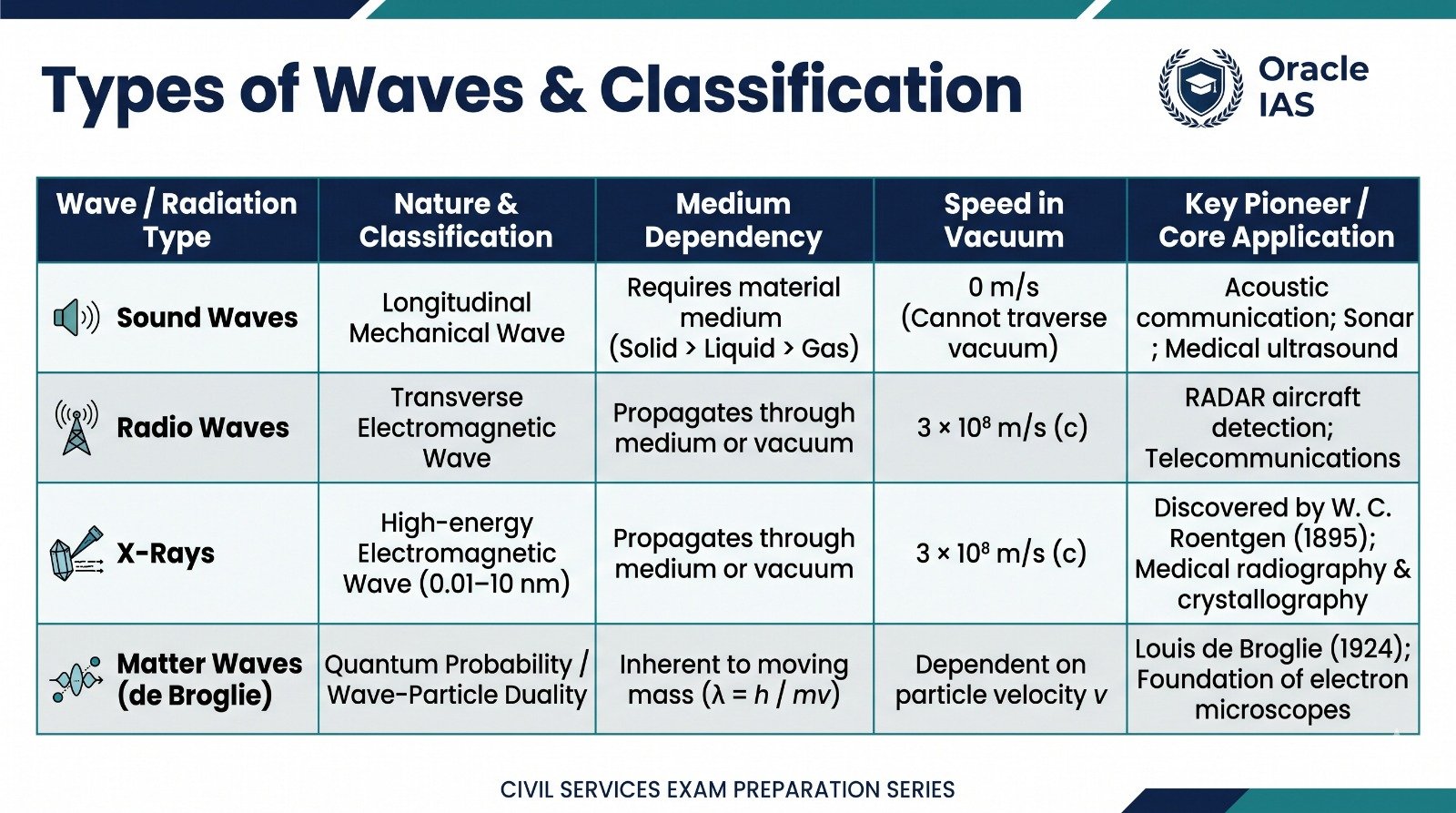
| Wave / Radiation Type | Nature & Classification | Medium Dependency | Speed in Vacuum | Key Pioneer / Core Application |
| Sound Waves | Longitudinal Mechanical Wave | Requires material medium (Solid > Liquid > Gas) | 0 m/s (Cannot traverse vacuum) | Acoustic communication; Sonar; Medical ultrasound |
| Radio Waves | Transverse Electromagnetic Wave | Propagates through medium or vacuum | 3 × 10⁸ m/s (c) | RADAR aircraft detection; Telecommunications |
| X-Rays | High-energy Electromagnetic Wave (0.01–10 nm) | Propagates through medium or vacuum | 3 × 10⁸ m/s (c) | Discovered by W. C. Roentgen (1895); Medical radiography & crystallography |
| Matter Waves (de Broglie) | Quantum Probability / Wave-Particle Duality | Inherent to moving mass (λ = h / mv) | Dependent on particle velocity v | Louis de Broglie (1924); Foundation of electron microscopes |
3. Master Questions
Q1. What is the de Broglie wavelength associated with a ball of mass 0.12 kg moving at a uniform velocity of 20 m/s? (Take Planck’s constant h = 6.63 × 10⁻³⁴ J·s)
[UKPSC Pre 2024] [Statement-Based]
(a) 6.63 × 10⁻³⁰ m
(b) 6.63 × 10⁻³⁴ m
(c) 2.76 × 10⁻³⁰ m
(d) 2.76 × 10⁻³⁴ m
Q2. The discovery of highly penetrating ‘X-Rays’ in 1895, which laid the foundation for modern medical radiography, was made by:
[UKPSC UDA/LDA Pre 2003] [Direct Fact]
(a) Ernest Rutherford
(b) Wilhelm Conrad Roentgen
(c) James Clerk Maxwell
(d) Evangelista Torricelli
Q3. A RADAR installation tracking the velocity, elevation, and geographic coordinates of inbound aircraft operates using:
[UKPSC Mains 2002-03] [Direct Fact]
(a) Coherent light waves
(b) Radio waves
(c) Ultrasonic sound waves
(d) Infrasonic pressure waves
Q4. The propagation speed of acoustic sound waves reaches its maximum value in which of the following media?
[UKPSC Pre 2011 | UKPSC APO 2021] [Direct Fact]
(a) Complete Vacuum
(b) Structural Metal (Steel/Iron)
(c) Pure Liquid Water
(d) Ambient Air
Q5. Which of the following is classified strictly as a ‘Mechanical Wave’ that is incapable of traversing empty space?
[UKPSC Pre 2016 | UKPSC Forest Guard 2022] [Direct Fact]
(a) Radio waves
(b) X-rays
(c) Visible light waves
(d) Sound waves
Q6. In the photoelectric effect, electrons are ejected from the surface of an irradiated photosensitive metal when the incident light possesses:
[UKPSC APO 2015] [Direct Fact]
(a) A sufficiently small (short) wavelength
(b) A very large (long) wavelength
(c) A reduced propagation velocity
(d) An accumulated negative electrical charge
4. Master Explanations & Answer Key
- Ans. (d)
- Direct Answer: According to the de Broglie wave equation, λ = h / (m·v) = (6.63 × 10⁻³⁴) / (0.12 × 20) = (6.63 × 10⁻³⁴) / 2.4 ≈ 2.76 × 10⁻³⁴ m.
- Exam Trap / Distractor Alert: Watch the power exponents closely; options (c) and (d) provide identical numerical coefficients (2.76) but vary between 10⁻³⁰ and 10⁻³⁴. For macroscopic bodies, the denominator produces a small number (2.4), keeping the exponent around 10⁻³⁴.
- High-Yield Extra Facts: Louis de Broglie formulated wave-particle duality in 1924 (earning the 1929 Nobel Prize in Physics); Clinton Davisson and Lester Germer experimentally confirmed electron wave diffraction in 1927.
- Ans. (b)
- Direct Answer: Wilhelm Conrad Roentgen discovered X-rays in November 1895 while experimenting with cathode-ray discharge tubes at the University of Würzburg.
- Exam Trap / Distractor Alert: Ernest Rutherford discovered alpha and beta particles and formulated the nuclear planetary model of the atom; James Clerk Maxwell developed the unified classical theory of electromagnetic radiation.
- High-Yield Extra Facts: Roentgen received the inaugural Nobel Prize in Physics in 1901; X-rays possess wavelengths ranging roughly from 0.01 nm to 10 nm, occupying the spectrum between ultraviolet light and gamma radiation.
- Ans. (b)
- Direct Answer: RADAR (Radio Detection and Ranging) transmits directional electromagnetic radio waves or microwaves that reflect back from solid airframes to establish target distance, altitude, and relative velocity.
- Exam Trap / Distractor Alert: Do not confuse RADAR (which tracks airborne bodies through the atmosphere using radio waves) with SONAR (which detects submerged submarine objects underwater using ultrasonic acoustic waves).
- High-Yield Extra Facts: Ground and airborne Doppler radars exploit the Doppler frequency shift to detect rotational wind vectors within storms and cyclones; LIDAR (Light Detection and Ranging) uses pulsed lasers instead of radio frequencies.
- Ans. (b)
- Direct Answer: Sound propagates fastest through solid metals (e.g., steel ≈ 5,100 m/s; aluminum ≈ 6,420 m/s) because solids exhibit higher elastic moduli (bulk/Young’s modulus) relative to their density.
- Exam Trap / Distractor Alert: Unlike electromagnetic light, which reaches maximum speed in a vacuum (3 × 10⁸ m/s) and slows down in denser matter, mechanical sound cannot propagate through a vacuum at all (v = 0 m/s).
- High-Yield Extra Facts: The velocity of sound in ambient dry air at 0 °C is 331 m/s, rising to ≈ 343 m/s at 20 °C; humidity increases sound velocity in air because moist air is less dense than dry air.
- Ans. (d)
- Direct Answer: Sound waves are longitudinal mechanical waves that require physical matter (atoms or molecules) to transmit kinetic energy through mechanical vibrations.
- Exam Trap / Distractor Alert: Radio waves, X-rays, and light waves are all transverse electromagnetic waves consisting of coupled oscillating electric and magnetic fields, allowing them to cross interstellar vacuum without any supporting medium.
- High-Yield Extra Facts: Mechanical waves are subdivided into longitudinal waves (particle displacement parallel to wave direction, e.g., sound in fluids) and transverse waves (particle displacement perpendicular, e.g., surface water ripples or S-waves in seismic tremors).
- Ans. (a)
- Direct Answer: Photoelectric emission occurs only when the incident photon energy (E = h·ν = h·c / λ) matches or exceeds the metal’s characteristic work function (Φ), requiring high frequency (ν) and a correspondingly short wavelength (λ ≤ λ₀).
- Exam Trap / Distractor Alert: Increasing the intensity (brightness) of light increases the rate of emitted photoelectrons, but does not increase individual photon energy; emission is impossible if the wavelength exceeds the cutoff threshold (λ₀), regardless of light intensity.
- High-Yield Extra Facts: Albert Einstein explained the photoelectric effect in 1905 utilizing Planck’s quantum hypothesis, for which he was awarded the 1921 Nobel Prize in Physics; the velocity of light in vacuum (c) remains invariant.
Contact Oracle IAS:
Call/WhatsApp 9997453844 for details
Join Our Preparation program:

He is a bibliophile,accomplished writer and a fitness enthusiast.
- UKPSC Physics: Waves, Speed of Sound & Modern Particle Physics (Solved PYQs & Notes) - October 14, 2026
- UPPCS Pre Revision #6: UP Judiciary – Allahabad High Court, Lucknow Bench & Key Provisions || Oracle IAS - October 13, 2026
- UKPSC Physics: Mechanics & Energy Transformations (Solved PYQs & Revision Notes) - October 13, 2026
 WhatsApp us