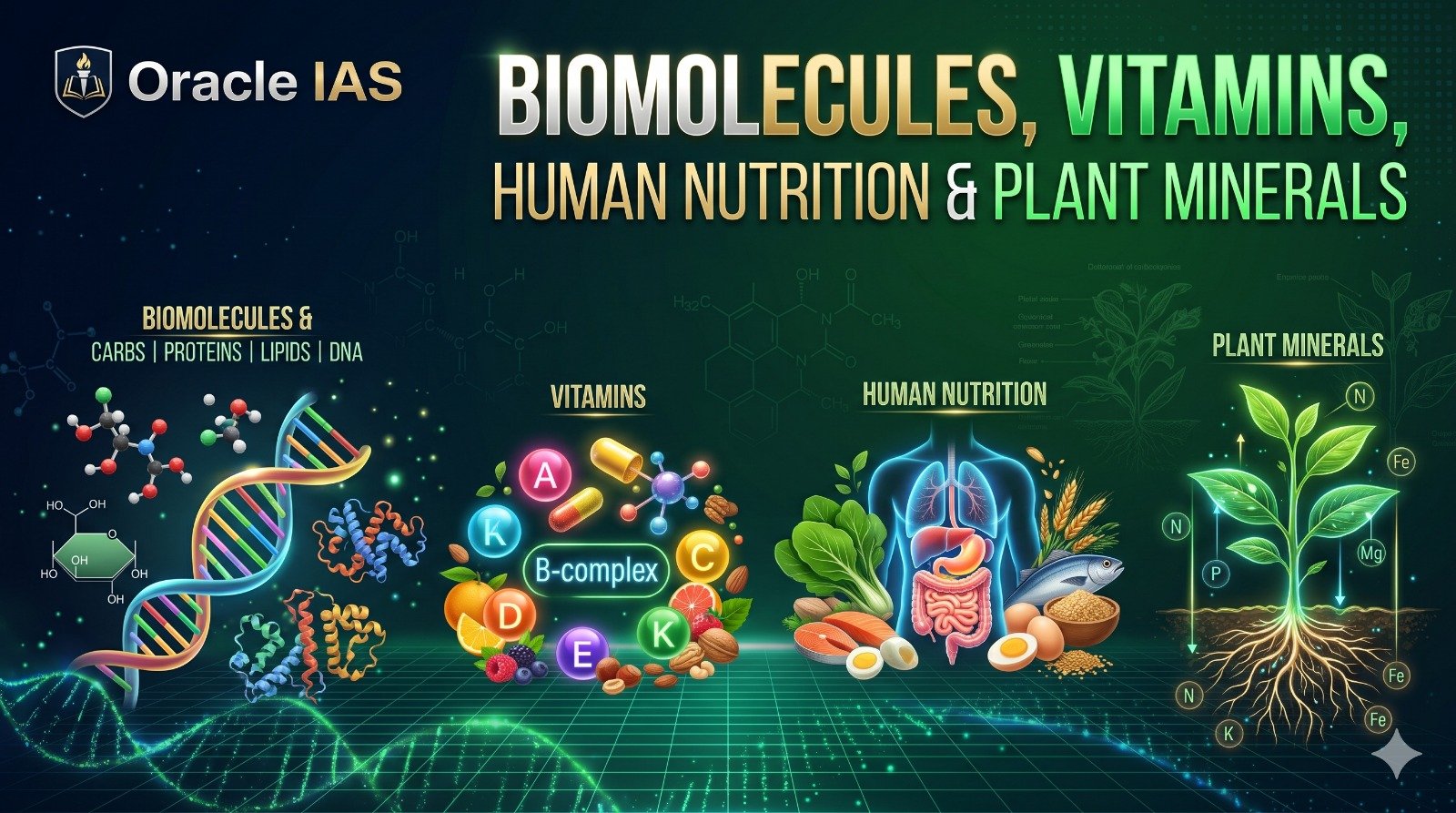
UKPSC Biology (Unit 2): Biomolecules, Vitamins, Human Nutrition & Plant Minerals
Part of the UKPSC General Science & Technology Revision Series.
1.High-Yield Micro-Notes
- Vitamins (Nomenclature, Classification & Deficiencies): Vitamins are micro-nutrients that yield zero calories and are assimilated directly without hydrolytic enzymatic digestion. They are grouped by solubility: Water-soluble (Vitamins B-complex and C) and Fat-soluble (Vitamins A, D, E, K). Vitamin C (Ascorbic Acid) is sensitive to heat and abundant in raw citrus fruits, amla, guava (100–200 mg/100g), and orange. Vitamin D (Calciferol / Sunshine Vitamin) is photochemically synthesized in epidermal skin when 7-dehydrocholesterol absorbs solar UVB radiation. Vitamin E (Tocopherol) acts as an antioxidant lipid protector whose deficiency induces reproductive sterility. Vitamin K (Phylloquinone) is vital for hepatic prothrombin synthesis and blood coagulation; both Vitamin A and Vitamin K are maintained at elevated levels in commercial poultry feed. Vitamin B12 (Cyanocobalamin) uniquely coordinates a central Cobalt (Co) metallic ion. Consuming polished white rice strips the thiamine-rich aleurone bran layer, causing Beriberi (Vitamin B1 deficiency). Golden Rice is a genetically engineered biofortified crop developed to biosynthesize beta-carotene (pro-vitamin A) to counter childhood blindness.
- Macromolecules & Structural Proteins: Proteins are heteropolymers composed of alpha-amino acids linked via covalent peptide (-CO-NH-) bonds, with Nitrogen acting as their defining elemental signature (distinguishing them from simple carbohydrates and fats). Severe dietary protein deprivation stunts skeletal muscle growth, resulting in childhood Kwashiorkor and Marasmus. Casein is the primary phosphoprotein stabilizing calcium in milk; Keratin is an insoluble, cysteine-rich fibrous structural protein forming hair, nails, hooves, and epidermal stratum corneum. Enzymes are globular proteinaceous biocatalysts that accelerate metabolic rate by reducing activation energy. Fructose (fruit sugar / laevulose) is a naturally occurring ketohexose monosaccharide found in fruits and honey, recognized as the sweetest natural sugar.
- Plant Mineral Nutrition & Plastid Storage: Plants demand 17 essential elements: macronutrients required in substantial bulk (C, H, O, N, P, K, Ca, Mg, S) and micronutrients needed in minute quantities (Fe, Mn, Zn, Cu, B, Mo, Cl, Ni); among choices like Ca, K, S, and Zn, plants absorb Zinc (Zn) in the least quantity. Plastids in plant storage parenchyma include Amyloplasts (store starch), Aleuroplasts (store proteins), and Elaioplasts (store fats, lipids, and essential oils).
- Dietary Minerals, Thyroid Function & Animal Digestion: Iodine is a micronutrient required by thyroid follicle cells to synthesize thyroxine (T4) and triiodothyronine (T3); iodine deficiency causes compensatory thyroid hyperplasia known as endemic Goitre. Non-heme dietary iron is concentrated in dark green leafy vegetables (spinach, containing folate, vitamin K, and iron) and dry berries like Karonda (Carissa carandas), whereas leguminous Soybean (Glycine max) supplies the highest dietary protein density among field crops (approx. 36–40 g protein per 100 g). Coprophagy (cecotrophy) is a specialized digestive adaptation where herbivores like rabbits re-ingest nutrient-rich soft cecal pellets to absorb microbially synthesized B-vitamins and amino acids produced in the hindgut.
2. Important facts you should know:
| Biomolecule / Nutrient | Chemical / Common Name | Key Dietary Source | Physiological Role / Deficiency Syndrome |
| Vitamin C | Ascorbic Acid | Guava, Amla, Citrus fruits, Green chili | Collagen synthesis, wound healing; deficiency causes Scurvy. |
| Vitamin D | Calciferol (Sunshine Vitamin) | Solar UVB conversion in skin, Fish liver oil | Calcium absorption, mineralization; deficiency causes Rickets (children), Osteomalacia. |
| Vitamin E | Tocopherol (Antifertility Vitamin) | Wheat germ oil, sunflower seeds, nuts | Membrane antioxidant; deficiency causes hemolysis, reproductive sterility. |
| Vitamin K | Phylloquinone / Menaquinone | Green leafy greens, intestinal gut microflora | Synthesizes blood clotting factors II, VII, IX, X; deficiency causes prolonged bleeding. |
| Vitamin B12 | Cyanocobalamin | Animal meats, dairy products, eggs | Coordinates Cobalt ion; deficiency causes Pernicious Megaloblastic Anemia. |
| Casein | Milk Phosphoprotein | Mammalian milk, curd, cheese | Provides amino acids and bound calcium-phosphate micelles for mammalian growth. |
| Keratin | Fibrous Structural Scleroprotein | Hair, horn, hooves, feathers, human nails | High mechanical strength, water-insoluble structural integument protection. |
| Elaioplasts | Lipid-storing Leucoplasts | Oil-bearing seeds (Castor, Groundnut, Mustard) | Synthesizes and sequesters plant fatty acid reserves and triglycerides. |
3. Master Questions
Q1. The physiological behavioral adaptation known as coprophagy (re-ingesting soft cecal fecal pellets to maximize nutrient and vitamin uptake) is naturally observed in:
[UKPSC APO 2021] [Direct Fact]
(a) Frogs
(b) Tree Squirrels
(c) Rabbits
(d) Garden Lizards
Q2. In commercial poultry farming, the formulated feed mixtures are systematically enriched with high concentrations of which two vitamins to ensure bone integrity, feather development, and blood coagulation?
[UKPSC Junior Assistant 2022] [Direct Fact]
(a) Vitamin A and Vitamin C
(b) Vitamin A and Vitamin K
(c) Vitamin B and Vitamin C
(d) Vitamin C and Vitamin D
Q3. Polypeptides and structural proteins that drive cellular architecture and metabolic enzymatic action are polymers made up of:
[UKPSC AE 2007] [Direct Fact]
(a) Nucleotides and purine bases
(b) Long-chain fatty acids
(c) Alpha-amino acids
(d) Hexose sugars
Q4. The chemical name of the water-soluble, heat-sensitive micronutrient Vitamin C is:
[UKPSC AE 2007 | UKPSC RO/ARO Pre 2006 | UKPSC RO/ARO Mains 2016] [Direct Fact]
(a) Citric Acid
(b) Ascorbic Acid
(c) Acetic Acid
(d) Tartaric Acid
Q5. Among common orchard fruits, which of the following provides the highest concentration of Vitamin C per 100 grams of edible pulp?
[UKPSC Pre 2002-03] [Direct Fact]
(a) Carrot
(b) Guava
(c) Mango
(d) Orange
Q6. In human biochemistry and physiology, an enzyme is functionalized and categorized as a/an:
[UKPSC Pre 2011] [Direct Fact]
(a) Essential fat-soluble vitamin
(b) Unicellular bacterium
(c) Organic Biocatalyst
(d) Sub-microscopic virion
Q7. Among common pulses and grain legumes, the highest percentage of dietary protein per 100 grams is found in:
[UKPSC Pre 2002-03] [Direct Fact]
(a) French String Beans
(b) Red Lentils (Masoor)
(c) Pigeon Pea (Arhar / Tur)
(d) Soybean
Q8. Among everyday food items, non-heme dietary iron content is found in the highest concentration in:
[UKPSC Pre 2002-03] [Direct Fact]
(a) Cooked Field Beans
(b) Hen Eggs
(c) Green Leafy Vegetables (Spinach)
(d) Whole Bovine Milk
Q9. The dominant white phosphoprotein that remains dispersed in mammalian milk and coagulates under acidic conditions is:
[UKPSC Pre 2006-07] [Direct Fact]
(a) Agglutinin
(b) Casein
(c) Myosin
(d) Hemoglobin
Q10. The naturally occurring ketohexose monosaccharide that serves as the primary sweetening carbohydrate in fresh fruits and honey is:
[UKPSC RO/ARO Pre 2022] [Direct Fact]
(a) D-Glucose
(b) Sucrose
(c) Fructose (Laevulose)
(d) Galactose
Q11. The lipid-soluble antioxidant micronutrient Vitamin E is chemically designated as:
[UKPSC APS Mains 2017 | UKPSC RO/ARO Pre 2023 | UKPSC RO/ARO 2023] [Direct Fact]
(a) Ergocalciferol
(b) Axerophytol
(c) Ascorbic Acid
(d) Tocopherol
Q12. Which of the following vitamins dissolves in polar aqueous solutions and is excreted in urine rather than being stored in hepatic tissues?
[UKPSC Pre 2011] [Direct Fact]
(a) Vitamin A
(b) Vitamin C
(c) Vitamin D
(d) Vitamin E
Q13. Which lipid-soluble vitamin is required by hepatic parenchymal cells for the post-translational carboxylation of clotting factors essential for blood coagulation?
[UKPSC Pre 2012] [Direct Fact]
(a) Vitamin A
(b) Vitamin C
(c) Vitamin E
(d) Vitamin K
Q14. Among the seventeen essential mineral elements absorbed by angiosperms, which of the following is an enzymatic micronutrient absorbed in the least quantity?
[UKPSC Mains 2006] [Direct Fact]
(a) Calcium
(b) Potassium
(c) Zinc
(d) Sulfur
Q15. Which vitamin is synthesized endogenously when cutaneous 7-dehydrocholesterol in the human skin absorbs solar ultraviolet-B (UVB) radiation?
[UKPSC Mains 2006] [Direct Fact]
(a) Vitamin A
(b) Vitamin B-complex
(c) Vitamin C
(d) Vitamin D
Q16. Severe childhood growth retardation, skeletal muscle atrophy, and impaired cellular repair are classic deficiency indicators of:
[UKPSC Mains 2006] [Direct Fact]
(a) Polyunsaturated Fats
(b) Inorganic Trace Minerals
(c) Dietary Proteins
(d) Dietary Fibers
Q17. Among wild and cultivated bush fruits, which berry is recognized as an exceptionally rich source of dietary iron?
[UKPSC RO/ARO Pre 2006] [Direct Fact]
(a) Jamun (Syzygium cumini)
(b) Karonda (Carissa carandas)
(c) Loquat (Eriobotrya japonica)
(d) Papaya (Carica papaya)
Q18. Fresh raw citrus fruits such as sweet orange and lemon serve as major culinary sources of:
[UKPSC RO/ARO Pre 2006] [Direct Fact]
(a) Ascorbic Acid (Vitamin C)
(b) Retinol (Vitamin A)
(c) Saturated Fatty Acids
(d) Animal Glycogen
Q19. The characteristic and primary chemical element that distinguishes protein macromolecules from simple carbohydrates and triglycerides is:
[UKPSC RO/ARO Pre 2016] [Direct Fact]
(a) Hydrogen
(b) Nitrogen
(c) Oxygen
(d) Carbon
Q20. Plant leucoplast organelles specialized for synthesizing and storing non-polar lipids, plant oils, and triglycerides are termed:
[UKPSC RO/ARO Mains 2016] [Direct Fact]
(a) Amyloplasts
(b) Aleuroplasts
(c) Elaioplasts
(d) Chromoplasts
Q21. Abnormal non-neoplastic enlargement of the thyroid gland, clinically diagnosed as endemic Goitre, is caused by nutritional deficiency of:
[UKPSC Forest Ranger Pre 2012] [Direct Fact]
(a) Vitamin D
(b) Trace Iodine
(c) Nicotinic Acid
(d) Functional Hemoglobin
Q22. Which essential transition metal ion is coordinated at the center of the corrin ring structure of Vitamin B12 (Cyanocobalamin)?
[UKPSC Forest Ranger Pre 2015] [Direct Fact]
(a) Cobalt
(b) Magnesium
(c) Iron
(d) Copper
Q23. Which of the following dietary nutrient categories is absorbed and assimilated directly across intestinal enterocytes without undergoing preceding hydrolytic digestion?
[UKPSC FRO/ACF Pre 2019] [Direct Fact]
(a) Triglyceride Fats
(b) Dietary Polypeptides
(c) Polysaccharide Carbohydrates
(d) Vitamins and Inorganic Minerals
Q24. Bovine dairy milk, farm-fresh eggs, and fortified butter are excellent dietary sources of which pair of fat-soluble vitamins?
[UKPSC Combined SES 2021] [Direct Fact]
(a) Vitamin B and Vitamin C
(b) Vitamin A and Vitamin D
(c) Vitamin C and Vitamin D
(d) Vitamin A and Vitamin C
Q25. Consider the following statements:
Assertion (A): Unpolished brown rice is nutritionally preferable to polished white rice.
Reason (R): Mechanical industrial polishing abrades and strips the outer aleurone and embryo layers containing Vitamin B1 (Thiamine).
Choose the correct code:
[UKPSC RO/ARO 2023] [Assertion-Reason]
(a) Both (A) and (R) are true, and (R) is the correct explanation of (A)
(b) Both (A) and (R) are true, but (R) is not the correct explanation of (A)
(c) (A) is true, but (R) is false
(d) (A) is false, but (R) is true
Q26. Which of the following biological macromolecules is an insoluble, fibrous structural protein rather than a storage carbohydrate or lipid?
[UKPSC AE 2012] [Direct Fact]
(a) Glycogen
(b) Keratin
(c) Cholesterol
(d) Chitin
Q27. ‘Golden Rice’ is a bioengineered genetically modified (GM) oryza crop variety created to biosynthesize:
[UKPSC Regional Inspector 2022] [Direct Fact]
(a) Beta-carotene (precursor to Vitamin A)
(b) Saffron carotenoid pigments
(c) Bacillus thuringiensis endotoxins
(d) Recombinant Human Insulin
4. Master Explanations & Answer Key
- Ans. (c)
- Direct Answer: Rabbits (lagomorphs) exhibit coprophagy (specifically cecotrophy), producing soft cecotropes that they re-ingest directly to absorb microbial proteins and B-vitamins synthesized in the cecum.
- Exam Trap / Distractor Alert: True coprophagy in lagomorphs differs from general scavenging; rabbits produce two types of fecal pellets: hard, dry day feces (which are discarded) and soft, mucus-coated nocturnal cecotropes (which are re-ingested).
- High-Yield Extra Facts: Other small non-ruminant herbivores that practice cecotrophy include guinea pigs, chinchillas, and hamsters; this process compensates for the inability of hindgut fermenters to absorb microbial proteins upstream in the small intestine.
- Ans. (b)
- Direct Answer: Commercial poultry diets are supplemented with high levels of Vitamin A (which maintains epithelial mucosal health, retinal vision, and fertility) and Vitamin K (which prevents internal hemorrhagic disorders and maintains blood clotting during debeaking or injury).
- Exam Trap / Distractor Alert: Birds can endogenously synthesize Vitamin C under non-stress conditions, making dietary Vitamin C supplementation secondary; Vitamin A and Vitamin K must be continuously supplied via poultry premixes.
- High-Yield Extra Facts: Vitamin K3 (Menadione) is the synthetic water-soluble analogue commonly blended into livestock feed premixes.
- Ans. (c)
- Direct Answer: Proteins are linear, unbranched heteropolymers assembled from 20 standard proteinogenic alpha-amino acids linked together through peptide bonds.
- Exam Trap / Distractor Alert: Nucleic acids (DNA/RNA) are assembled from nucleotides; polysaccharides (glycogen/starch/cellulose) are polymers of monosaccharide sugars; fatty acids form lipids, not proteins.
- High-Yield Extra Facts: Each amino acid contains an amino group (-NH₂), a carboxyl group (-COOH), a hydrogen atom, and a variable side chain (R-group) bound to a central chiral alpha-carbon (except glycine, which is achiral).
- Ans. (b)
- Direct Answer: Vitamin C is chemically known as L-Ascorbic Acid (C₆H₈O₆), an enolic hexose derivative functioning as a water-soluble antioxidant and enzymatic cofactor.
- Exam Trap / Distractor Alert: Citric acid is a tricarboxylic acid that provides tart flavor in citrus fruits, but it does not possess vitamin activity; Ascorbic acid is the true antiscorbutic vitamin.
- High-Yield Extra Facts: Primates, guinea pigs, and fruit bats cannot synthesize ascorbic acid endogenously due to an evolutionary loss-of-function mutation in the gene encoding the final pathway enzyme, L-gulonolactone oxidase.
- Ans. (b)
- Direct Answer: Guava (Psidium guajava) contains between 100 mg and 200 mg of Vitamin C per 100 g of fresh fruit, exceeding typical sweet oranges (≈ 50 mg/100g) and carrots (≈ 6–8 mg/100g).
- Exam Trap / Distractor Alert: While citrus fruits like oranges and lemons are commonly cited as the classic reference sources for Vitamin C, Indian gooseberry (Amla, 600–700 mg/100g) and Guava offer significantly higher concentrations per unit mass.
- High-Yield Extra Facts: Vitamin C is destroyed by thermal cooking, atmospheric oxidation, and prolonged boiling; fresh raw preparations best preserve its bioactivity.
- Ans. (c)
- Direct Answer: Enzymes are biological catalysts (nearly all are globular proteins, with catalytic RNAs termed ribozymes acting as exceptions) that accelerate biochemical reaction rates without being consumed in the process.
- Exam Trap / Distractor Alert: Enzymes do not shift the chemical equilibrium of a reaction; they lower the activation energy barrier (Ea) separating reactants from products.
- High-Yield Extra Facts: The catalytic activity of an enzyme depends on its three-dimensional tertiary conformation; thermal boiling or severe pH shifts denature this structure, inactivating the enzyme.
- Ans. (d)
- Direct Answer: Soybean (Glycine max) contains approximately 36% to 40% protein by dry weight, representing the highest protein density among all commonly cultivated legumes and pulses.
- Exam Trap / Distractor Alert: Traditional Indian pulses (such as Masoor, Chana, and Arhar) provide roughly 22% to 26% protein by weight; soybean delivers nearly 1.5 times that amount.
- High-Yield Extra Facts: Soy protein is one of the few plant proteins considered a “complete protein” because its amino acid profile closely matches human nutritional requirements, containing all nine essential amino acids.
- Ans. (c)
- Direct Answer: Green leafy vegetables, particularly fresh spinach (Spinacia oleracea), provide non-heme iron (approx. 2.7 to 3.5 mg per 100 g), surpassing whole bovine milk (which contains virtually no iron).
- Exam Trap / Distractor Alert: Milk is an incomplete food because it is deficient in both iron and Vitamin C; spinach is iron-dense, although dietary oxalates can partially inhibit non-heme iron bio-absorption in the gut.
- High-Yield Extra Facts: Consuming Vitamin C alongside green vegetables converts insoluble ferric iron (Fe³⁺) into soluble ferrous iron (Fe²⁺), improving mucosal iron uptake.
- Ans. (b)
- Direct Answer: Casein is the principal family of phosphoproteins found in mammalian milk (accounting for roughly 80% of protein in cow milk), existing as colloidal calcium phosphate-casein micelles.
- Exam Trap / Distractor Alert: Myosin is a contractile motor protein found in skeletal muscle tissue; Hemoglobin is the oxygen-transporting metalloprotein in erythrocytes.
- High-Yield Extra Facts: The liquid remaining after milk curdles and casein precipitates out is called whey, which contains the soluble whey proteins beta-lactoglobulin and alpha-lactalbumin.
- Ans. (c)
- Direct Answer: Fructose (fruit sugar) is a six-carbon polyhydroxy ketone (ketohexose) found in ripe tree fruits, berries, and honey.
- Exam Trap / Distractor Alert: Sucrose is a disaccharide (table sugar composed of glucose + fructose); Fructose is an unbranched monosaccharide that rotates plane-polarized light to the left, earning the alternate name laevulose.
- High-Yield Extra Facts: Fructose is the sweetest of all naturally occurring carbohydrates—approximately 1.7 times sweeter than commercial granulated sucrose.
- Ans. (d)
- Direct Answer: Vitamin E is chemically identified as Tocopherol (predominantly alpha-tocopherol), a lipid-soluble fat chain acting as a peroxyl radical scavenger in biological membranes.
- Exam Trap / Distractor Alert: Calciferol is Vitamin D; Axerophytol is an older historical term for Retinol (Vitamin A); Riboflavin is Vitamin B2.
- High-Yield Extra Facts: Alpha-tocopherol prevents lipid peroxidation of polyunsaturated fatty acids (PUFAs) in cell membranes; its severe deficiency is linked to hemolytic anemia, neuromuscular ataxia, and reproductive failures in animal models.
- Ans. (b)
- Direct Answer: Vitamin C (as well as all members of the Vitamin B complex) is water-soluble; because the kidneys filter water-soluble molecules, excess amounts are excreted in urine rather than stored long-term in adipose tissue.
- Exam Trap / Distractor Alert: Vitamins A, D, E, and K are fat-soluble; they are stored in the liver and subcutaneous adipose tissue, meaning high doses can accumulate and lead to hypervitaminosis toxicity.
- High-Yield Extra Facts: Polishing, excessive washing of cut vegetables, and discarding boiling water removes water-soluble B and C vitamins through aqueous leaching.
- Ans. (d)
- Direct Answer: Vitamin K serves as an obligate cofactor for the microsomal enzyme gamma-glutamyl carboxylase, which carboxylates glutamate residues on clotting factors II (prothrombin), VII, IX, and X in the liver.
- Exam Trap / Distractor Alert: Vitamin E acts as an antioxidant and can actually display mild anti-coagulant properties in mega-doses; it is Vitamin K that is required to enable blood clotting cascade pathways.
- High-Yield Extra Facts: Newborn human infants routinely receive an intramuscular injection of Vitamin K at birth because their gut is sterile and breast milk contains low levels of this vitamin, preventing hemorrhagic disease of the newborn.
- Ans. (c)
- Direct Answer: Zinc (Zn) is an enzymatic micronutrient (trace element), required by plant tissues in concentrations below 100 mg/kg (ppm) of dry matter, whereas Calcium, Potassium, and Sulfur are macronutrients absorbed in much larger quantities.
- Exam Trap / Distractor Alert: Do not confuse primary and secondary macronutrients: N, P, and K are primary macronutrients, while Ca, Mg, and S are secondary macronutrients. Zinc, Boron, and Copper are trace micronutrients.
- High-Yield Extra Facts: Zinc is required for the biosynthesis of the primary plant growth auxin, Indole-3-Acetic Acid (IAA); zinc deficiency in crops like rice causes “Khaira disease.”
- Ans. (d)
- Direct Answer: Vitamin D3 (Cholecalciferol) is generated in the stratum spinosum and basale layers of the skin when 7-dehydrocholesterol absorbs solar ultraviolet-B radiation (wavelengths 290–315 nm).
- Exam Trap / Distractor Alert: Solar radiation does not “contain” the vitamin itself; light delivers photonic energy that photochemically cleaves the sterol B-ring to form previtamin D3, which then thermally isomerizes into active cholecalciferol.
- High-Yield Extra Facts: Full activation requires two successive hydroxylations: first in the liver to 25-hydroxyvitamin D3 [calcidiol], and second in the renal proximal tubules of the kidneys to 1,25-dihydroxyvitamin D3 [calcitriol].
- Ans. (c)
- Direct Answer: Dietary protein deficiency during early childhood impairs muscle synthesis and linear skeletal growth, leading to protein-energy malnutrition (PEM) disorders like Kwashiorkor.
- Exam Trap / Distractor Alert: Kwashiorkor is caused specifically by inadequate protein intake despite adequate caloric intake (characterized by edema, ascites, and flaky-paint dermatosis); Marasmus is caused by an overall deficiency of both protein and total calories (characterized by severe wasting without edema).
- High-Yield Extra Facts: The Indian Council of Medical Research (ICMR) recommends a dietary allowance of approximately 0.83 grams of high-quality protein per kilogram of body weight per day for healthy adults.
- Ans. (b)
- Direct Answer: Karonda (Carissa carandas), a hardy thorny shrub grown throughout northern and central India, produces small berries that provide one of the highest plant-based iron concentrations (approx. 39 mg of iron per 100 g in dried fruit).
- Exam Trap / Distractor Alert: While Jamun is well regarded for managing glycemic response and diabetic diets, Karonda is the standout botanical fruit source for dietary iron and scorbutic acid therapies.
- High-Yield Extra Facts: Karonda is widely used in traditional pickling and Ayurvedic medicine to treat nutritional iron-deficiency anemia.
- Ans. (a)
- Direct Answer: Citrus fruits (oranges, limes, lemons, grapefruits) are rich dietary sources of L-ascorbic acid (Vitamin C).
- Exam Trap / Distractor Alert: Animal meats and refined dairy fats contain virtually no Vitamin C; consuming raw, fresh plant tissues is necessary to maintain adequate ascorbic acid intake.
- High-Yield Extra Facts: British naval surgeon James Lind demonstrated in 1747 that scurvy could be treated by consuming citrus fruits like lemons and oranges, leading to the mandatory supply of lime juice on British Royal Navy vessels.
- Ans. (b)
- Direct Answer: Nitrogen is the characteristic elemental component of all proteins (making up roughly 16% of protein mass), contained within the alpha-amino groups (-NH₂) that link the polymer chain.
- Exam Trap / Distractor Alert: While carbon, hydrogen, and oxygen make up carbohydrates, fats, and proteins alike, simple carbohydrates and neutral lipids contain no nitrogen; nitrogen is the defining marker of amino acids and proteins.
- High-Yield Extra Facts: The Kjeldahl analytical technique measures the percentage of nitrogen in food samples, multiplying the result by a protein factor (typically 6.25) to calculate total crude protein content.
- Ans. (c)
- Direct Answer: Elaioplasts (also called oleosomes or lipidoplasts) are non-pigmented leucoplasts in plant cells specialized for the storage of oils and fatty triglycerides.
- Exam Trap / Distractor Alert: Amyloplasts store starch (abundant in potato tubers and cereal endosperm); Aleuroplasts (proteinoplasts) store crystalline proteins (found in maize seeds); Chromoplasts store colored carotenoids (giving color to flowers and ripe fruits).
- High-Yield Extra Facts: Elaioplasts are found in high concentrations in the embryonic cotyledons of oilseed crops such as castor, groundnut, mustard, and sunflower.
- Ans. (b)
- Direct Answer: Simple or endemic goiter is the compensatory hypertrophy and hyperplasia of the thyroid gland triggered by chronic deficiency of dietary Iodine.
- Exam Trap / Distractor Alert: When systemic iodine intake drops below 50 micrograms/day, the anterior pituitary secretes excess Thyroid-Stimulating Hormone (TSH) in an effort to maintain hormone output, causing the thyroid gland to swell into a visible neck goiter.
- High-Yield Extra Facts: The sub-Himalayan belt across northern India (including Uttarakhand, Himachal Pradesh, and Jammu & Kashmir) is an endemic goiter zone due to glacial soil leaching, which led to national mandatory salt iodization policies using potassium iodate (KIO₃).
- Ans. (a)
- Direct Answer: Vitamin B12 (Cyanocobalamin) contains a centrally coordinated trivalent Cobalt ion (Co³⁺) held inside a tetrapyrrolic corrin macrocyclic ring.
- Exam Trap / Distractor Alert: Magnesium (Mg) is coordinated at the center of plant chlorophyll rings; Iron (Fe) sits at the center of the porphyrin ring of hemoglobin and myoglobin; Copper (Cu) is found in hemocyanin and cytochrome c oxidase.
- High-Yield Extra Facts: Cyanocobalamin is the largest and most structurally complex vitamin known; it is synthesized in nature only by certain bacteria and archaea, requiring humans to obtain it from animal-derived foods or fortified supplements.
- Ans. (d)
- Direct Answer: Water-soluble and fat-soluble vitamins, along with inorganic minerals, are absorbed across the small intestinal brush border in their native forms without requiring digestive hydrolysis.
- Exam Trap / Distractor Alert: Macromolecules cannot enter circulation intact: complex carbohydrates must be cleaved into monosaccharides, proteins into free amino acids and dipeptides, and triglycerides into free fatty acids and monoglycerides.
- High-Yield Extra Facts: Fat-soluble vitamins (A, D, E, K) require bile salts and mixed lipid micelles to cross the apical membrane of jejunal enterocytes, while water-soluble vitamins use specialized carrier-mediated transport systems.
- Ans. (b)
- Direct Answer: Dairy milk, cheese, and farm eggs are rich dietary sources of the fat-soluble vitamins Vitamin A (Retinol) and Vitamin D (Calciferol).
- Exam Trap / Distractor Alert: Egg whites contain no Vitamin C, and mammalian dairy milk contains almost zero Vitamin C; any answer option pairing Vitamin C with milk or eggs is incorrect.
- High-Yield Extra Facts: Egg yolk contains high concentrations of Vitamin A, Vitamin D, lutein, and choline, while egg white is composed primarily of ovalbumin protein and water.
- Ans. (a)
- Direct Answer: Both statements are correct and (R) provides the explanation for (A): commercial mechanical abrasive polishing strips the outer pericarp, seed coat, and aleurone layers of the rice grain, removing its water-soluble B vitamins (especially Vitamin B1 / Thiamine).
- Exam Trap / Distractor Alert: Relying on polished white rice as a primary dietary staple causes Beriberi, an endemic neurological and cardiovascular deficiency syndrome described historically across Asia; unpolished or parboiled rice preserves these nutrients.
- High-Yield Extra Facts: Parboiling (hydrothermal processing of paddy before milling) drives water-soluble vitamins from the outer bran inward into the starch endosperm, allowing parboiled rice to retain most of its thiamine even after outer polishing.
- Ans. (b)
- Direct Answer: Keratin is an insoluble, fibrous structural scleroprotein that forms the protective outer layers of mammalian hair, fingernails, animal hooves, horns, reptile scales, and bird feathers.
- Exam Trap / Distractor Alert: Glycogen and chitin are polysaccharides (chitin forms arthropod exoskeletons); Cholesterol is a polycyclic sterol lipid; Keratin is composed of polypeptide alpha-helices stabilized by disulfide (-S-S-) bridges from cysteine residues.
- High-Yield Extra Facts: The high concentration of cysteine gives keratin its rigidity and resistance to digestive enzymes; burning hair emits a pungent odor due to sulfur compounds released from these disulfide bonds.
- Ans. (a)
- Direct Answer: Golden Rice is a genetically modified strain of Oryza sativa bioengineered with genes from daffodil (Narcissus pseudonarcissus) and the bacterium Erwinia uredovora to synthesize beta-carotene (pro-vitamin A) in its edible endosperm.
- Exam Trap / Distractor Alert: Golden Rice does not contain direct animal Vitamin A (retinol); it produces beta-carotene, which the human liver cleaves into active Vitamin A; it does not produce insecticidal Bt toxins or human hormones.
- High-Yield Extra Facts: Ingo Potrykus and Peter Beyer developed Golden Rice in the 1990s as a humanitarian biofortification tool to combat Vitamin A deficiency (VAD), which causes xerophthalmia and childhood blindness in developing countries.
Contact Oracle IAS:
Call/WhatsApp 9997453844 for details
Join Our Preparation program:

He is a bibliophile,accomplished writer and a fitness enthusiast.
- UKPSC Biology: Biomolecules, Vitamins, Human Nutrition & Plant Minerals (Solved PYQs & Notes) - November 2, 2026
- UKPSC Biology: Branches of Biology, Cytology, Chromosomes & Cell Division (Solved PYQs & Notes) - November 2, 2026
- UKPSC Chemistry: Applied Chemistry, Polymers, Cement & Environmental Science (Solved PYQs & Notes) - October 29, 2026