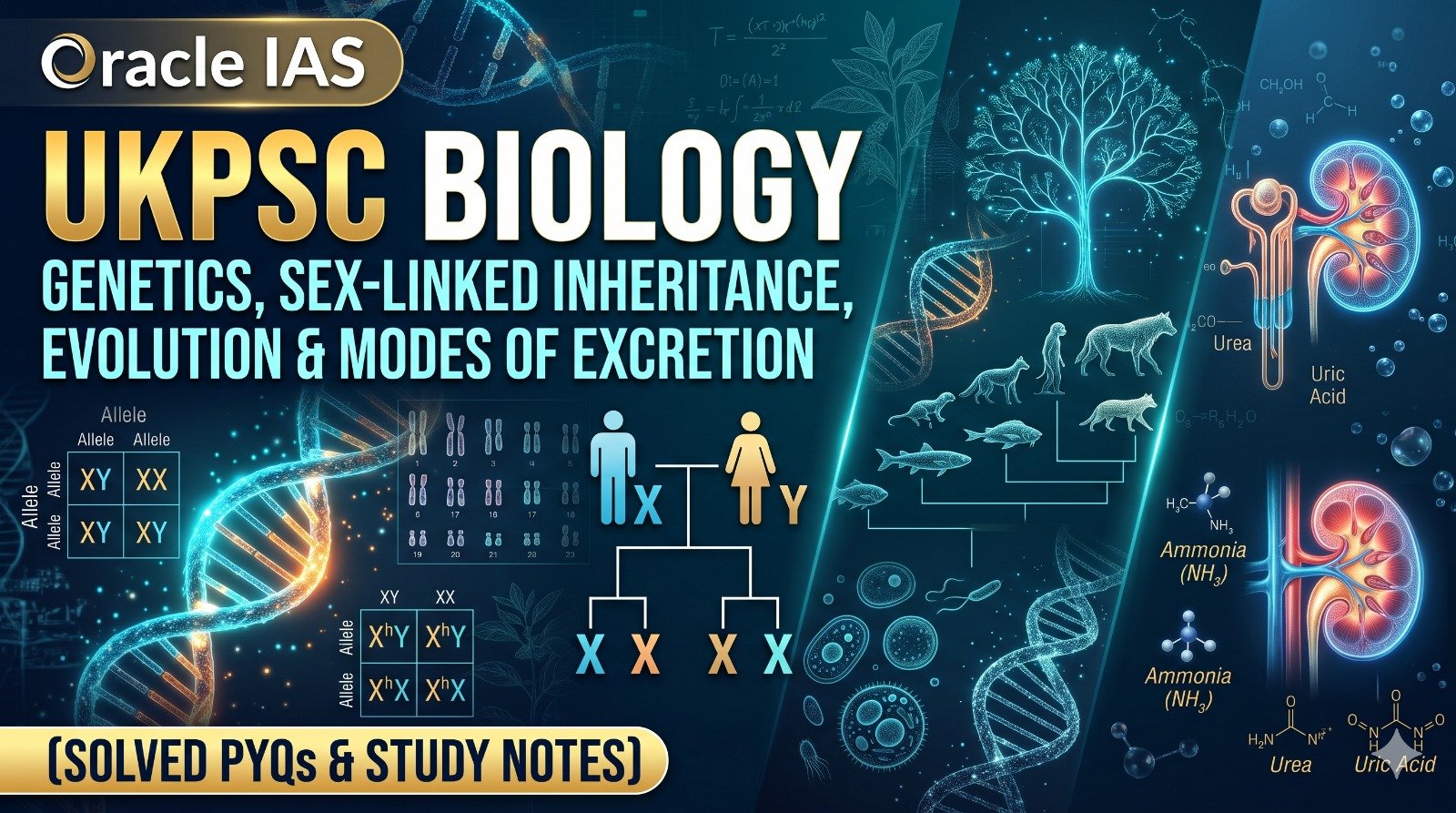
UKPSC Biology (Unit 3): Genetics, Sex-Linked Inheritance, Evolution & Modes of Excretion
Part of the UKPSC General Science & Technology Revision Series.
1.High-Yield Micro-Notes
- Modes of Nitrogenous Excretion: Animals are categorized based on their primary metabolic nitrogenous excretory product: Ammonotelic (excrete highly toxic, water-soluble ammonia requiring abundant water, e.g., bony freshwater fishes, aquatic amphibians), Ureotelic (excrete urea via the hepatic ornithine cycle, e.g., mammals, adult terrestrial amphibians, cartilaginous sharks), and Uricotelic (excrete virtually water-insoluble uric acid or guanine paste to conserve body water, e.g., birds, reptiles/lizards, terrestrial insects, and land snails).
- Sex-Linked Inheritance (Hemophilia & Color Blindness): Both classic Hemophilia (lack of Factor VIII in Hemophilia A or Factor IX in Hemophilia B) and Red-Green Color Blindness are X-linked recessive hereditary disorders. Because males are hemizygous ($X^c Y$), possessing only a single maternal X chromosome, the presence of one mutated allele produces full clinical expression. Females require two mutated alleles ($X^c X^c$) to express the disorder; a heterozygous female ($X^C X^c$) remains an asymptomatic carrier. In a cross between a color-blind male ($X^c Y$) and a genotypically normal female ($X^C X^C$ whose parents had normal vision), all sons are normal ($X^C Y$) and all daughters are carriers ($X^C X^c$), meaning 0% of the children are clinically color-blind.
- Recombinant DNA Technology & Genetic Engineering: Recombinant gene transfer relies heavily on two model bacterial workhorses: Escherichia coli (primary host for routine plasmid cloning vectors like pBR322) and Agrobacterium tumefaciens (soil bacterium harboring the Ti plasmid / tumor-inducing plasmid, used as a natural genetic engineer to introduce foreign T-DNA cassettes into dicotyledonous plant genomes). Modern molecular genetics isolates, cuts, and recombines genetic sequences via restriction endonucleases and DNA ligases (gene splicing), paving the way for targeted endonuclease technologies like CRISPR-Cas9.
2. Important facts you should know:
| Biological Concept / Entity | Taxonomic Class / Mode of Action | Key Mechanism / Genetic Rule |
| Uricotelic Excretion | Birds (Aves), Lizards/Snakes (Reptilia), Insects | Excretes paste-like uric acid pellets; minimizes biological water loss. |
| Hemophilia / Royal Disease | X-linked Recessive Hereditary Trait | Impairs blood coagulation cascade (Factor VIII/IX deficiency); predominantly affects males. |
| Color Blindness | X-linked Recessive Hereditary Trait | Defective opsin photopigment in retinal cone cells; criss-cross inheritance from mother to son. |
| Agrobacterium tumefaciens | Gram-negative Alphaproteobacteria | Ti plasmid transfers T-DNA into nuclear plant genomes for transgenic crop engineering. |
| Escherichia coli | Gram-negative Gammaproteobacteria | Standard laboratory prokaryotic host for amplifying recombinant plasmids (e.g., pBR322). |
3. Master Questions
Q1. The semi-solid, insoluble nitrogenous waste product ‘Uric Acid’ is the primary excretory output of which of the following animal groups?
[UKPCS Lower Pre 2021] [Direct Fact]
(a) Human mammals
(b) Birds only
(c) Desert lizards only
(d) Both Birds and Lizards
Q2. Which of the following medical conditions is classified as an inherited X-linked recessive hereditary disorder?
[UKPSC Pre 2006-07] [Direct Fact]
(a) Hemophilia
(b) Pulmonary Tuberculosis
(c) Cervical Cancer
(d) Amoebic Dysentery
Q3. In modern biotechnology, the core molecular process involving the selective cleavage and enzymatic recombination of foreign DNA fragments to modify an organism’s genome is termed:
[UKPSC Pre 2006-07] [Direct Fact]
(a) Gene analysis
(b) Gene mapping
(c) Gene splicing
(d) Gene synthesis
Q4. Which two bacterial species serve as foundational host and vector tools in classical genetic engineering and plant transgenic experiments?
[UKPSC Pre 2021] [Direct Fact]
(a) Nitrosomonas and Klebsiella
(b) Escherichia coli and Agrobacterium tumefaciens
(c) Nitrobacter and Azotobacter
(d) Rhizobium and Diplococcus
Q5. A marriage takes place between a color-blind male and a woman with normal vision whose parents also possessed completely normal eyesight. What is the phenotypic probability that their children will be clinically color-blind?
[UKPSC UDA/LDA Pre 2003] [Statement-Based]
(a) 25%
(b) 50%
(c) 100%
(d) 0% (UKPSC Key Error Note: Official key published as 50%)
4. Master Explanations & Answer Key
- Ans. (d)
- Direct Answer: Both birds and lizards (reptiles), along with terrestrial insects and land snails, are uricotelic organisms that excrete insoluble uric acid paste to conserve physiological water.
- Exam Trap / Distractor Alert: Mammals, including adult humans, are primary ureotelic organisms (excreting soluble urea via the kidneys); although humans synthesize small amounts of uric acid from purine nucleotide catabolism, uric acid is not their primary nitrogenous waste.
- High-Yield Extra Facts: Excreting ammonia requires roughly 300–500 mL of water per gram of nitrogen, urea requires 50 mL, and uric acid requires only about 1–10 mL of water per gram, making uricotelism a water-conserving evolutionary adaptation for terrestrial and aerial life.
- Ans. (a)
- Direct Answer: Hemophilia is a hereditary, congenital, sex-linked (X-linked) recessive bleeding disorder characterized by defective synthesis of blood clotting proteins (Factor VIII in Hemophilia A, Factor IX in Hemophilia B).
- Exam Trap / Distractor Alert: Tuberculosis is an infectious bacterial disease (Mycobacterium tuberculosis); Dysentery is caused by enteric bacteria (Shigella) or protozoans (Entamoeba histolytica); Cancer arises primarily from acquired somatic oncogenic mutations.
- High-Yield Extra Facts: Hemophilia is historically termed the “Royal Disease” because it was carried by Britain’s Queen Victoria and passed down through the royal dynasties of Russia, Spain, and Germany; males inherit the defective X chromosome exclusively from their mothers.
- Ans. (c)
- Direct Answer: Gene splicing is the recombinant DNA procedure wherein DNA strands are cleaved at targeted palindromic sequences using bacterial restriction endonucleases and covalently rejoined using DNA ligase.
- Exam Trap / Distractor Alert: Gene mapping refers to establishing the relative spatial positions and loci of genes along a chromosome, whereas gene splicing is the physical cutting and joining of genetic sequences.
- High-Yield Extra Facts: Paul Berg was awarded the 1980 Nobel Prize in Chemistry for creating the first recombinant DNA molecule via gene splicing; the natural cellular analogue is RNA splicing, where spliceosomes remove non-coding introns from pre-mRNA.
- Ans. (b)
- Direct Answer: Escherichia coli is the standard prokaryotic cellular factory used to clone and express recombinant plasmid vectors (such as pBR322), while Agrobacterium tumefaciens serves as the natural transformation vector for introducing foreign genetic sequences into plant cells via its tumor-inducing (Ti) plasmid.
- Exam Trap / Distractor Alert: Nitrosomonas and Nitrobacter are chemoautotrophic nitrifying bacteria involved in the terrestrial nitrogen cycle; Rhizobium is a symbiotic nitrogen fixer in legume root nodules.
- High-Yield Extra Facts: The transfer DNA (T-DNA) segment of the Ti plasmid integrates into the host plant’s nuclear chromosomal genome; genetic engineers disarm the Ti plasmid by removing crown-gall oncogenes while retaining the border repeats to deliver foreign recombinant traits.
- Ans. (d) [Official Exam Key Note: (b)]
- Direct Answer: Because the mother has normal vision and both of her parents had normal eyesight, her genotype is homozygous normal ($X^C X^C$). Crossing an affected color-blind male ($X^c Y$) with a homozygous normal female ($X^C X^C$) yields sons who receive the maternal $X^C$ ($X^C Y$, 100% normal) and daughters who receive the paternal $X^c$ and maternal $X^C$ ($X^C X^c$, 100% unaffected carriers). Therefore, 0% of their children are clinically color-blind.
- Exam Trap / Distractor Alert: In the historical UKPSC 2003 paper, the commission published 50% (b) as the official answer key by incorrectly assuming the mother was a heterozygous carrier ($X^C X^c$). If the question specifies that the mother’s parents had normal vision, she cannot be a carrier of this X-linked trait, making 0% the scientifically correct answer.
- High-Yield Extra Facts: X-linked recessive traits follow a “criss-cross” inheritance pattern: an affected father passes the mutant allele to all his daughters (making them obligate carriers), who may then pass the disease to 50% of their future sons.
Contact Oracle IAS:
Call/WhatsApp 9997453844 for details
Join Our Preparation program:

He is a bibliophile,accomplished writer and a fitness enthusiast.
- UKPSC Biology: Genetics, Sex-Linked Inheritance, Evolution & Modes of Excretion (Solved PYQs & Notes) - November 3, 2026
- UKPSC Biology: Biomolecules, Vitamins, Human Nutrition & Plant Minerals (Solved PYQs & Notes) - November 2, 2026
- UKPSC Biology: Branches of Biology, Cytology, Chromosomes & Cell Division (Solved PYQs & Notes) - November 2, 2026