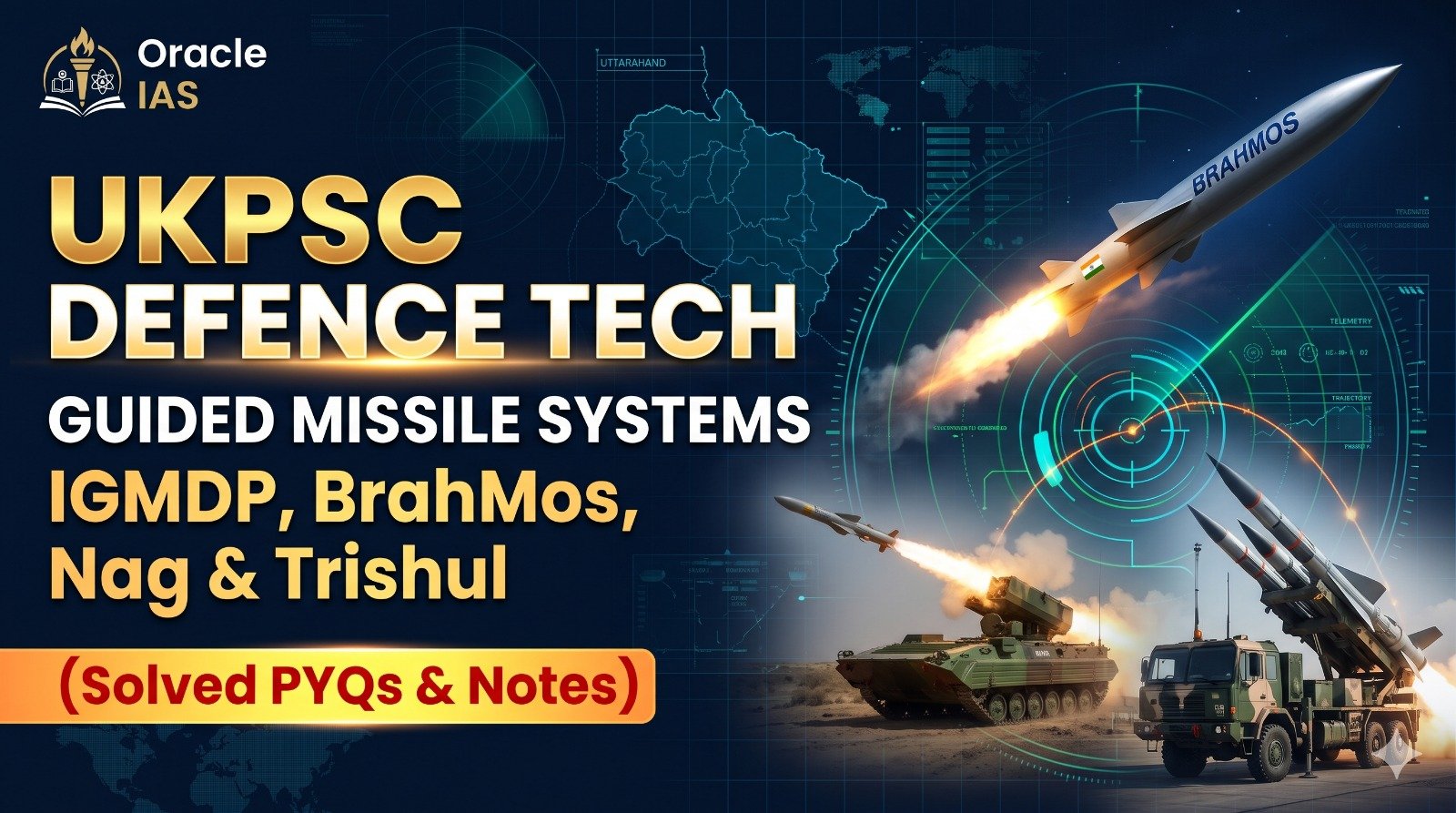
UKPSC Defence Tech (Unit 1): Guided Missile Systems, IGMDP, BrahMos, Nag & Trishul (Solved PYQs & Notes)
Part of the UKPSC General Science & Technology Revision Series.
1.High-Yield Micro-Notes
- Integrated Guided Missile Development Programme (IGMDP): Conceived by Dr. A.P.J. Abdul Kalam and sanctioned by the Government of India in 1983, the IGMDP aimed to achieve self-reliance in missile technology. It developed five core missile systems (acronym PATNA):
- Prithvi: Short-range, surface-to-surface tactical ballistic missile (liquid/solid propellant).
- Agni: Intermediate-to-intercontinental surface-to-surface ballistic missile (strategic deterrent).
- Trishul: Short-range, quick-reaction surface-to-air missile.
- Nag: Third-generation, “fire-and-forget” anti-tank guided missile.
- Akash: Medium-range, surface-to-air missile using an air-breathing ramjet propulsion system.
- Trishul Missile System: Developed as a quick-reaction, all-weather, low-level surface-to-air missile (SAM). Designed to counter sea-skimming anti-ship missiles and low-flying aircraft with a combat operational range between 500 meters and 9 km, operating at supersonic velocity (Mach 2).
- BrahMos Supersonic Cruise Missile: A joint development venture between India’s Defence Research and Development Organisation (DRDO) and Russia’s NPO Mashinostroyeniya (forming BrahMos Aerospace). The name is a portmanteau derived from two rivers: the Brahmaputra of India and the Moskva of Russia. It operates on a two-stage propulsion mechanism (solid propellant booster first stage, liquid ramjet sustainer second stage), achieving supersonic cruise speeds of Mach 2.8 to 3.0. It features a “fire-and-forget” trajectory with a launch envelope deployable across sea, sub-surface, land, and air-launched (Su-30MKI) platforms.
- Nag Anti-Tank Guided Missile (ATGM): A third-generation, all-weather, fire-and-forget anti-tank guided missile with an operational range of 500 meters to 4 km (and up to 7–8 km for the air-launched helicopter variant, Helina / Dhruvastra). Employs an active Imaging Infrared (IIR) focal plane array seeker operating in the 8–12 micron thermal band, capable of defeating modern explosive reactive armour (ERA) using a tandem shaped-charge high-explosive anti-tank (HEAT) warhead. The dedicated tracked armoured carrier variant is designated NAMICA (Nag Missile Carrier).
2. Important facts you should know:
| Missile System | Classification | Operational Range | Speed & Propulsion | Key Guidance / Architecture |
| Trishul | Surface-to-Air (SAM) | 500 m to 9 km | Supersonic (~Mach 2); 2-stage solid propellant | Command line-of-sight; low-level sea-skimmer interceptor. |
| BrahMos | Supersonic Cruise Missile | 290 km (extended to 450+ km) | Mach 2.8–3.0; Solid booster + Liquid ramjet | Active radar homing; multi-platform (land, sea, air, sub-surface). |
| Nag | Anti-Tank Guided Missile | 500 m to 4 km (Land); 7–8 km (Helina) | Subsonic; Solid rocket motor | Imaging Infrared (IIR) seeker; top-attack and direct-attack modes. |
| Agni (I–V) | Ballistic Missile (IRBM/ICBM) | 700 km (Agni-I) to 5,000+ km (Agni-V) | Hypersonic terminal entry; Solid composite propellant | Ring Laser Gyro INS + micro-navigation; cannisterized road mobility. |
| Prithvi (I–III) | Tactical Ballistic Missile | 150 km to 350 km | Liquid propellant (Prithvi I/II) | Inertial navigation; tactical battlefield battlefield support. |
3. Master Questions
Q1. The short-range, quick-reaction surface-to-air missile ‘Trishul’, test-fired from the Integrated Test Range at Chandipur, Odisha, is classified by flight speed as a:
[UKPSC Mains 2002-03] [Direct Fact]
(a) Subsonic Missile
(b) Supersonic Missile
(c) Hypersonic Missile
(d) Non-ballistic Drone
Q2. BrahMos, developed as a collaborative joint venture between India and Russia, is a:
[UKPSC UDA/LDA Pre 2003] [Direct Fact]
(a) Specialized reconnaissance aircraft
(b) Malicious military computer worm
(c) Supersonic cruise missile
(d) Nuclear-powered ballistic missile submarine
Q3. The indigenously developed ‘Nag’ missile system, built under the Integrated Guided Missile Development Programme (IGMDP) by DRDO, is classified as a/an:
[UKPSC AE 2007] [Direct Fact]
(a) Anti-tank guided missile
(b) Surface-to-Air missile
(c) Air-to-Ground missile
(d) Beyond-Visual-Range Air-to-Air missile
4. Master Explanations & Answer Key
- Ans. (b)
- Direct Answer: Trishul is a supersonic surface-to-air missile capable of flying at Mach 2, engineered with a quick reaction time to intercept low-flying targets and sea-skimming anti-ship missiles.
- Exam Trap / Distractor Alert: Subsonic missiles fly below Mach 0.8 (e.g., Nirbhay cruise missile); Supersonic missiles fly between Mach 1.2 and Mach 5.0 (Trishul, BrahMos); Hypersonic missiles fly at Mach 5 or higher (e.g., HSTDV testbed).
- High-Yield Extra Facts: While development challenges led DRDO to de-link Trishul from production in 2008, the dual-thrust solid propellant rocket motor and radar technologies developed during the program were incorporated into subsequent systems, including the Barak-8 (LRSAM/MRSAM) joint development and the Quick Reaction Surface-to-Air Missile (QRSAM).
- Ans. (c)
- Direct Answer: BrahMos is a medium-range supersonic cruise missile that can be launched from submarines, ships, aircraft, or land-based mobile autonomous launchers against surface and maritime targets.
- Exam Trap / Distractor Alert: BrahMos is a cruise missile (it flies along a non-ballistic trajectory within the atmosphere propelled by an air-breathing engine), not a ballistic missile; the naval submarine component is INS Arihant, not BrahMos.
- High-Yield Extra Facts: In 2016, upon India’s formal accession to the Missile Technology Control Regime (MTCR), the range restrictions capping BrahMos at 290 km were removed, enabling the development and testing of extended-range variants exceeding 450 to 500 km; the BrahMos-II program is currently developing a hypersonic variant powered by a scramjet engine.
- Ans. (a)
- Direct Answer: Nag is a third-generation, fire-and-forget anti-tank guided missile (ATGM) equipped with an Imaging Infrared (IIR) passive seeker and a tandem HEAT warhead designed to penetrate heavily armoured main battle tanks.
- Exam Trap / Distractor Alert: Akash is DRDO’s surface-to-air missile; Astra is the beyond-visual-range air-to-air missile; Nag is specifically the anti-tank weapon.
- High-Yield Extra Facts: The ground-launched carrier version of Nag is deployed on the BMP-2 amphibious infantry combat chassis known as NAMICA; the man-portable variant developed for infantry foot soldiers is designated MPATGM (Man-Portable Anti-Tank Guided Missile).
Contact Oracle IAS:
Call/WhatsApp 9997453844 for details
Join Our Preparation program:

He is a bibliophile,accomplished writer and a fitness enthusiast.
- UKPSC Defence Tech: Military RADAR, NAL Saras Aircraft & INS Tarkash Frigate (Solved PYQs & Notes) - November 27, 2026
- UKPSC Defence Tech: Guided Missile Systems, IGMDP, BrahMos, Nag & Trishul (Solved PYQs & Notes) - November 27, 2026
- UKPSC Space Tech: Indian Satellites, NavIC, Geostationary Orbits & Chandrayaan-3 (Solved PYQs & Notes) - November 27, 2026