Part of the UKPSC General Science & Technology Revision Series.
1. High-Yield Micro-Notes
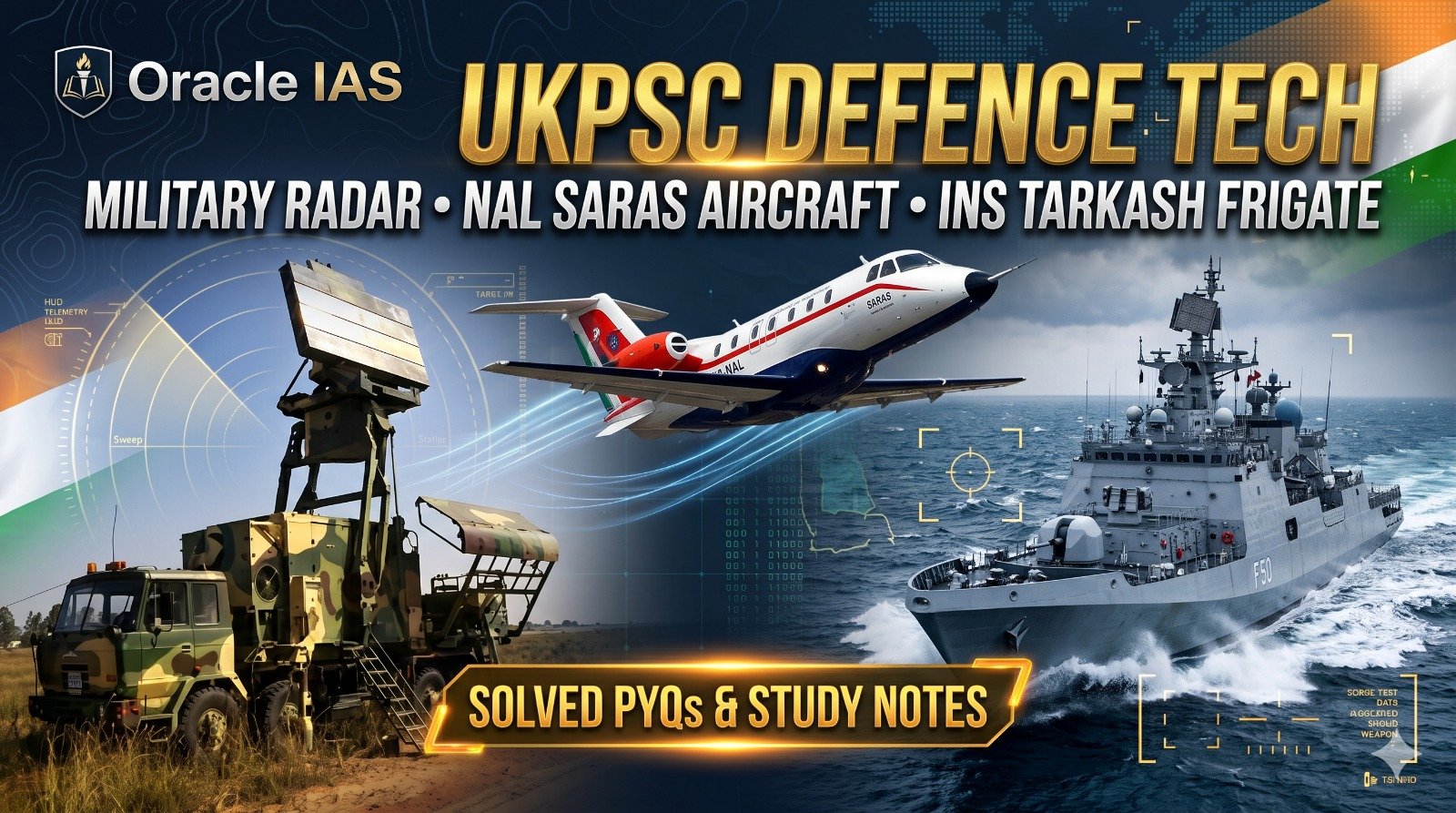
- RADAR Principles & Operating Bands: RADAR is an acronym for Radio Detection and Ranging. It operates by transmitting pulses of electromagnetic waves (typically within the microwave spectrum, spanning 1 GHz to 40 GHz across UHF, L, S, C, X, and Ku bands) into the atmosphere via a directional antenna. When the wave front encounters a metallic reflecting body (such as an aircraft airframe), a fraction of the energy scatters back to the receiver.
- Indigenous Civilian & Transport Aircraft (Saras): The NAL Saras is India’s first indigenous multi-role civilian passenger and light transport aircraft prototype, engineered and fabricated by the National Aerospace Laboratories (NAL), a CSIR constituent laboratory in Bengaluru. Named after the Indian Sarus Crane, the twin-turboprop pusher-configuration aircraft was designed for regional feeder connectivity, air ambulance services, and remote-area transport.
- Modern Stealth Naval Frigates (Talwar & Tarkash): INS Tarkash (F50) is an advanced, multi-role stealth guided-missile frigate of the Indian Navy belonging to the Talwar class (Batch II, Project 11356). Constructed at the Yantar Shipyard in Kaliningrad, Russia, and commissioned into the Indian Navy’s Western Fleet in November 2012, INS Tarkash features a reduced radar cross-section (stealth hull design) and is armed with vertical-launch systems for the BrahMos supersonic cruise missile and Shtil-1 surface-to-air missile systems.
2. Important facts you should know:
| Platform / Equipment | Manufacturer / Developer | Classification | Operational Role & Armament |
| RADAR | DRDO / BEL | Electromagnetic Detection System | Air-traffic tracking, surveillance, fire control using microwaves. |
| Saras | CSIR-NAL, Bengaluru | Light Transport Civilian Aircraft | 14–19 passenger regional transport with twin pusher turboprops. |
| INS Tarkash | Yantar Shipyard / Indian Navy | Stealth Guided-Missile Frigate | Talwar-class frigate carrying BrahMos supersonic cruise missiles. |
| LCA Tejas | HAL / ADA, Bengaluru | 4.5-Generation Light Combat Aircraft | Tailless delta-wing supersonic fighter armed with Astra and precision bombs. |
| ALH Dhruv | HAL, Bengaluru | Multi-role Utility Helicopter | Twin-engine utility helicopter with weaponized variants (Rudra, Prachand). |
3. Master Questions
Q1. What electromagnetic wave band is utilized by conventional surveillance and detection RADAR systems to trace the flight path and velocity of aircraft?
[UKPSC J 2008] [Direct Fact]
(a) Microwave radiation
(b) Electrostatic wave fields
(c) Ultrasonic compression waves
(d) Acoustic sound waves
Q2. The technical acronym ‘RADAR’ stands for:
[UKPSC Revenue Inspector 2023] [Direct Fact]
(a) Radio Detection and Ranging
(b) Radio Divergence and Ranging
(c) Radio Detection and Radiation
(d) Radial Distance and Ranging
Q3. The name ascribed to the first prototype of a multi-purpose civil passenger and light transport aircraft developed indigenously in India by the CSIR-NAL is:
[UKPSC UDA/LDA Pre 2003] [Direct Fact]
(a) Cheetal
(b) Chetak
(c) Mayur
(d) Saras
Q4. ‘INS Tarkash’, commissioned into active service by the Indian Navy, is a:
[UKPSC Combined SES 2021] [Direct Fact]
(a) Computer-simulated war game
(b) Mobile tactical tracking application
(c) Supersonic surface-to-surface missile
(d) Stealth Guided-Missile Frigate
4. Master Explanations & Answer Key
- Ans. (a)
- Direct Answer: Modern aviation RADAR systems use microwaves (electromagnetic waves ranging in frequency from 1 GHz to 40 GHz) because their shorter wavelengths allow narrow, focused beams that penetrate clouds, rain, and fog to detect distant moving metal airframes.
- Exam Trap / Distractor Alert: Ultrasonic and acoustic sound waves are mechanical waves that attenuate rapidly in air and cannot travel across long distances; SONAR (Sound Navigation and Ranging) uses acoustic waves in water, whereas RADAR uses electromagnetic microwaves in air.
- High-Yield Extra Facts: Active Electronically Scanned Array (AESA) radar systems, such as India’s indigenous Uttam AESA radar developed by DRDO’s Electronics and Radar Development Establishment (LRDE) for the Tejas fighter, steer hundreds of solid-state transmit/receive modules electronically without requiring mechanical dish rotation.
- Ans. (a)
- Direct Answer: RADAR stands for Radio Detection and Ranging, reflecting its primary function of detecting target presence and calculating range via reflected radio pulses.
- Exam Trap / Distractor Alert: Options substituting “Radiation” or “Divergence” are common exam traps; the correct term is always “Detection and Ranging.”
- High-Yield Extra Facts: Scottish physicist Sir Robert Watson-Watt is credited with developing the first practical ground radar system in 1935, which played a decisive role in the air defence of Great Britain during World War II.
- Ans. (d)
- Direct Answer: Saras is India’s first indigenous multi-role civilian passenger and light transport aircraft prototype, designed and built by the National Aerospace Laboratories (CSIR-NAL) in Bengaluru.
- Exam Trap / Distractor Alert: Chetak and Cheetal are single-engine utility light helicopters manufactured by Hindustan Aeronautics Limited (HAL); Saras is a fixed-wing multi-passenger transport aircraft.
- High-Yield Extra Facts: The upgraded Saras Mk-2 is engineered as a 19-seater regional commuter airliner to improve domestic air transport connectivity under the Government of India’s UDAN (Ude Desh ka Aam Naagrik) regional aviation scheme.
- Ans. (d)
- Direct Answer: INS Tarkash is a stealth guided-missile frigate belonging to the Talwar class of the Indian Navy, capable of conducting anti-air, anti-surface, and anti-submarine operations.
- Exam Trap / Distractor Alert: Do not confuse “Tarkash” the naval warship with military joint exercises (such as Exercise Tarkash, a joint counter-terrorism exercise conducted between the Indian National Security Guard and US Special Operations Forces).
- High-Yield Extra Facts: INS Tarkash played an active role in international evacuation efforts, including Operation Rahat (2015) in Yemen and Operation Kaveri (2023) in Sudan, evacuating stranded Indian nationals from active conflict zones.
Contact Oracle IAS:
Call/WhatsApp 9997453844 for details
Join Our Preparation program:
He is a bibliophile,accomplished writer and a fitness enthusiast.
- UKPSC Defence Tech: Military RADAR, NAL Saras Aircraft & INS Tarkash Frigate (Solved PYQs & Notes) - November 27, 2026
- UKPSC Defence Tech: Guided Missile Systems, IGMDP, BrahMos, Nag & Trishul (Solved PYQs & Notes) - November 27, 2026
- UKPSC Space Tech: Indian Satellites, NavIC, Geostationary Orbits & Chandrayaan-3 (Solved PYQs & Notes) - November 27, 2026