
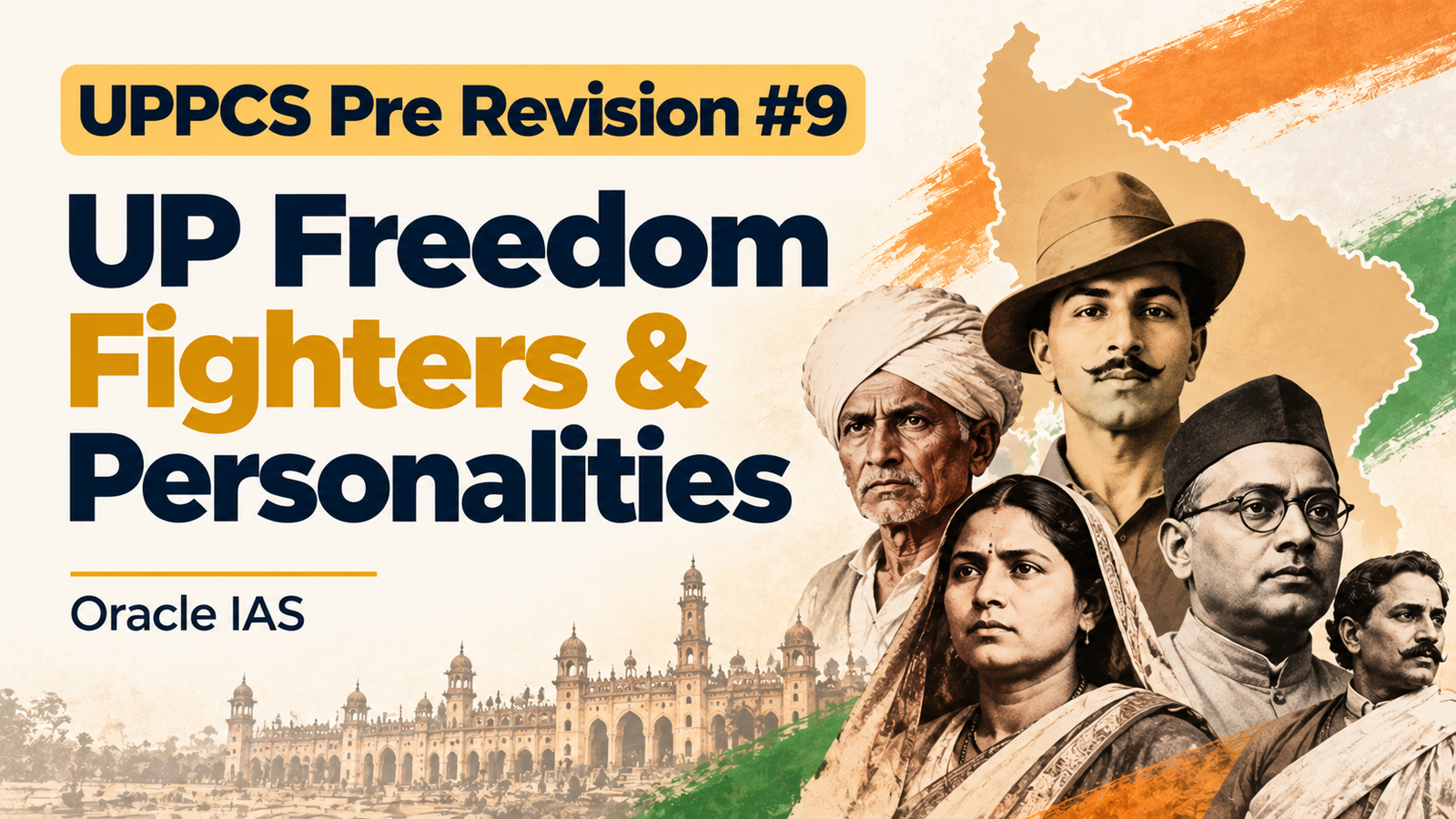
Uttar Pradesh played a central role in India’s freedom struggle, from the Revolt of 1857 to the revolutionary activities of the Kakori group, Gandhian mass movements, peasant uprisings and the Quit India Movement.
For UPPCS Prelims, focus on four dimensions: personality–district associations, organisations, movements and important dates. Also distinguish a person’s birthplace from the place where they worked, fought or were executed.
1. Timeline of the freedom struggle in Uttar Pradesh
| Year / date | Event | Significance |
|---|---|---|
| 1857–58 | Revolt of 1857 | Major centres included Meerut, Kanpur, Lucknow, Jhansi, Bareilly and Allahabad |
| 1916 | Lucknow Congress Session and Lucknow Pact | Congress–Muslim League agreement; session presided over by Ambica Charan Mazumdar |
| 1918 | Mainpuri Conspiracy | Revolutionary activity associated with Ram Prasad Bismil and Genda Lal Dixit |
| 1920 | Non-Cooperation Movement | Mass mobilisation across the United Provinces |
| 1920–21 | Awadh Kisan movement | Baba Ramchandra and local peasant leaders mobilised cultivators |
| 1921–22 | Eka movement | Agrarian protest associated with Madari Pasi in parts of Awadh |
| 4 February 1922 | Chauri Chaura incident | Violence in Gorakhpur district; Gandhi subsequently suspended Non-Cooperation |
| 9 August 1925 | Kakori Train Action | HRA revolutionaries targeted a government treasury train near Lucknow |
| 17 December 1927 | Rajendra Lahiri executed | Kakori case |
| 19 December 1927 | Bismil, Ashfaqulla Khan and Roshan Singh executed | Major revolutionary martyrs of the Kakori case |
| 1928 | Simon Commission protests and Nehru Report | Motilal Nehru chaired the committee associated with the report |
| 1929 | Lahore Congress | Jawaharlal Nehru presided; Purna Swaraj became the Congress goal |
| 1930–34 | Civil Disobedience Movement | Boycotts, demonstrations, tax resistance and arrests across UP |
| 25 March 1931 | Ganesh Shankar Vidyarthi died in Kanpur | Journalist and nationalist who tried to protect people during communal violence |
| August 1942 | Quit India Movement | Major protests; Ballia briefly challenged British district authority |
| 23 August 1942 | Doharia firing | Repression of protesters in present-day Gorakhpur district |
| 15 August 1947 | Independence | End of British rule |
2. Revolt of 1857: important UP personalities
The revolt combined military rebellion with resistance by rulers, taluqdars, peasants and local communities. Its causes included military grievances, annexation policies, land-related discontent and fears of interference with religious and social practices.
| Personality | Centre / district association | Contribution |
|---|---|---|
| Mangal Pandey | Born in Nagwa, present-day Ballia; action at Barrackpore | His action on 29 March 1857 preceded the widespread uprising |
| Begum Hazrat Mahal | Lucknow | Led resistance in Awadh and supported the proclamation of Birjis Qadr |
| Rani Lakshmibai | Jhansi | Led resistance against British forces; died near Gwalior in 1858 |
| Jhalkari Bai | Jhansi | Remembered for her role in the defence of Jhansi |
| Uda Devi | Sikandar Bagh, Lucknow | Associated with resistance during the recapture of Lucknow |
| Maulvi Ahmadullah Shah | Faizabad and Awadh | Important religious and military leader |
| Nana Sahib | Kanpur | Led resistance; aggrieved by refusal to continue his adoptive father’s pension |
| Tantia Tope | Kanpur and central India | Major rebel commander who continued resistance after early defeats |
| Azimullah Khan | Kanpur | Adviser and associate of Nana Sahib |
| Khan Bahadur Khan | Bareilly | Led resistance in Rohilkhand |
| Maulvi Liaquat Ali | Allahabad (Prayagraj) | Rebel leader associated with Khusro Bagh |
| Shah Mal | Baraut, present-day Baghpat | Mobilised peasants and village communities |
| Dhan Singh Gurjar | Meerut | Remembered for his role in the local uprising |
| Walidad Khan | Malagarh, Bulandshahr region | Led local resistance |
| Mehndi Hasan | Sultanpur | Organised resistance in Awadh |
| Maulana Fazle Haq Khairabadi | Khairabad, Sitapur district | Religious scholar who opposed British rule and was imprisoned in the Andamans |
3. National leaders associated with Uttar Pradesh
Madan Mohan Malaviya (1861–1946)
Known as Mahamana, Malaviya was an educationist, lawyer, journalist and nationalist.
- Principal founder and organiser of Banaras Hindu University (BHU), established in 1916.
- Served as President of the Indian National Congress four times: 1909, 1918, 1932 and 1933.
- Promoted national education, public service and constitutional reform.
- Closely associated with Varanasi and the development of BHU.
Motilal Nehru (1861–1931)
A leading lawyer and Congress politician associated with Allahabad (Prayagraj).
- Congress president in 1919 and 1928.
- Chaired the committee associated with the Nehru Report of 1928.
- Co-founded the Swaraj Party with C.R. Das in 1923.
- Anand Bhawan and Swaraj Bhawan in Allahabad became important centres of nationalist activity.
Jawaharlal Nehru (1889–1964)
Born in Allahabad on 14 November 1889, Nehru became a leading figure in the national movement.
- Participated in the Non-Cooperation Movement.
- Worked among peasants in the United Provinces.
- Took part in protests against the Simon Commission.
- Presided over the Lahore Congress of 1929, where Purna Swaraj was adopted.
- Participated in Civil Disobedience and Quit India activities and was repeatedly imprisoned.
- Became India’s first Prime Minister in 1947.
Prelims distinction: Motilal Nehru is associated with the Nehru Report; Jawaharlal Nehru presided over the Lahore Congress of 1929.
4. Revolutionary nationalism and the Kakori group
The revolutionary movement was particularly active in Shahjahanpur, Kanpur, Lucknow, Allahabad and Varanasi.
Ram Prasad Bismil (1897–1927)
Born in Shahjahanpur, Bismil was a revolutionary, writer and poet.
- Associated with the Mainpuri Conspiracy of 1918.
- Helped establish the Hindustan Republican Association (HRA).
- Participated in the Kakori Train Action on 9 August 1925.
- Popularised patriotic revolutionary poetry.
- Executed at Gorakhpur Jail on 19 December 1927.
Ashfaqulla Khan (1900–1927)
Born in Shahjahanpur, Ashfaqulla Khan worked with Bismil and other HRA revolutionaries. He participated in the Kakori action and was executed at Faizabad Jail on 19 December 1927. His partnership with Bismil is an important example of interfaith cooperation within the revolutionary movement.
Thakur Roshan Singh (1892–1927)
Associated with the revolutionary movement and the Kakori case, Roshan Singh was executed at Allahabad on 19 December 1927. He was convicted despite not being present on the train during the action.
Rajendra Nath Lahiri (1901–1927)
A member of the revolutionary movement, Lahiri was executed at Gonda Jail on 17 December 1927, two days before the other three principal Kakori martyrs.
Kakori Train Action: facts at a glance
| Fact | Detail |
|---|---|
| Date | 9 August 1925 |
| Location | Kakori, near Lucknow |
| Organisation | Hindustan Republican Association |
| Objective | Obtain government treasury funds for revolutionary activity |
| Principal revolutionaries associated with the case | Ram Prasad Bismil, Ashfaqulla Khan, Rajendra Lahiri and Roshan Singh |
| Execution dates | Lahiri: 17 December 1927; Bismil, Ashfaqulla Khan and Roshan Singh: 19 December 1927 |
5. Other revolutionaries and nationalist journalists
| Personality | UP association | Contribution |
|---|---|---|
| Chandrashekhar Azad | Banaras and Allahabad | Revolutionary leader; died at Alfred Park, Allahabad, on 27 February 1931 |
| Sachindra Nath Sanyal | Varanasi | Important revolutionary organiser associated with the HRA |
| Genda Lal Dixit | Mainpuri and Auraiya region | Revolutionary organiser associated with the Mainpuri Conspiracy |
| Jogesh Chandra Chatterjee | Revolutionary networks including Kanpur | Associated with the organisation of revolutionary activity |
| Durga Devi Vohra (Durga Bhabhi) | Revolutionary networks | Supported revolutionary operations and helped Bhagat Singh escape after the Saunders killing |
| Shiv Verma | Hardoi district | Revolutionary and member of the HSRA |
| Ganesh Shankar Vidyarthi | Active in Kanpur | Journalist, nationalist and editor of Pratap |
Ganesh Shankar Vidyarthi (1890–1931)
Vidyarthi used journalism to challenge colonial repression and highlight social injustice.
- Edited the Hindi newspaper Pratap.
- Supported nationalist activity and was imprisoned for his writings.
- Tried to protect people during communal violence in Kanpur.
- Died on 25 March 1931.
Chandrashekhar Azad
Azad was born in Bhavra, present-day Madhya Pradesh, but became closely associated with revolutionary activity in Uttar Pradesh. He worked with the HRA and later the HSRA. He died at Alfred Park in Allahabad on 27 February 1931.
Exam trap: Azad’s birthplace was outside UP; Allahabad was the site of his death.
6. Peasant movements in Uttar Pradesh
Agrarian grievances—high rents, revenue demands, tenancy insecurity and landlord exploitation—were important in the nationalist period. Peasant movements sometimes worked with Congress organisations but also developed independent local leadership.
Baba Ramchandra and the Awadh Kisan movement
Baba Ramchandra, born Shridhar Balwant Jodhpurkar, became a major organiser of peasants in Awadh.
- Mobilised cultivators against high rents and oppressive practices.
- Helped organise meetings and peasant associations.
- Connected agrarian demands with the broader nationalist movement.
- Worked alongside local peasant leaders and, at different stages, Congress figures including Jawaharlal Nehru.
The Awadh Kisan Sabha developed in 1920.
Madari Pasi and the Eka movement
The Eka movement developed in parts of Hardoi, Sitapur and neighbouring areas during 1921–22.
Its grievances included excessive rents, landlord exploitation and agrarian insecurity. Madari Pasi became one of its best-known leaders.
Distinction: The Awadh Kisan movement and the Eka movement were related to agrarian unrest but were not the same organisation or campaign.
7. Gandhian mass movements in UP
Non-Cooperation Movement (1920–22)
The movement called for the boycott of colonial institutions, titles and foreign goods. UP saw participation by students, lawyers, peasants, urban workers and Congress volunteers.
Chauri Chaura (4 February 1922)
At Chauri Chaura in Gorakhpur district, a protest escalated into violence after police fired on demonstrators. The crowd attacked and burned a police station, killing policemen inside.
- Date: 4 February 1922.
- Location: Chauri Chaura, Gorakhpur district.
- Consequence: Gandhi suspended the Non-Cooperation Movement on 12 February 1922.
Civil Disobedience Movement (1930–34)
The movement involved defiance of selected colonial laws, boycotts, demonstrations and tax resistance. In UP, Congress workers and local volunteers organised protests, while peasant grievances remained an important part of the political context.
Quit India Movement (1942)
Following the demand for an end to British rule in August 1942, protests spread through UP. Some areas witnessed strikes, attacks on colonial administrative infrastructure and attempts to establish alternative local authority.
Ballia: Chittu Pandey
Chittu Pandey, known as the Sher-e-Ballia, became a prominent leader of the 1942 uprising. Protesters briefly challenged British district authority and established a form of parallel administration before British forces reasserted control.
Doharia firing
On 23 August 1942, firing on protesters at Doharia in present-day Gorakhpur district became an important local episode of the Quit India Movement.
UPPCS association: Ballia–Chittu Pandey–parallel government–Quit India Movement.
8. Women freedom fighters associated with UP
| Personality | Association | Contribution |
|---|---|---|
| Begum Hazrat Mahal | Lucknow | Led resistance during the Revolt of 1857 |
| Rani Lakshmibai | Jhansi | Military resistance in 1857–58 |
| Jhalkari Bai | Jhansi | Remembered for her role in the defence of Jhansi |
| Uda Devi | Lucknow | Associated with the fighting at Sikandar Bagh |
| Durga Devi Vohra (Durga Bhabhi) | Revolutionary networks | Supported revolutionary activities |
| Kamala Nehru | Allahabad and national movement | Participated in nationalist mobilisation and civil disobedience |
| Vijay Lakshmi Pandit | Born in Allahabad | Nationalist and political leader; later a diplomat |
| Sucheta Kriplani | Freedom movement and UP politics | Participated in Quit India and underground activity; later became UP’s first woman Chief Minister |
| Sarojini Naidu | Congress politics; Kanpur Session | Presided over the 1925 Congress Session at Kanpur; first Indian woman to preside over the Congress |
9. Congress sessions and important political developments
| Event | Year | Key fact |
|---|---|---|
| Lucknow Congress Session | 1916 | President: Ambica Charan Mazumdar |
| Lucknow Pact | 1916 | Agreement between Congress and the Muslim League on constitutional demands and representation |
| Kanpur Congress Session | 1925 | President: Sarojini Naidu |
| Nehru Report | 1928 | Associated with the committee chaired by Motilal Nehru |
| Lahore Congress Session | 1929 | President: Jawaharlal Nehru; Purna Swaraj adopted |
| Lucknow Congress Session | 1936 | President: Jawaharlal Nehru |
10. District-wise freedom struggle associations
| District / place | Personality or event | Key fact |
|---|---|---|
| Ballia | Mangal Pandey | Born in Nagwa; famous military action at Barrackpore |
| Ballia | Chittu Pandey | Parallel government during Quit India, 1942 |
| Meerut | Dhan Singh Gurjar | Associated with the outbreak of 1857 |
| Baghpat | Shah Mal | Peasant mobilisation around Baraut |
| Lucknow | Begum Hazrat Mahal | Resistance in Awadh |
| Lucknow | Kakori Train Action | 9 August 1925 |
| Jhansi | Rani Lakshmibai | Resistance during 1857–58 |
| Shahjahanpur | Ram Prasad Bismil | Revolutionary; executed at Gorakhpur |
| Shahjahanpur | Ashfaqulla Khan | Revolutionary; executed at Faizabad |
| Allahabad / Prayagraj | Maulvi Liaquat Ali | Rebel leader in 1857 |
| Allahabad / Prayagraj | Chandrashekhar Azad | Died at Alfred Park in 1931 |
| Allahabad / Prayagraj | Motilal and Jawaharlal Nehru | Nationalist politics and Anand Bhawan |
| Kanpur | Ganesh Shankar Vidyarthi | Editor of Pratap; died in 1931 |
| Kanpur | Sarojini Naidu | Congress president at the 1925 session |
| Gorakhpur | Chauri Chaura | 4 February 1922 |
| Gorakhpur | Ram Prasad Bismil | Executed in Gorakhpur Jail |
| Sitapur | Maulana Fazle Haq Khairabadi | Associated with Khairabad and the 1857 resistance |
| Faizabad | Maulvi Ahmadullah Shah | Major leader of the Awadh uprising |
| Faizabad | Ashfaqulla Khan | Executed in Faizabad Jail |
| Bareilly | Khan Bahadur Khan | Resistance in Rohilkhand |
| Bulandshahr | Walidad Khan | Malagarh resistance in 1857 |
| Sultanpur | Mehndi Hasan | Awadh resistance |
| Varanasi | Madan Mohan Malaviya | BHU and nationalist politics |
| Varanasi | Sachindra Nath Sanyal | Revolutionary organiser |
| Hardoi–Sitapur | Madari Pasi | Eka movement |
| Awadh | Baba Ramchandra | Kisan movement |
| Gonda | Rajendra Lahiri | Executed in Gonda Jail |
| Fatehpur | Dariyaw Singh and Jodha Singh Ataiya | Local resistance during 1857–58 |
Note: A leader’s birthplace, area of activity and place of execution can be different. Read the exact wording of any matching question carefully.
11. Important dates and revolutionary executions
| Date | Event |
|---|---|
| 10 May 1857 | Widespread uprising began at Meerut |
| 1916 | Lucknow Congress Session and Lucknow Pact |
| 1918 | Mainpuri Conspiracy |
| 4 February 1922 | Chauri Chaura incident |
| 12 February 1922 | Gandhi suspended Non-Cooperation |
| 9 August 1925 | Kakori Train Action |
| 17 December 1927 | Rajendra Lahiri executed |
| 19 December 1927 | Ram Prasad Bismil, Ashfaqulla Khan and Roshan Singh executed |
| 1928 | Nehru Report |
| 1929 | Lahore Congress and Purna Swaraj |
| 27 February 1931 | Chandrashekhar Azad died at Alfred Park, Allahabad |
| 25 March 1931 | Ganesh Shankar Vidyarthi died in Kanpur |
| August 1942 | Quit India uprising and Ballia parallel government |
| 23 August 1942 | Doharia firing |
| 15 August 1947 | Independence |
Contact:
Call/WhatsApp 9997453844 for details
Join Our Preparation program:
He is a bibliophile,accomplished writer and a fitness enthusiast.
- UPPCS 2026 Revision Quiz #2 - October 21, 2026
- UPPCS Pre Revision #10: UP Freedom Fighters & Personalities - October 21, 2026
- UKPSC Physics: Magnetism, Magnetic Dipoles & Electromagnetic Induction (Solved PYQs & Notes) - October 21, 2026
 WhatsApp us