
UKPSC Physics: Magnetism, Magnetic Dipoles & Electromagnetic Induction
1. High-Yield Micro-Notes
- Fundamental Laws of Magnetism: Magnetic poles always exist in dipoles (isolated magnetic monopoles do not exist in nature). Like poles repel each other, while unlike poles attract each other. The magnetic force between two magnetic poles follows Coulomb’s Inverse Square Law of Magnetism (F = (μ₀ / 4π) · (m₁ · m₂ / r²)).
- Electromagnetic Induction (EMI): Discovered by Michael Faraday in 1831, EMI is the physical process of generating an induced electromotive force (EMF) and current in a closed conductor due to a change in the magnetic flux linked with it (often produced via relative motion between a magnet and a coil). The induced EMF is given by Faraday’s Law (e = -dΦ/dt), where the negative sign denotes Lenz’s Law (the direction of induced current always opposes the change in magnetic flux producing it, obeying conservation of energy).
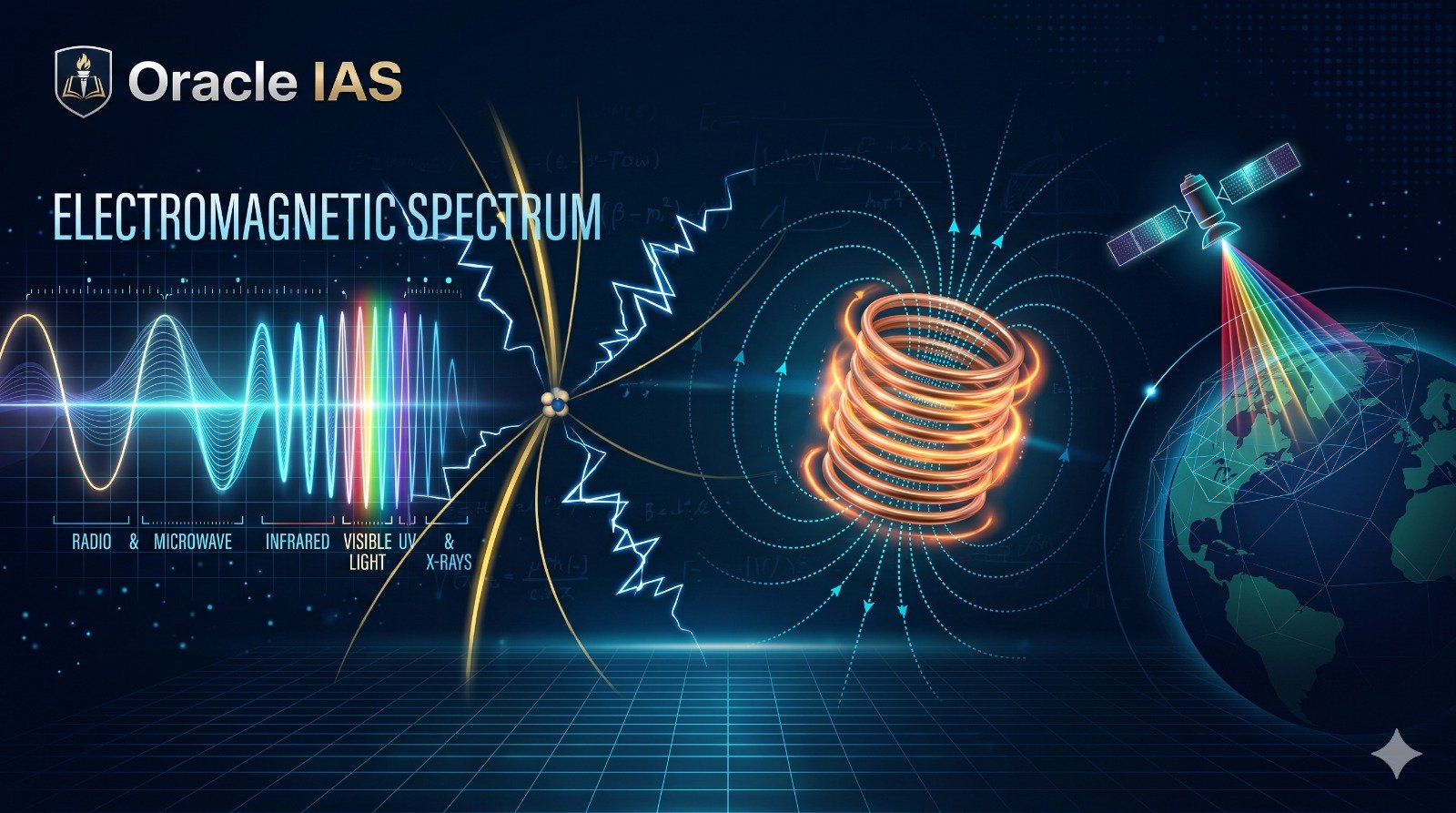
- Remote Sensing & The Electromagnetic Spectrum: Satellite and airborne remote sensing systems operate across the electromagnetic (EM) wave spectrum, utilizing reflected solar radiation or emitted thermal radiation (optical, near-infrared, shortwave infrared, thermal infrared, and active/passive microwaves).
- Wave Classification (EM Radiation vs. Nuclear Particulate Emissions): The classical electromagnetic wave spectrum includes (in order of increasing wavelength): Gamma rays, X-rays, Ultraviolet rays, Visible light (0.4 to 0.7 µm), Infrared rays, Microwaves, and Radio waves. In contrast, alpha (α) rays (fast-moving Helium nuclei: ⁴₂He²⁺) and beta (β) rays (high-speed electrons ⁰₋₁e or positrons) consist of energetic subatomic particles with rest mass and electrical charge—they are not electromagnetic waves.
2. Important facts you should know:
| Radiation / Physical Phenomenon | Nature & Constituent | Electrical Charge / Mass | Propagation & Media Requirement |
| Electromagnetic Waves (X-rays, IR, Light) | Coupled oscillating electric and magnetic fields | Zero net rest mass; uncharged photons | Can traverse vacuum at speed c (3 × 10⁸ m/s) |
| Alpha (α) Particles | Helium-4 nuclei (2 protons + 2 neutrons) | +2 elementary charge; mass ≈ 4 amu | Particulate ionizing radiation; deflected by E/B fields |
| Beta (β) Particles | High-energy energetic electrons or positrons | -1e (electron) or +1e (positron); negligible mass | Particulate ionizing radiation; deflected by E/B fields |
| Electromagnetic Induction | Production of induced EMF via dΦ/dt | Macroscopic physical phenomenon | Governs dynamos, generators, and induction transformers |
| Remote Sensing Spectral Bands | Reflected/emitted EM flux (VIS, NIR, TIR, Microwave) | Neutral electromagnetic quanta | Utilizes atmospheric transmission windows |
3. Master Questions
Q1. Aerospace and satellite-based remote sensing technologies capture geospatial information from Earth’s surface primarily by utilizing:
[UKPSC Pre 2021] [Direct Fact]
(a) Electrostatic charge waves
(b) SONAR acoustic waves
(c) Highly penetrating Cosmic rays
(d) Electromagnetic Waves
Q2. Which of the following forms of radiation is NOT an electromagnetic wave?
[UKPSC Mains 2010-11] [Direct Fact]
(a) Alpha (α) Rays
(b) Beta (β) Rays
(c) Infrared Rays
(d) X-Rays
Q3. When two identical, like magnetic poles (such as North pole to North pole) are positioned in close physical proximity, they:
[UKPSC RO/ARO Pre 2022] [Direct Fact]
(a) Repel each other
(b) Attract each other
(c) First attract and subsequently repel each other
(d) Exert zero resultant magnetic force on one another
Q4. The physical phenomenon of Electromagnetic Induction (EMI) is defined as:
[UKPSC Revenue Inspector 2023] [Direct Fact]
(a) The process of transferring static electrostatic charge to a neutral body
(b) The generation of a steady magnetic field around a current-carrying straight wire
(c) The production of an induced electric current in a closed coil caused by relative motion or variation in magnetic flux
(d) The mechanical rotation of an armature coil inside a direct-current motor
4. Master Explanations & Answer Key
- Ans. (d)
- Direct Answer: Satellite remote sensing systems operate by measuring reflected, scattered, or emitted electromagnetic waves across visible, infrared, and microwave wavelengths.
- Exam Trap / Distractor Alert: SONAR uses mechanical acoustic waves through water, not air or space; gamma rays are too hazardous and absorbed by high atmosphere layers, making them unsuitable for terrestrial remote mapping.
- High-Yield Extra Facts: The visible spectrum used in optical remote sensing extends from 0.4 µm (violet) to 0.7 µm (red); the Indian Institute of Remote Sensing (IIRS), a constituent unit of ISRO, is headquartered in Dehradun, Uttarakhand.
- Ans. (a) [Note: Both (a) and (b) are particulate radiations]
- Direct Answer: Alpha (α) rays are streams of doubly-ionized helium nuclei (composed of 2 protons and 2 neutrons), meaning they are particulate nuclear emissions rather than electromagnetic waves.
- Exam Trap / Distractor Alert: In standard nuclear physics, both alpha (α) and beta (β) rays consist of matter particles carrying mass and electrical charge, whereas gamma rays, X-rays, and infrared rays are true massless electromagnetic waves. In single-choice exam formats, alpha rays are marked as primary because of their composite nuclear mass (4 amu).
- High-Yield Extra Facts: Alpha particles have the highest ionizing power but low penetrating depth (stopped by a single sheet of paper); gamma rays have no charge or mass and possess the highest penetrating power through matter.
- Ans. (a)
- Direct Answer: In classical magnetostatics, like magnetic poles (North–North or South–South) repel each other, whereas unlike magnetic poles (North–South) attract.
- Exam Trap / Distractor Alert: Magnetic lines of force never intersect; when like poles approach each other, their field lines run in opposite directions and curve away laterally, creating mutual repulsion.
- High-Yield Extra Facts: Breaking a bar magnet in half does not isolate the poles; each fragment forms its own dipole with both a North and a South pole, confirming Gauss’s Law for Magnetism (div B = 0).
- Ans. (c)
- Direct Answer: Electromagnetic induction is the generation of an electromotive force (EMF) and resulting electric current across an electrical conductor when it experiences a time-varying magnetic flux (e = -dΦ/dt).
- Exam Trap / Distractor Alert: Generating a magnetic field from an electric current is Oersted’s discovery of the magnetic effect of electric current, whereas electromagnetic induction is Faraday’s discovery of the reverse process (generating electricity from changing magnetic fields).
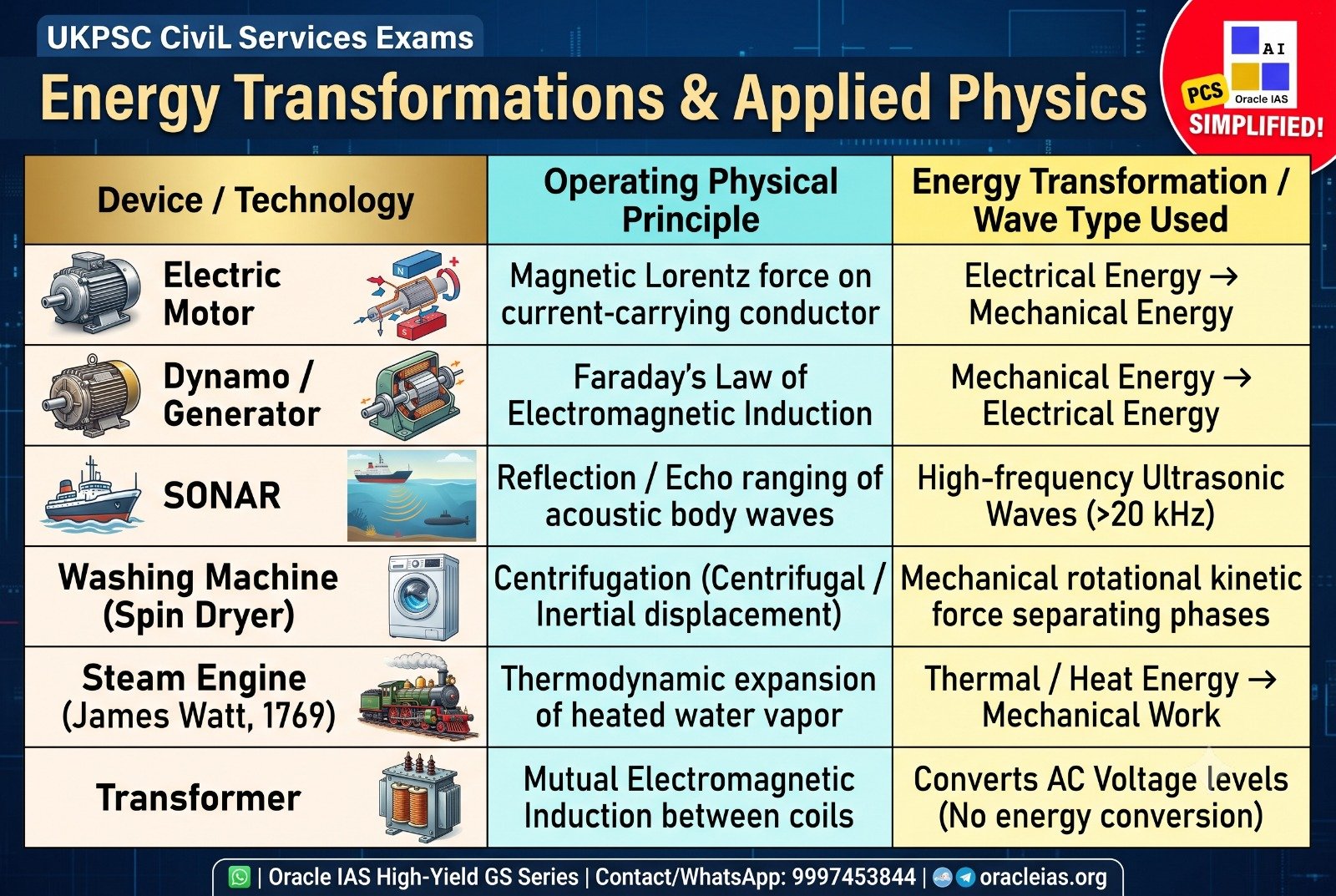
- High-Yield Extra Facts: Practical applications of electromagnetic induction include electric power alternators, dynamos, induction cooktops, and step-up/step-down transformers; the direction of induced current is predicted using Fleming’s Right-Hand Rule.
Contact Oracle IAS:
Call/WhatsApp 9997453844 for details
Join Our Preparation program:

He is a bibliophile,accomplished writer and a fitness enthusiast.
- UKPSC Physics: Magnetism, Magnetic Dipoles & Electromagnetic Induction (Solved PYQs & Notes) - October 21, 2026
- UPPCS 2026 Pre Revision Quiz #1 - October 19, 2026
- UKPSC Physics: Electricity, Magnetism & Electronics (Solved PYQs & Notes) - October 19, 2026
 WhatsApp us