
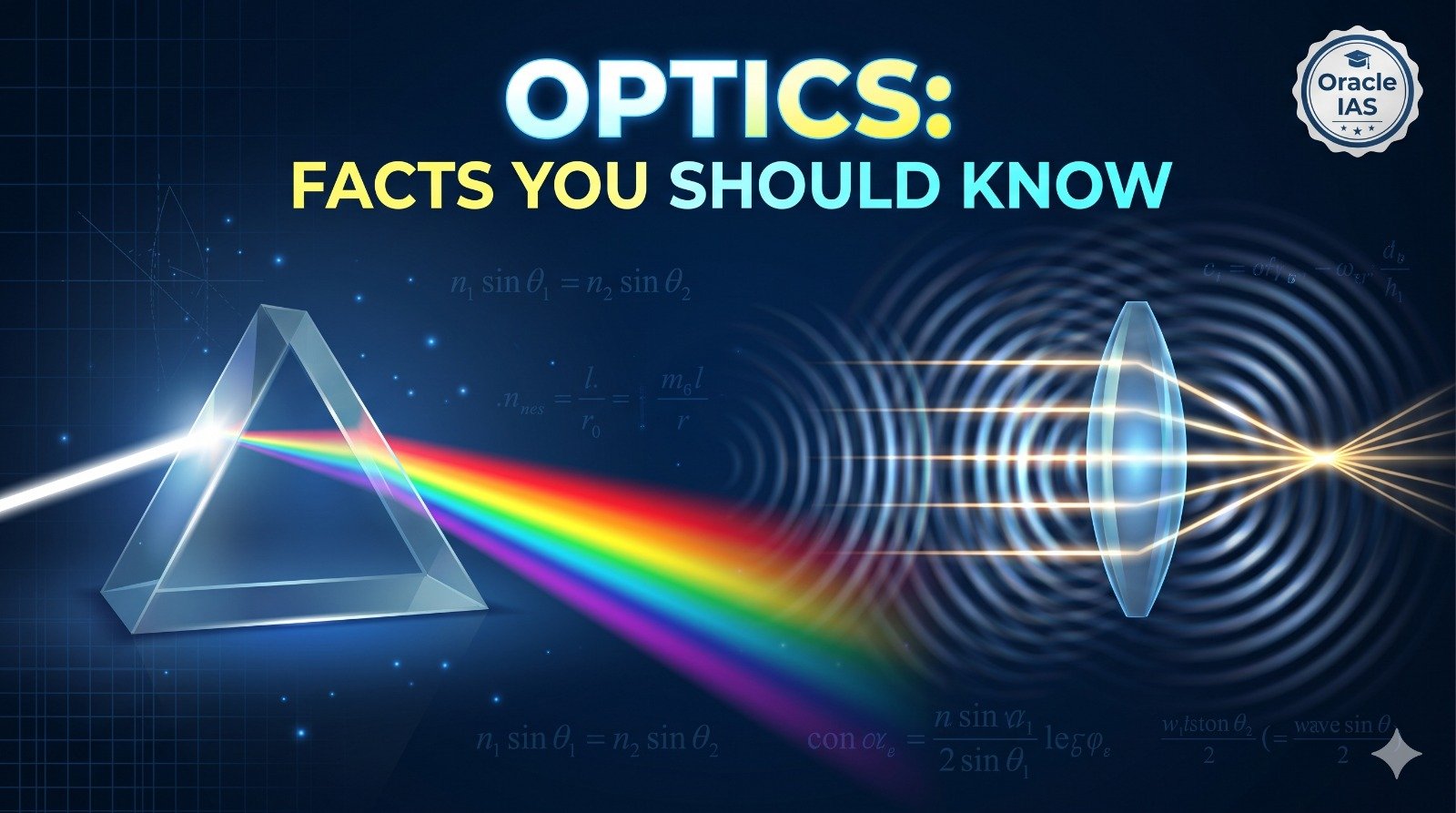
UKPSC Physics: Optics, Light, Reflection, Refraction & Human Vision
1. High-Yield Micro-Notes
- Wave Nature & Interference: In Young’s Double Slit Experiment (YDSE), the fringe separation (fringe width) is given by β = λ·D / d, where λ is wavelength, D is screen distance, and d is slit separation. Reducing slit spacing or increasing screen distance widens the interference fringes.
- Rayleigh Scattering & Atmospheric Phenomena: Scattering intensity is inversely proportional to the fourth power of wavelength (I ∝ 1/λ⁴). Shorter wavelengths (blue/violet) scatter far more strongly than longer wavelengths (red/orange). This explains why the daytime sky appears blue and why the Sun appears red at sunrise and sunset (longer atmospheric path leaves only least-scattered red rays). In the absence of an atmosphere (e.g., from high-altitude aircraft, space, or the Moon), scattering cannot occur, causing the sky to appear black.
- Dispersion vs. Scattering (Rainbow Mechanics): Rainbow formation is driven by atmospheric water droplets acting as tiny prisms through refraction, dispersion, and internal reflection—not scattering. In the visible spectrum (VIBGYOR), violet light has the shortest wavelength, highest frequency, highest refractive index in glass, and slowest speed in dense media. Conversely, red light has the longest wavelength, lowest refractive index, and fastest speed in glass.
- Optical Devices & Mirrors: Convex mirrors are universally used as vehicle rear-view mirrors because they form erect, diminished virtual images and provide a significantly wider field of view. Thin lenses placed in direct contact have an additive combined optical power: P = D₁ + D₂ (measured in Diopters).
- Physiological Optics & Color Vision: The real, inverted image of an object is focused onto the retina (acting as a photosensitive screen). The human eye exhibits maximum photopic sensitivity to green-yellow light (≈ 555 nm). The primary additive colors of light used in television screens and display monitors are Red, Green, and Blue (RGB). An object displays color by selective reflection: a red flower illuminated solely by monochromatic green light reflects nothing and appears black, whereas a white garment appears white because it reflects all incident visible wavelengths.
2. Facts you should know:
| Optical Parameter / Phenomenon | Dominant Color / Formula | Physical Mechanism / Governing Law |
| Visible Spectrum Extremes | Violet (≈ 400 nm) to Red (≈ 700 nm) | Violet: minimum λ, maximum frequency; Red: maximum λ, minimum frequency. |
| Speed of Light in Glass | Red (Fastest) > Violet (Slowest) | Velocity v = c / n; refractive index n is highest for violet and lowest for red (Cauchy’s equation). |
| Rayleigh Scattering Law | Scattering ∝ 1/λ⁴ | Rayleigh scattering by sub-micron atmospheric molecules; responsible for blue sky and red twilight. |
| YDSE Fringe Width | β = λ·D / d | Linear separation between adjacent bright or dark constructive/destructive bands. |
| Lens Combination Power | P = D₁ + D₂ (Diopters, D = 1/f) | Net optical vergence for thin coaxial lenses placed in direct physical contact. |
| Vehicle Rear-View Optics | Convex Spherical Mirror | Diverging reflection producing an erect, diminished virtual image with an expanded field of view. |
| Photometric Illumination | Lux (lx = 1 lumen / m²) | Standard SI unit of illuminance (luminous flux incident per unit surface area). |
3. Master Questions
Q1. In a Young’s double-slit interference setup, two slits are placed 1 mm apart and the observation screen is positioned 1 meter away. If a monochromatic blue-green light of wavelength 500 nm is utilized, what is the resulting fringe separation (fringe width)?
[UKPSC Pre 2024] [Direct Fact]
(a) 0.5 m
(b) 0.5 mm
(c) 50 mm
(d) 50 m
Q2. Which optical mirror is standardly fitted as a driver’s rear-view mirror in motor vehicles to monitor trailing traffic?
[UKPSC Pre 2004-05] [Direct Fact]
(a) Concave Mirror
(b) Plane Mirror
(c) Cylindrical Mirror
(d) Convex Mirror
Q3. Within the visible light spectrum (VIBGYOR), which color exhibits the shortest physical wavelength?
[UKPSC Pre 2004-05] [Direct Fact]
(a) Red
(b) Yellow
(c) Blue
(d) Violet
Q4. The daylight sky appears blue to an observer on Earth’s surface primarily because:
[UKPSC Pre 2004-05 | UKPCS Lower Pre 2021] [Direct Fact]
(a) High-altitude volatile blue gases collect in the upper atmosphere
(b) Industrial airborne suspended particulates concentrate blue tones
(c) Distant stellar bodies continuously radiate blue light
(d) Fine atmospheric gas molecules scatter shorter wavelengths of sunlight more effectively
Q5. In Albert Einstein’s foundational mass-energy equivalence equation E = mc², the variable ‘c’ denotes:
[UKPSC Pre 2006-07] [Direct Fact]
(a) Velocity of sound in air
(b) Velocity of light in vacuum
(c) Characteristic wavelength of electromagnetic radiation
(d) Universal gravitational constant
Q6. The transmission velocity of electromagnetic light attains its absolute maximum value through:
[UKPSC Pre 2021] [Direct Fact]
(a) Dry atmospheric air
(b) Pure liquid water
(c) Vacuum
(d) Crown glass
Q7. When observed by an astronaut from outer space or by a passenger inside an aircraft cruising at extremely high altitudes, the sky appears:
[UKPSC Mains 2002-03] [Direct Fact]
(a) Azure blue
(b) Brilliant white
(c) Pitch black
(d) Crimson red
Q8. A summer shirt or kurta appears bright white in daytime sunlight because the textile fabric:
[UKPSC Mains 2004-05] [Direct Fact]
(a) Completely reflects all incident visible light wavelengths
(b) Fully absorbs all incident solar radiation
(c) Exclusively absorbs the red spectral band
(d) Exclusively absorbs the blue spectral band
Q9. Under standard photopic daylight conditions, the human eye demonstrates the highest visual sensitivity to:
[UKPSC Mains 2004-05] [Direct Fact]
(a) Red light
(b) Green light
(c) Blue light
(d) Infrared radiation
Q10. If an opaque natural red rose is illuminated exclusively with pure monochromatic green light, its petals will appear:
[UKPSC Mains 2004-05] [Direct Fact]
(a) Bright green
(b) Vivid red
(c) Dull black
(d) Golden yellow
Q11. The deep reddish coloration of the Sun during sunrise and sunset is caused by:
[UKPSC Mains 2004-05] [Direct Fact]
(a) Atmospheric refraction across thermal density gradients
(b) Specular reflection from cloud formations
(c) Rayleigh scattering of sunlight passing through thick atmospheric layers
(d) Complete absorption of solar flux by atmospheric greenhouse gases
Q12. Consider the following statements:
- The sky appears blue on a clear day due to the scattering of sunlight.
- The seven colors of a natural rainbow are generated primarily by the atmospheric scattering of light.
- The reddish hue of the Sun during sunrise is an outcome of light scattering.
Which of the statements given above are correct?
[UKPSC UDA/LDA Pre 2003] [Statement-Based]
(a) 1 only
(b) 1 and 3 only
(c) 2 only
(d) 2 and 3 only
Q13. What is the Standard International (SI) unit for the measurement of illuminance (illumination)?
[UKPSC RO/ARO Pre 2022] [Direct Fact]
(a) Ohm
(b) Kelvin
(c) Lux
(d) Ampere
Q14. In the human visual system, the real, inverted optical image of an external object is formed on the:
[UKPCS Lower Pre 2010 | UKPSC Constable 2021 | UKPSC Forest Guard 2022] [Direct Fact]
(a) Cornea
(b) Iris
(c) Pupil
(d) Retina
Q15. The full spectrum of shades, colors, and images rendered on a cathode-ray tube, LED, or television display is produced by combining which three primary light colors?
[UKPCS Lower Pre 2010] [Direct Fact]
(a) Red, Green, and Blue
(b) Red, Yellow, and Green
(c) Orange, Green, and Purple
(d) Red, Yellow, Green, and Black
Q16. If two thin optical lenses with individual powers D₁ and D₂ are placed in direct physical contact along a common axis, the resultant net optical power of the combination is:
[UKPSC APO 2015] [Direct Fact]
(a) D₁ + D₂
(b) D₁ – D₂
(c) D₁ / D₂
(d) D₁ × D₂
Q17. When a beam of white light enters a dispersive transparent glass medium from air, which spectral color component travels at the slowest velocity?
[UKPSC Polytechnic Lecturer 2015-16] [Direct Fact]
(a) Red
(b) Green
(c) Violet
(d) All colors travel at identical velocities
4. Master Explanations & Answer Key
- Ans. (b)
- Direct Answer: Fringe width β = λ·D / d. Substituting the given values: β = (500 × 10⁻⁹ m × 1 m) / (1 × 10⁻³ m) = 5 × 10⁻⁴ m = 0.5 mm.
- Exam Trap / Distractor Alert: Pay close attention to metric unit prefixes; 0.5 m is 1,000 times too large, while 50 mm is 100 times too large.
- High-Yield Extra Facts: Thomas Young demonstrated the wave nature of light using this double-slit experiment in 1801; fringe width β increases if the entire experimental apparatus is submerged in a medium with a lower refractive index, but decreases if submerged in water (where λ decreases to λ/n).
- Ans. (d)
- Direct Answer: Convex mirrors are chosen for vehicle side and rear-view mirrors because they form erect, virtual, and diminished images, providing an expanded panoramic field of view.
- Exam Trap / Distractor Alert: Concave mirrors produce inverted images for objects beyond the focal point and are used where magnification is required (e.g., shaving mirrors, solar concentrators, or ENT headlamps).
- High-Yield Extra Facts: The focal length and radius of curvature of a convex mirror are conventionally positive; the mirror equation is 1/f = 1/v + 1/u.
- Ans. (d)
- Direct Answer: Violet light occupies the high-frequency edge of the visible spectrum, possessing the shortest wavelength (approximately 380–400 nm).
- Exam Trap / Distractor Alert: Red light has the longest wavelength (approximately 650–700 nm) and the lowest frequency; the mnemonic VIBGYOR arranges the visible spectrum in order of increasing wavelength.
- High-Yield Extra Facts: Photons of violet light carry the highest quantum energy (E = h·c / λ ≈ 3.1 eV) in the visible band, whereas red light photons carry the lowest energy (≈ 1.8 eV).
- Ans. (d)
- Direct Answer: According to Lord Rayleigh’s scattering law, atmospheric gas molecules (predominantly N₂ and O₂) scatter shorter blue and violet wavelengths roughly 10 times more efficiently than longer red wavelengths.
- Exam Trap / Distractor Alert: Although violet light is scattered even more than blue, the human sky appears blue because sunlight has a higher solar intensity in the blue spectrum and human retinal cone photoreceptors are more sensitive to blue than violet.
- High-Yield Extra Facts: Rayleigh scattering occurs when particle diameter is significantly smaller than the wavelength of light (d << λ); larger particles like water droplets in clouds produce wavelength-independent Mie scattering, making clouds look white.
- Ans. (b)
- Direct Answer: In Einstein’s mass-energy equivalence equation (E = mc²), formulated in his 1905 Special Theory of Relativity, ‘c’ designates the speed of light in vacuum (exactly 299,792,458 m/s ≈ 3 × 10⁸ m/s).
- Exam Trap / Distractor Alert: Do not mistake ‘c’ for sound velocity or a variable empirical constant; it represents a fundamental invariant physical constant across all inertial frames.
- High-Yield Extra Facts: This equation provides the theoretical framework for nuclear energy release in both nuclear fission reactors and thermonuclear fusion within stars like the Sun.
- Ans. (c)
- Direct Answer: Light propagates at its absolute upper speed limit (c ≈ 3 × 10⁸ m/s) in a vacuum, where there are no atoms or refractive media to cause electromagnetic phase delays.
- Exam Trap / Distractor Alert: Unlike mechanical sound waves (which require a material medium and travel fastest in dense solids), light is slowed down by denser transparent media (v = c / n).
- High-Yield Extra Facts: The refractive index of air is ≈ 1.0003, water is ≈ 1.33, and typical crown glass is ≈ 1.52; diamond has one of the highest optical refractive indices at 2.42, slowing light down to ≈ 1.24 × 10⁸ m/s.
- Ans. (c)
- Direct Answer: At extreme altitudes or in outer space, the absence of an atmosphere eliminates Rayleigh scattering, leaving the background sky pitch black while the Sun shines as a bright disc.
- Exam Trap / Distractor Alert: The sky does not appear blue in space; atmospheric scattering is required to diffuse light across the celestial dome.
- High-Yield Extra Facts: For the same reason, lunar astronauts observe a black daytime sky on the Moon, which lacks a substantial atmosphere to scatter incoming solar radiation.
- Ans. (a)
- Direct Answer: A textile fabric looks white when it reflects almost all incident visible wavelengths equally across the spectrum, absorbing minimal radiant energy.
- Exam Trap / Distractor Alert: An ideal black body absorbs all incident electromagnetic radiation without reflection; wearing white clothes in hot sunny climates keeps the wearer cooler by reflecting radiative thermal energy.
- High-Yield Extra Facts: Color perception depends on which wavelengths an object reflects into the eye; an object absorbing all wavelengths except red will appear red because only red light is reflected.
- Ans. (b)
- Direct Answer: The human eye’s photopic (daylight) cone photoreceptors exhibit peak spectral sensitivity at a wavelength of approximately 555 nm, which lies in the green-yellow region.
- Exam Trap / Distractor Alert: Many assume red is the most visible color because it is used for danger signals; red is chosen for warning beacons because its long wavelength scatters least in fog and dust, not because the retina is most sensitive to it.
- High-Yield Extra Facts: Under scotopic (night/low-light) rod-dominated vision, peak human visual sensitivity shifts toward the blue-green spectrum at approximately 507 nm (the Purkinje effect).
- Ans. (c)
- Direct Answer: A red rose appears red because its pigment reflects red wavelengths and absorbs other colors; when illuminated exclusively by monochromatic green light, it absorbs the green light and reflects nothing, appearing black.
- Exam Trap / Distractor Alert: Do not apply pigment-mixing rules (e.g., mixing green and red paint to yield brown); here, an object that cannot reflect green light simply absorbs the incident beam, resulting in a dark/black appearance.
- High-Yield Extra Facts: If the red flower had green leaves attached, the leaves would reflect the green light and appear bright green, while the red petals would look black.
- Ans. (c)
- Direct Answer: At sunrise and sunset, solar rays travel through a longer path of Earth’s atmosphere, scattering away most shorter blue and green wavelengths and leaving predominantly the longer red and orange rays to reach the observer.
- Exam Trap / Distractor Alert: Atmospheric refraction causes the apparent flattening of the solar disc and shifts the apparent position of the Sun (causing advanced sunrise and delayed sunset by about 2 minutes each), but the reddish color itself is caused by scattering.
- High-Yield Extra Facts: Volcanic eruptions that eject fine aerosol ash into the stratosphere can intensify reddish twilights worldwide by increasing high-altitude particulate scattering.
- Ans. (b)
- Direct Answer: Statements 1 and 3 are correct (both blue sky and red dawn/dusk are products of Rayleigh scattering); statement 2 is incorrect because rainbows are formed by refraction, dispersion, and internal reflection within water droplets.
- Exam Trap / Distractor Alert: Rainbow colors are separated by dispersion (differential refraction of different wavelengths through water droplets), not scattering.
- High-Yield Extra Facts: Primary rainbows involve two refractions and one internal reflection (producing a red outer rim and violet inner rim at an angle of 40°–42°); secondary rainbows involve two internal reflections (producing reversed colors at 50°–53°).
- Ans. (c)
- Direct Answer: The SI unit of illuminance (the measure of luminous flux per unit area) is the Lux (lx), where 1 lux = 1 lumen per square meter.
- Exam Trap / Distractor Alert: Candela (cd) is the base SI unit of luminous intensity in a given direction; Lumen (lm) is the unit of total emitted luminous flux; Lux (lx) measures how much flux illuminates a surface.
- High-Yield Extra Facts: An older imperial unit of illuminance is the foot-candle (1 foot-candle ≈ 10.764 lux); 1 lux equals approximately 0.0929 foot-candles.
- Ans. (d)
- Direct Answer: The human eye’s crystalline lens system focuses incident light onto the retina, a photosensitive neural tissue lining the back of the eye that converts photons into electrical nerve impulses.
- Exam Trap / Distractor Alert: Light enters through the cornea and passes through the adjustable aperture of the pupil (regulated by the iris), but image formation and photoreception take place on the retina.
- High-Yield Extra Facts: The optical image formed on the retina is real and inverted; the brain’s visual cortex processes and interprets it right-side up. Rods mediate low-light vision, while cones enable color vision and high visual acuity.
- Ans. (a)
- Direct Answer: Red, Green, and Blue (RGB) are the primary additive colors of light; combining them in varying intensities produces the full spectrum of colors on television, computer, and mobile displays.
- Exam Trap / Distractor Alert: In pigment, dye, and printing processes, the primary subtractive colors are Cyan, Magenta, and Yellow (CMY), or Red, Yellow, and Blue in traditional art. Color displays operate via light emission (additive synthesis), which relies on RGB.
- High-Yield Extra Facts: Combining equal intensities of all three primary additive colors (Red + Green + Blue) produces white light.
- Ans. (a)
- Direct Answer: When two or more thin lenses are placed in direct coaxial contact, their net optical power equals the algebraic sum of their individual powers: P = D₁ + D₂.
- Exam Trap / Distractor Alert: Focal lengths follow a reciprocal sum (1/F = 1/f₁ + 1/f₂); optical powers (P = 1/f) add together directly. Remember to use appropriate signs: convex lenses have positive power (+D), while concave lenses have negative power (-D).
- High-Yield Extra Facts: If a convex lens of power +3 D is paired with a concave lens of power -1 D in contact, the combination has a net converging power of P = (+3) + (-1) = +2 D.
- Ans. (c)
- Direct Answer: Violet light travels slowest in glass because transparent dispersive media exhibit the highest refractive index for shorter wavelengths (n_violet > n_red, and v = c / n).
- Exam Trap / Distractor Alert: In a vacuum, all colors of light travel at the same speed (c ≈ 3 × 10⁸ m/s); their speeds diverge only when they enter a material medium like glass or water.
- High-Yield Extra Facts: Because violet light slows down the most upon entering glass from air, it undergoes the greatest angular deviation (bending), while red light deviates the least. This differential bending causes white light to disperse into a spectrum inside a prism.
Contact Oracle IAS:
Call/WhatsApp 9997453844 for details
Join Our Preparation program:

He is a bibliophile,accomplished writer and a fitness enthusiast.
- UKPSC Physics: Optics, Light, Reflection, Refraction & Human Vision (Solved PYQs & Notes) - October 17, 2026
- UPPCS Pre Revision #9: 1857 in Uttar Pradesh: Centres, Leaders & Major Events - October 16, 2026
- UPPCS Pre Revision #8: Important Cities, Rivers & District Associations of UP - October 15, 2026
 WhatsApp us