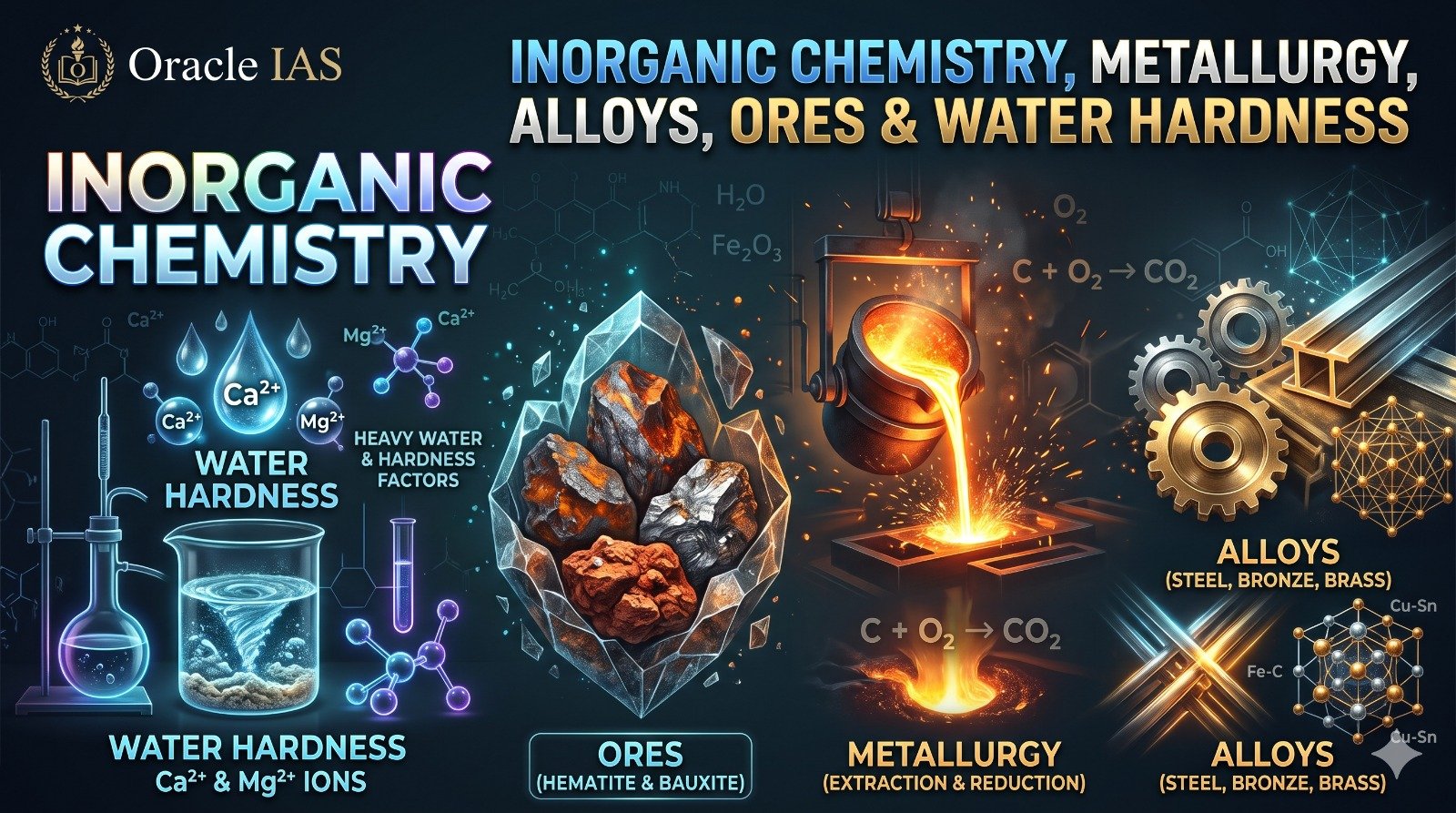
UKPSC Chemistry Unit 2: Inorganic Chemistry, Metallurgy, Alloys, Ores & Water Hardness
Part of the UKPSC General Science & Technology Revision Series.
1.High-Yield Micro-Notes
- Metallurgy, Alloys & Industrial Hardness: Diamond is the hardest naturally occurring allotrope of carbon, defined by an sp³ hybridized tetrahedral lattice. Alkali metals like Sodium (Na) and Potassium (K) are soft with low cohesive metallic bonding and can be sliced cleanly with a knife. Stainless steel is an alloy of iron with small amounts of carbon (0.05–0.1%), chromium (10.5–18%, providing a self-healing Cr₂O₃ passive anti-rust film), and nickel (which stabilizes the austenitic structure and renders it non-magnetic). Brass is an alloy of Copper and Zinc (Cu + Zn), whereas Bronze is an alloy of Copper and Tin (Cu + Sn). Aluminum is commercially extracted from its primary hydrated oxide ore, Bauxite (Al₂O₃·2H₂O).
- Chemical Compounds & Common Formulations: Washing Soda is Sodium Carbonate (Na₂CO₃·10H₂O); Baking Soda is Sodium Hydrogen Carbonate (NaHCO₃); Caustic Soda is Sodium Hydroxide (NaOH); and Bleaching Powder is Calcium Oxychloride (CaOCl₂), prepared by passing chlorine gas over dry slaked lime (Ca(OH)₂). The explosive matchstick head and striker strip utilize Red Phosphorus (safer and less pyrophoric than poisonous White Phosphorus).
- Industrial Gases & Aviation Safety: Nitrogen (N₂) is filled into aircraft tires and modern vehicle shock absorbers/struts because it is chemically inert, non-flammable, moisture-free, and exhibits low thermal expansion under extreme frictional heating. Laughing gas is Nitrous Oxide (N₂O), used as a dental sedative and anesthetic. Fluorescent tube lights contain mercury vapor mixed with noble gases (neon or argon) at low pressure (0.3% of atmospheric pressure).
- Water Hardness & Treatment: Permanent hardness of water is caused by dissolved chlorides and sulfates of calcium and magnesium (CaCl₂, MgCl₂, CaSO₄, MgSO₄) and cannot be removed by simple boiling (requiring washing soda or ion-exchange resins). Temporary hardness is caused solely by calcium and magnesium bicarbonates (Ca(HCO₃)₂, Mg(HCO₃)₂) and precipitates out upon boiling. Municipal civil water supplies are primarily disinfected through Chlorination (forming germicidal hypochlorous acid, HOCl).
- Plant Nutrients & Hydrogen Chemistry: Plants require 17 essential elements: macronutrients (C, H, O, N, P, K, Ca, Mg, S) and micronutrients (Fe, Mn, Cu, Zn, Mo, B, Cl, Ni); Sodium (Na) is non-essential for higher plant growth. In pure water (H₂O, molecular weight 18 g/mol), hydrogen contributes 11.11% by mass and oxygen contributes 88.89%. Tritium (³₁H) is a radioactive isotope of hydrogen with 1 proton and 2 neutrons (half-life ≈ 12.3 years).
2. Important facts you should know:
| Commercial / Trivial Name | Chemical Formula | Key Industrial / Environmental Application |
| Washing Soda | Na₂CO₃·10H₂O | Alkaline detergent, paper manufacturing, water softening. |
| Baking Soda | NaHCO₃ | Leavening agent in baking, mild antacid, fire extinguishers. |
| Bleaching Powder | CaOCl₂ | Disinfectant for water, industrial textile bleaching agent. |
| Heavy Water | D₂O (Deuterium Oxide) | Neutron moderator and coolant in nuclear reactors (PHWRs). |
| Lignite (“Brown Coal”) | Peat → Lignite → Bituminous → Anthracite | Lowest-rank mature coal (25–35% carbon); used in thermal power plants. |
| Biogas / Gobar Gas | CH₄ (55–65%) + CO₂ (30–40%) + H₂ + H₂S | Anaerobic digestion renewable fuel for heating and rural electrification. |
| Teflon (PTFE) | (-CF₂-CF₂-)ₙ (Polytetrafluoroethylene) | Chemically inert, heat-resistant non-stick cooking ware coating. |
| Cobalt-60 | ⁶⁰Co (Radioactive isotope, t_1/2 = 5.27 yrs) | Emits penetrating gamma (γ) rays for deep oncological radiation therapy. |
3. Master Questions
Q1. The low-rank, high-moisture organic sedimentary deposit widely termed ‘brown coal’ and primarily mined for thermal electricity generation is:
[UKPSC Draftsman 2023] [Direct Fact]
(a) Bituminous Limestone
(b) Lignite
(c) Magnetite Iron Ore
(d) Malachite Copper Ore
Q2. The common trivial chemical name for Sodium Carbonate (Na₂CO₃) is:
[UKPSC APO 2021] [Direct Fact]
(a) Baking Soda
(b) Caustic Soda
(c) Washing Soda
(d) Bleaching Powder
Q3. Which naturally occurring allotropic form of carbon possesses the highest physical hardness on the Mohs mineral scale?
[UKPSC APS Mains 2017] [Direct Fact]
(a) Refined Platinum
(b) Natural Diamond
(c) Crystalline Silicon
(d) Pure Gold
Q4. Which of the following metals is classified as diamagnetic, exhibiting magnetic permeability less than unity, and is NOT a ferromagnetic material?
[UKPSC APO 2015] [Direct Fact]
(a) Iron
(b) Alloy Steel
(c) Copper
(d) Cobalt
Q5. Which metallic transition element combines high tensile strength comparable to steel with low density and corrosion resistance, making it essential in aerospace and defense manufacturing?
[UKPSC APO 2009] [Direct Fact]
(a) Gaseous Radon
(b) Titanium
(c) Cultured Bacteria
(d) Zirconium
Q6. A diatomic covalent molecule containing a covalent double bond between its two constituent atoms is:
[UKPSC Combined SES 2021] [Direct Fact]
(a) Hydrogen (H₂)
(b) Oxygen (O₂)
(c) Water (H₂O)
(d) Ammonia (NH₃)
Q7. Which of the following metals exhibits such weak metallic bonding and low mechanical hardness that it can be easily cut with an ordinary knife?
[UKPSC RO/ARO Mains 2016] [Direct Fact]
(a) Silver
(b) Aluminum
(c) Zinc
(d) Sodium
Q8. In nuclear energy technology, Heavy Water (Deuterium Oxide, D₂O) serves primarily in the reactor core as a:
[UKPSC RO/ARO Mains 2016] [Direct Fact]
(a) Chemical initiator
(b) Neutron Moderator
(c) Therapeutic radiopharmaceutical
(d) Primary fissile fuel
Q9. The active friction-sensitive tip and striking surface of modern safety matchsticks contain which allotrope of phosphorus?
[UKPSC APS Mains 2017] [Direct Fact]
(a) Phosphorus pentoxide
(b) White phosphorus
(c) Red phosphorus
(d) Phosphorus pentachloride
Q10. What is the correct increasing order of elemental weight percentages typically present in standard structural stainless steel?
[UKPSC FRO/ACF Pre 2021] [Statement-Based]
(a) Chromium, Carbon, Iron
(b) Carbon, Chromium, Iron
(c) Carbon, Iron, Chromium
(d) Iron, Chromium, Carbon
Q11. Radioactive Cobalt-60 (⁶⁰Co) is deployed in oncological radiotherapy for cancer treatment because its nuclear decay emits highly penetrating:
[UKPSC Mains 2010-11] [Direct Fact]
(a) Alpha (α) rays
(b) Beta (β) rays
(c) Gamma (γ) rays
(d) Thermal neutrons
Q12. Commercial fluorescent lighting tubes operate under low internal pressure containing a discharge gas mixture of:
[UKPSC Pre 2004-05] [Direct Fact]
(a) Pure Argon and Neon
(b) Neon (or Argon) and Mercury Vapor
(c) High-pressure Nitrogen and Neon
(d) Pure unmixed Argon
Q13. Which transition metal is alloyed with iron and chromium to stabilize the austenitic crystal structure and make stainless steel non-magnetic?
[UKPSC Pre 2004-05 | UKPSC Pre 2011] [Direct Fact]
(a) Copper
(b) Zinc
(c) Nickel
(d) Tin
Q14. The permanent hardness of natural water that resists removal by ordinary thermal boiling is caused by dissolved:
[UKPSC Pre 2004-05] [Direct Fact]
(a) Chlorides and Sulfates of Calcium and Magnesium
(b) Bicarbonates of Calcium
(c) Bicarbonates of Magnesium
(d) Chlorides of Silver and Potassium
Q15. Which of the following metallic cations is NOT listed among the seventeen essential macro- or micro-nutrients required for normal higher plant growth?
[UKPSC Pre 2004-05] [Direct Fact]
(a) Sodium (Na)
(b) Potassium (K)
(c) Calcium (Ca)
(d) Magnesium (Mg)
Q16. Brass and Bronze are two classical non-ferrous engineering alloys composed of:
[UKPSC Mains 2004-05 | UKPSC Pre 2016] [Direct Fact]
(a) Copper and Zinc (Brass); Copper and Tin (Bronze)
(b) Iron and Copper (Brass); Iron and Zinc (Bronze)
(c) Iron and Zinc (Brass); Copper and Lead (Bronze)
(d) Copper and Silver (Brass); Copper and Nickel (Bronze)
Q17. Fine atmospheric dust creates acute respiratory distress and bronchospasm in chronic asthma patients primarily due to the presence of:
[UKPSC Mains 2004-05] [Direct Fact]
(a) Ambient humidity and carbon dioxide
(b) Nitrogen gas mixtures
(c) Inorganic silica particles and biological pollen grains
(d) Pure moisture vapors
Q18. Consider the following statements:
Assertion (A): Hydrogen gas is classified as a zero-emission clean alternative fuel.
Reason (R): The combustion of hydrogen fuel produces pure water vapor and does not release chlorofluorocarbons (CFCs) or greenhouse pollutants.
Choose the correct code:
[UKPSC Mains 2004-05] [Assertion-Reason]
(a) Both (A) and (R) are true, but (R) is NOT the full exclusive explanation of (A)
(b) (A) is false, but (R) is true
(c) (A) is true, but (R) is false
(d) Both (A) and (R) are true, and (R) is the correct explanation of (A)
Q19. Tritium (³₁H or T) is a radioactive isotope of hydrogen whose nucleus contains:
[UKPSC RO/ARO Pre 2022] [Direct Fact]
(a) One proton and two neutrons
(b) Two protons and one neutron
(c) Three protons and zero neutrons
(d) One proton and one neutron
Q20. Nitrous Oxide (N₂O), widely utilized in dental and minor surgical clinics as an inhalational sedative and analgesic, is commonly called:
[UKPSC FRO/ACF Pre 2021] [Direct Fact]
(a) Tear gas
(b) Laughing gas
(c) Phosgene
(d) Water gas
Q21. Municipal civil water supplies across urban water distribution boards are disinfected primarily by:
[UKPSC APS Mains 2017] [Direct Fact]
(a) Fractional Distillation
(b) Chlorination
(c) Coarse Paper Filtration
(d) Gravity Decantation
Q22. Which of the following chemical species is a cyclic monomer precursor used in synthesizing Nylon-6, rather than a finished high-molecular-weight polymer?
[UKPSC Pre 2012] [Direct Fact]
(a) Nylon-6,6
(b) Teflon
(c) Caprolactam
(d) Polystyrene
Q23. High-pressure aircraft tires and heavy-duty automotive shock absorbers are inflated with dry Nitrogen gas rather than compressed atmospheric air because Nitrogen:
[UKPSC RO/ARO Pre 2006 | UKPSC Regional Inspector 2022] [Direct Fact]
(a) Liquefies at ambient runway temperatures
(b) Is inert, moisture-free, non-combustible, and shows low thermal expansion
(c) Has a density significantly lower than pure helium
(d) Chemically reacts with rubber polymers to harden tire treads
Q24. The primary economic ore mineral mined for the industrial commercial extraction of metallic Aluminum is:
[UKPSC RO/ARO Mains 2006] [Direct Fact]
(a) Pitchblende
(b) Crystalline Graphite
(c) Bauxite
(d) Argentite
Q25. Calculated by molecular stoichiometry, the exact gravimetric percentage of Hydrogen in pure water (H₂O) by weight is:
[UKPSC RO/ARO Mains 2006] [Direct Fact]
(a) 44.45%
(b) 5.55%
(c) 88.89%
(d) 11.11%
Q26. The chemical formulation of commercial Bleaching Powder is:
[UKPSC Combined SES 2021] [Direct Fact]
(a) Calcium Oxychloride (CaOCl₂)
(b) Sodium Hypochlorite (NaOCl)
(c) Pure Calcium Chloride (CaCl₂)
(d) Calcium Tetrachloride (CaCl₄)
Q27. Teflon, widely used for non-stick linings in kitchen cookware and chemical gasket seals, is chemically classified as:
[UKPSC APO 2009 | UKPSC Mains 2004-05] [Direct Fact]
(a) Polytetrafluoroethylene (PTFE) plastic
(b) Synthetic aromatic painkiller
(c) Vulcanized natural rubber
(d) Phenol-formaldehyde resin
Q28. Which ancient, plant-extracted organic heterocyclic dye is used in textile vats to impart deep blue colors and neutralize fabric yellowing?
[UKPSC APO 2015] [Direct Fact]
(a) Proline
(b) Orlon
(c) Indigo
(d) Nicotine
Q29. Biogas (Gobar gas) produced by the anaerobic methanogenic fermentation of organic animal dung consists primarily of:
[UKPSC AE 2012] [Direct Fact]
(a) CH₄, CO₂, H₂, and traces of H₂S
(b) CH₄, Cl₂, N₂, and NH₃
(c) C₂H₄, H₂, Cl₂, and CO₂
(d) CH₄, NH₃, CO₂, and SO₂
4. Master Explanations & Answer Key
- Ans. (b)
- Direct Answer: Lignite is a soft, brownish-black combustible sedimentary coal rock with intermediate carbon content (25% to 35%) and high moisture levels, predominantly used to fuel thermal electric generation plants.
- Exam Trap / Distractor Alert: The developmental progression of coal ranks from lowest to highest carbon purity is Peat (<60% carbon) → Lignite (25–35%) → Bituminous (60–80%) → Anthracite (>90%). Anthracite is the hardest and highest quality coal.
- High-Yield Extra Facts: India’s major commercial lignite deposits are located at Neyveli in Tamil Nadu; Palana and Bikaner in Rajasthan also support lignite-based power infrastructure.
- Ans. (c)
- Direct Answer: Sodium Carbonate decahydrate (Na₂CO₃·10H₂O) is known commercially as washing soda, whereas anhydrous sodium carbonate is termed soda ash.
- Exam Trap / Distractor Alert: Candidates frequently confuse washing soda (Na₂CO₃) with baking soda (Sodium Bicarbonate, NaHCO₃); Caustic Soda is Sodium Hydroxide (NaOH).
- High-Yield Extra Facts: Washing soda is manufactured industrially via the Solvay (ammonia-soda) process; it softens hard water by precipitating soluble calcium and magnesium as insoluble carbonates.
- Ans. (b)
- Direct Answer: Diamond is the hardest known natural allotrope of carbon, defined as the top baseline standard of 10 on the Mohs mineral scale of relative scratch hardness.
- Exam Trap / Distractor Alert: Platinum and gold are dense and malleable metals, but they are mechanically soft; diamond’s hardness arises from rigid, three-dimensional covalent interlocking where every carbon atom is sp³ hybridized and bonded to four neighbors.
- High-Yield Extra Facts: Diamond is an electrical insulator due to localized valence electrons, but it is an exceptional conductor of thermal heat via lattice phonon vibrations.
- Ans. (c)
- Direct Answer: Copper is a diamagnetic metal with relative magnetic permeability slightly less than 1, meaning it is weakly repelled by strong magnetic fields rather than exhibiting ferromagnetism.
- Exam Trap / Distractor Alert: Ferromagnetic materials (Iron, Cobalt, Nickel, and their alloy steel formulations) have high magnetic permeability and strong permanent magnetic domain alignment.
- High-Yield Extra Facts: The three primary elemental ferromagnets at room temperature are Iron (Fe), Cobalt (Co), and Nickel (Ni); Gadolinium (Gd) becomes ferromagnetic below its Curie temperature of 19 °C.
- Ans. (b)
- Direct Answer: Titanium (Ti, atomic number 22) is a lightweight transition metal possessing a very high strength-to-weight ratio and corrosion resistance, making it an essential strategic material in military aircraft airframes, naval submarines, and ballistic armor.
- Exam Trap / Distractor Alert: Titanium is often termed a “space-age” or “strategic” metal; it is roughly 45% lighter than structural steel while offering comparable tensile strength.
- High-Yield Extra Facts: Titanium is biologically compatible and does not trigger tissue rejection, making it the global standard for orthopedic joint replacements and dental implants.
- Ans. (b)
- Direct Answer: The diatomic oxygen molecule (O₂) contains a double covalent bond (O=O) consisting of one sigma (σ) bond and one pi (π) bond, sharing two pairs of valence electrons to complete the octet.
- Exam Trap / Distractor Alert: Hydrogen (H-H), water (H-O-H), and ammonia (NH₃) contain only single covalent bonds; Nitrogen (N₂) contains a covalent triple bond (N≡N).
- High-Yield Extra Facts: Despite having a paired Lewis structure, molecular orbital theory shows that oxygen possesses two unpaired electrons in its anti-bonding pi orbitals, explaining its experimental paramagnetism.
- Ans. (d)
- Direct Answer: Sodium (Na) is an alkali metal with low density (0.97 g/cm³, floats on water) and weak metallic bonding, making it soft enough to be sliced cleanly with an ordinary butter knife.
- Exam Trap / Distractor Alert: Transition metals like zinc, silver, and aluminum have higher valence electron densities and stronger metallic crystal lattices, making them hard and resistant to simple knife cuts.
- High-Yield Extra Facts: Due to their extreme reactivity with atmospheric moisture and oxygen, sodium and potassium must be stored submerged under anhydrous kerosene oil or paraffin liquid.
- Ans. (b)
- Direct Answer: Heavy water (Deuterium Oxide, D₂O) serves as a neutron moderator in thermal nuclear reactors, slowing down energetic fast fission neutrons to thermal velocities without capturing them.
- Exam Trap / Distractor Alert: While heavy water also circulates as a heat-removal coolant in Pressurized Heavy Water Reactors (PHWRs), its primary nuclear physics classification is as a moderator.
- High-Yield Extra Facts: D₂O contains deuterium (²H), the heavy stable isotope of hydrogen; Gilbert N. Lewis first isolated pure heavy water via electrolysis in 1933.
- Ans. (c)
- Direct Answer: Safety match tips and the red friction striking surface on matchbox sides use non-toxic Red Phosphorus mixed with powdered glass and sulfur/potassium chlorate binders.
- Exam Trap / Distractor Alert: White phosphorus is pyrophoric and ignites spontaneously in air at 30 °C, which led to chronic industrial poisoning (“phossy jaw”) in early factory workers before being replaced by Red Phosphorus.
- High-Yield Extra Facts: Striking the match converts a trace of red phosphorus into white phosphorus via friction heat, which ignites and initiates the decomposition of potassium chlorate (KClO₃) to light the wood stem.
- Ans. (b)
- Direct Answer: In structural austenitic stainless steel, the weight composition is: Carbon (0.05% to 0.25%) < Chromium (16% to 18%) < Iron (roughly 70% to 74%), making the correct increasing sequence Carbon, Chromium, Iron.
- Exam Trap / Distractor Alert: Adding excess carbon above 0.2% can lead to chromium carbide precipitation at grain boundaries (sensitization), which reduces corrosion resistance.
- High-Yield Extra Facts: Standard 18/8 stainless steel contains roughly 18% Chromium and 8% Nickel, balancing corrosion resistance with mechanical ductility.
- Ans. (c)
- Direct Answer: Cobalt-60 (⁶⁰Co) decays via beta emission into an excited state of Nickel-60, which immediately releases two high-energy, deeply penetrating gamma-ray photons (1.17 MeV and 1.33 MeV) used in external beam radiotherapy to destroy malignant tumor cells.
- Exam Trap / Distractor Alert: While Cobalt-60 does emit beta particles during decay, clinical treatment machines filter out the beta emissions, using only the penetrating gamma rays to treat deep-seated internal tumors.
- High-Yield Extra Facts: Cobalt-60 has a half-life of 5.27 years and is produced industrially by irradiating natural Cobalt-59 with thermal neutrons inside nuclear reactors.
- Ans. (b)
- Direct Answer: Fluorescent tube lights contain low-pressure mercury vapor mixed with an inert noble buffer gas (typically argon, neon, or krypton) at roughly 0.3% of atmospheric pressure.
- Exam Trap / Distractor Alert: Neon alone produces the reddish-orange glow of decorative advertising neon signs; fluorescent lighting requires mercury vapor to emit ultraviolet radiation, which strikes internal phosphor powders to produce visible white light.
- High-Yield Extra Facts: Discarded fluorescent tube lamps require hazardous waste disposal protocols to prevent toxic mercury contamination of municipal soil and water tables.
- Ans. (c)
- Direct Answer: Adding Nickel (Ni, typically 8% to 12%) stabilizes the face-centered cubic (FCC) austenite phase of iron at room temperature, rendering the resulting stainless steel non-magnetic.
- Exam Trap / Distractor Alert: Ferritic stainless steels (containing only iron and chromium without nickel) remain magnetic; it is the nickel addition that suppresses ferromagnetism.
- High-Yield Extra Facts: Kitchen sinks and medical surgical instruments typically use austenitic non-magnetic stainless steel (e.g., AISI 304 grade).
- Ans. (a)
- Direct Answer: Permanent hardness in water is caused by dissolved chlorides and sulfates of calcium and magnesium (CaCl₂, MgCl₂, CaSO₄, MgSO₄), which remain soluble when heated.
- Exam Trap / Distractor Alert: Temporary hardness is caused by calcium and magnesium bicarbonates (Ca(HCO₃)₂ and Mg(HCO₃)₂), which decompose and precipitate as insoluble carbonates upon boiling.
- High-Yield Extra Facts: Permanent hardness can be removed chemically by adding washing soda (Na₂CO₃), using the Calgon process (sodium hexametaphosphate), or running water through synthetic zeolite/ion-exchange resins.
- Ans. (a)
- Direct Answer: Sodium (Na) is not an essential element for most higher plants, though it can act as a beneficial element for select C4 halophyte species.
- Exam Trap / Distractor Alert: Plants require 17 essential elements: structural (C, H, O), primary macronutrients (N, P, K), secondary macronutrients (Ca, Mg, S), and micronutrients (Fe, Mn, Zn, Cu, B, Mo, Cl, Ni).
- High-Yield Extra Facts: Potassium (K) regulates guard cell turgor for stomatal opening and closing; Magnesium (Mg) is the central coordinating metallic atom in the chlorophyll ring.
- Ans. (a)
- Direct Answer: Brass is an alloy consisting primarily of Copper (60–70%) and Zinc (30–40%); Bronze is an alloy of Copper (88–90%) and Tin (10–12%).
- Exam Trap / Distractor Alert: Do not confuse Bronze (Cu + Sn) with Bell Metal (higher tin content, ~22% Sn) or German Silver (Cu + Zn + Ni, which contains no silver).
- High-Yield Extra Facts: The ancient Indus Valley Civilization belongs archaeologically to the Bronze Age, using bronze tools, weapons, and sculptures (such as the ‘Dancing Girl’ of Mohenjo-daro).
- Ans. (c)
- Direct Answer: Asthma and bronchial allergies are triggered by airborne particulate matter, including inorganic respirable silica dust and biological allergens such as anemophilous pollen grains and fungal spores.
- Exam Trap / Distractor Alert: Ambient humidity and normal atmospheric gases (N₂, CO₂) do not cause allergic bronchospasm; fine particles bypass nasal cilia to trigger mast-cell degranulation and histamine release in bronchioles.
- High-Yield Extra Facts: Particulate matter smaller than 2.5 micrometers (PM 2.5) can penetrate deep into pulmonary alveoli, exacerbating respiratory diseases and cardiovascular conditions.
- Ans. (d)
- Direct Answer: Both statements are correct and (R) explains (A): hydrogen fuel combustion produces only water vapor (2H₂ + O₂ → 2H₂O), releasing no carbon dioxide, soot, sulfur oxides, or halogenated compounds like CFCs.
- Exam Trap / Distractor Alert: High-temperature combustion of hydrogen in open atmospheric air can form trace nitrogen oxides (NOx) with ambient nitrogen, though running hydrogen through a fuel cell generates electricity with pure water as the sole byproduct.
- High-Yield Extra Facts: Liquid hydrogen paired with liquid oxygen (LOX) is used as a cryogenic rocket propellant, including in ISRO’s indigenous CE-20 cryogenic upper stages.
- Ans. (a)
- Direct Answer: Tritium (³₁H) contains an atomic nucleus (the triton) comprising 1 proton and 2 neutrons, giving it an atomic mass number of 3.
- Exam Trap / Distractor Alert: Ordinary Hydrogen (Protium, ¹₁H) has 1 proton and 0 neutrons; Deuterium (²₁H) has 1 proton and 1 neutron; Tritium is the only radioactive isotope among the three.
- High-Yield Extra Facts: Tritium decays via low-energy beta minus (β⁻) emission into Helium-3 (³₂He) with a half-life of 12.32 years; it is used in self-luminous exit signs, military watch dials, and nuclear fusion experiments (such as ITER).
- Ans. (b)
- Direct Answer: Nitrous Oxide (chemical formula N₂O, dinitrogen monoxide) is known as laughing gas because it can induce mild euphoria when inhaled in low concentrations.
- Exam Trap / Distractor Alert: Nitric oxide (NO) is a biological signaling free radical; Nitrogen dioxide (NO₂) is a reddish-brown, toxic urban pollutant gas; Tear gas is typically 2-chlorobenzalmalononitrile (CS gas).
- High-Yield Extra Facts: Joseph Priestley discovered nitrous oxide in 1772; Humphry Davy identified its analgesic and euphoric effects in 1799, paving the way for its use in dental sedation.
- Ans. (b)
- Direct Answer: Chlorination (dosing with elemental chlorine gas or sodium hypochlorite) is the standard method for municipal drinking water disinfection worldwide.
- Exam Trap / Distractor Alert: Coarse filtration and sedimentation remove suspended turbidity and silt, but chemical disinfection (chlorination) is required to kill pathogenic enteric bacteria and viruses.
- High-Yield Extra Facts: Chlorine reacts with water to form hypochlorous acid (HOCl) and hypochlorite ions (OCl⁻), which disrupt microbial cell membranes; water utilities maintain a residual chlorine concentration (0.2–0.5 mg/L) to prevent recontamination in supply pipes.
- Ans. (c)
- Direct Answer: Caprolactam is a cyclic amide monomer containing a 7-membered carbon-nitrogen ring; ring-opening polymerization of caprolactam produces the commercial synthetic polymer Nylon-6.
- Exam Trap / Distractor Alert: Nylon-6,6, Teflon, and Polystyrene are high-molecular-weight polymers; Caprolactam is the unpolymerized starting monomer.
- High-Yield Extra Facts: Nylon-6,6 is synthesized by condensing two monomers: hexamethylenediamine and adipic acid; Nylon-6 requires only caprolactam.
- Ans. (b)
- Direct Answer: Nitrogen is dry, non-flammable, and chemically unreactive, preventing internal tire oxidation and rim corrosion while minimizing pressure fluctuations under extreme runway braking temperatures.
- Exam Trap / Distractor Alert: Compressed atmospheric air contains moisture and ~21% oxygen, which can vaporize and expand unpredictably during high-speed takeoffs or contribute to tire fires if brakes overheat.
- High-Yield Extra Facts: Dry nitrogen is also used in motorsport racing tires and aircraft hydraulic oleo-pneumatic struts to ensure stable damping response.
- Ans. (c)
- Direct Answer: Bauxite (hydrated aluminum oxide, Al₂O₃·2H₂O) is the principal economic ore from which alumina is extracted via the Bayer process and subsequently reduced to pure metallic aluminum via the Hall-Héroult electrolytic process.
- Exam Trap / Distractor Alert: Pitchblende (uraninite) is an ore of Uranium; Argentite (Ag₂S) is an ore of Silver; Graphite is an allotrope of carbon.
- High-Yield Extra Facts: Cryolite (Na₃AlF₆) is added to purified alumina during electrolysis to lower its melting point from 2072 °C down to ~950 °C and improve electrical conductivity.
- Ans. (d)
- Direct Answer: In a water molecule (H₂O), the molar mass is (2 × 1.008) + 16.00 = 18.016 g/mol. The mass percentage of Hydrogen is (2.016 / 18.016) × 100 ≈ 11.11%, while Oxygen accounts for 88.89%.
- Exam Trap / Distractor Alert: By atomic count, Hydrogen makes up 66.67% of water (2 out of 3 atoms); by weight, it accounts for only 11.11% because oxygen has a much higher atomic mass (16 vs 1).
- High-Yield Extra Facts: Heavy water (D₂O) has a molar mass of approximately 20 g/mol, where deuterium accounts for (4 / 20) × 100 = 20.0% by weight.
- Ans. (a)
- Direct Answer: Bleaching powder is chemically designated as Calcium Oxychloride (formula: CaOCl₂), also known as calcium hypochlorite mixture.
- Exam Trap / Distractor Alert: It is produced by treating dry slaked lime with chlorine gas: Ca(OH)₂ + Cl₂ → CaOCl₂ + H₂O; sodium hypochlorite (NaOCl) is the active agent in liquid household bleach, whereas bleaching powder is a dry solid.
- High-Yield Extra Facts: Bleaching powder gradually releases chlorine gas upon exposure to atmospheric carbon dioxide and moisture: CaOCl₂ + CO₂ → CaCO₃ + Cl₂↑.
- Ans. (a)
- Direct Answer: Teflon is the trade name for Polytetrafluoroethylene (PTFE), an addition fluoropolymer consisting of repeating (-CF₂-CF₂-) units, known for its high chemical inertness, low friction, and thermal stability up to 260 °C.
- Exam Trap / Distractor Alert: Teflon is a synthetic fluorocarbon plastic; its non-stick properties stem from extremely strong carbon-fluorine (C-F) single bonds, making it resistant to water, oils, and chemical attack.
- High-Yield Extra Facts: PTFE was discovered by Roy J. Plunkett in 1938 at DuPont; it has one of the lowest coefficients of friction against polished steel (0.04).
- Ans. (c)
- Direct Answer: Indigo is an ancient, insoluble organic vat dye historically extracted from the leaves of the Indigofera tinctoria plant, used to dye denim blue and brighten white cotton textiles.
- Exam Trap / Distractor Alert: Proline is a proteinogenic amino acid; Orlon is a commercial polyacrylonitrile synthetic acrylic fiber; Nicotine is an alkaloid found in tobacco plants.
- High-Yield Extra Facts: Because indigo is insoluble in water, it must first be chemically reduced into a soluble colorless “leuco-indigo” form for dyeing, which re-oxidizes to insoluble blue within fabric fibers upon exposure to air.
- Ans. (a)
- Direct Answer: Biogas is produced by the anaerobic digestion of wet animal dung and agricultural biomass, consisting primarily of Methane (CH₄, 55–65%), Carbon Dioxide (CO₂, 30–40%), along with small fractions of Hydrogen (H₂), Nitrogen (N₂), and Hydrogen Sulfide (H₂S).
- Exam Trap / Distractor Alert: Biogas contains no free chlorine (Cl₂) or sulfur dioxide (SO₂); traces of hydrogen sulfide (H₂S) give raw biogas its characteristic odor and must be scrubbed to prevent engine corrosion.
- High-Yield Extra Facts: The calorific value of biogas is approximately 20–25 MJ/m³; the residual slurry from gobar gas plants serves as an organic fertilizer rich in nitrogen and phosphorus.
Contact Oracle IAS:
Call/WhatsApp 9997453844 for details
Join Our Preparation program:

He is a bibliophile,accomplished writer and a fitness enthusiast.
- UKPSC Chemistry: Organic Chemistry, Hydrocarbons, Fuels, LPG & Carbon Allotropes (Solved PYQs & Notes) - October 25, 2026
- UKPSC Chemistry: Inorganic Chemistry, Metallurgy, Alloys, Ores & Water Hardness (Solved PYQs & Notes) - October 25, 2026
- UKPSC Chemistry: Physical Chemistry, States of Matter, pH Scale & Water Properties (Solved PYQs & Notes) - October 25, 2026