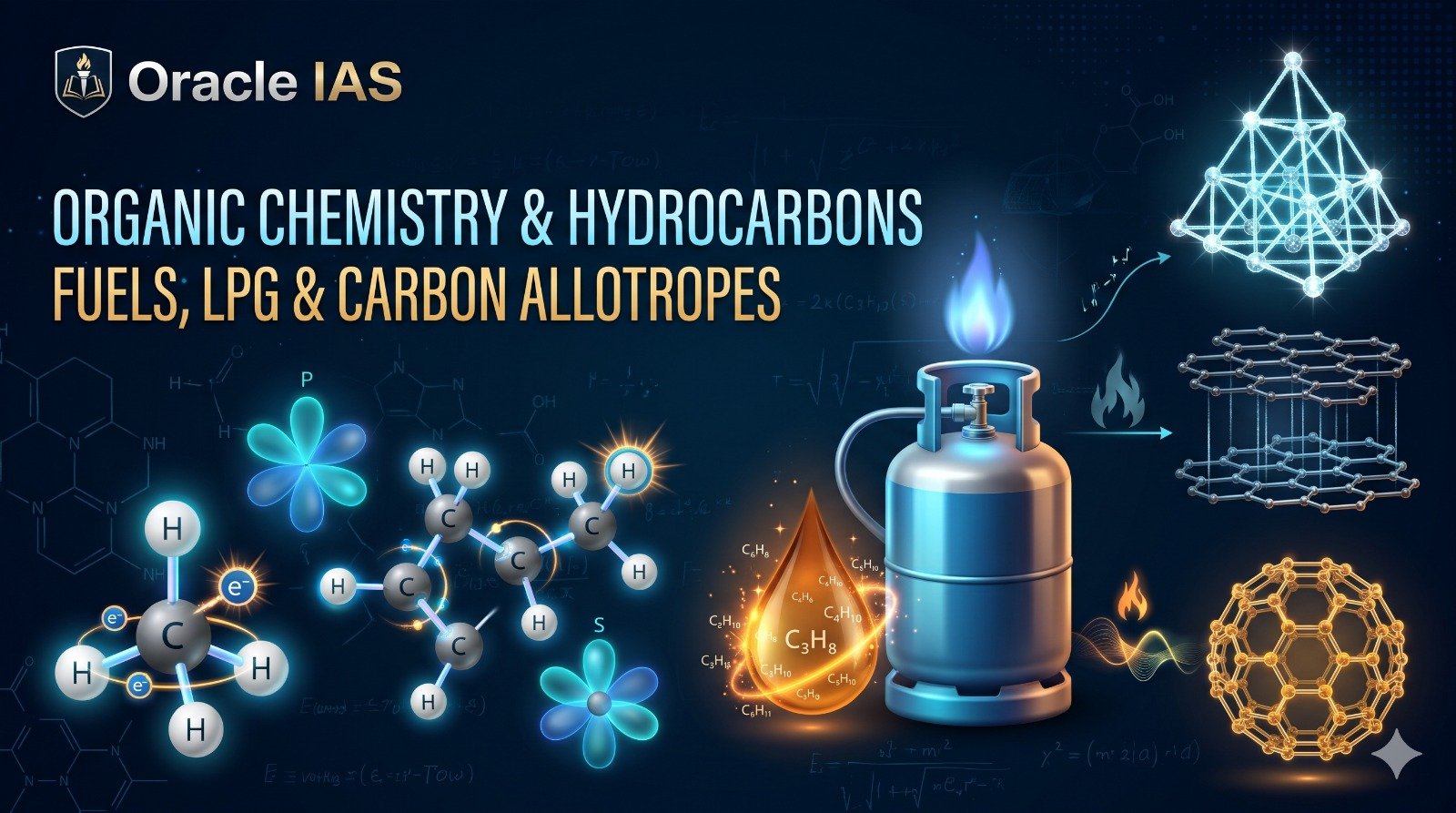
UKPSC Chemistry Unit 3: Organic Chemistry, Hydrocarbons, Fuels, LPG & Carbon Allotropes
Part of the UKPSC General Science & Technology Revision Series.
1.High-Yield Micro-Notes
- Hydrocarbons & Gaseous Fuels: Methane (CH₄) is the primary constituent of natural gas, Compressed Natural Gas (CNG ≈ 85–95%), and biogas/gobar gas (55–65%). Known historically as marsh gas, it is produced by the anaerobic decomposition of cellulose in wetlands and swamps. Domestic Liquefied Petroleum Gas (LPG) consists primarily of pressurized propane and butane (with traces of ethyl mercaptan added as an olfactory stenching agent for leak detection). Gasoline (petrol) is a complex blend of aliphatic hydrocarbons spanning C₆ to C₈, primarily hexane, heptane, and octane. In deep coal mines, explosive firedamp blasts occur predominantly when methane mixes with atmospheric air (5–15% explosive envelope).
- Carbon Allotropes & Structural Geochemistry: Carbon forms distinct crystalline allotropes: Diamond (purest natural allotrope, rigid 3D tetrahedral sp³ lattice, electrical insulator), Graphite (soft, planar hexagonal sp² sheets with delocalized pi electrons, electrical conductor), and Fullerenes (cage-like buckyballs, e.g., C₆₀). Sedimentary sandstone consists primarily of silicate quartz grains (SiO₂) and contains no native structural carbon. Dolomite is an anhydrous carbonate mineral ore of magnesium and calcium (CaMg(CO₃)₂). Natural pearls are biogenic accretions consisting predominantly of calcium carbonate (82–86% aragonite) bound by the organic protein matrix conchiolin (10–14%).
- Alcohols, Industrial Intermediates & Agro-Chemicals: Ethanol has a lower boiling point (78.3 °C) and is more volatile than water (100 °C) because ethanol forms weaker and fewer intermolecular hydrogen bonds. Molasses (sheera), an industrial byproduct of sugarcane processing, is the primary fermentation feedstock for producing power alcohol (ethanol blended with gasoline to yield gasohol: 10–20% ethyl alcohol + petrol). Urea [CO(NH₂)₂] fertilizer is synthesized industrially by reacting liquid anhydrous ammonia (NH₃) with carbon dioxide (CO₂) under high pressure. Solid carbon dioxide is termed Dry Ice because it sublimes directly into gas at -78.5 °C without passing through a liquid phase.
- Specialized Organic & Medicinal Formulations: Aspirin is chemically acetylsalicylic acid (C₉H₈O₄), synthesized via the acetylation of salicylic acid with acetic anhydride. Formalin is an aqueous preservative solution containing 37–40% formaldehyde (HCHO) with 10–15% methanol stabilizer. Natural biopolymers cellulose and starch are homopolymers derived from repeating glucose monomer units (beta-1,4 and alpha-1,4 glycosidic linkages, respectively). Trinitrotoluene (TNT, C₇H₅N₃O₆) is a high-order nitroaromatic explosive. Traditional cosmetic/ritual Vermilion (Sindoor) is mineral cinnabar, chemically designated as mercuric sulfide (HgS). High-performance bullet-resistant materials use thermoplastic polycarbonate or aramid polyamides (Kevlar).
2. Important facts you should know:
| Commercial / Trivial Name | Chemical Identity / Composition | Dominant Functional Application / Characteristic |
| Dry Ice | Solid Carbon Dioxide (CO₂) | Sublimes at -78.5 °C; cryogenic preservative and stage smoke refrigerant. |
| Marsh Gas / Natural Gas / CNG | Methane (CH₄) | Anaerobic wetland gas; clean fuel with high calorific yield. |
| LPG (Cooking Gas) | Liquefied Butane (C₄H₁₀) + Propane (C₃H₈) | Pressurized domestic fuel; supplemented with ethanethiol odorant. |
| Gasohol | Ethyl Alcohol (Ethanol) + Gasoline (Petrol) | Biofuel blend designed to reduce carbon monoxide emissions. |
| Oxy-Acetylene Flame | Acetylene (C₂H₂) + Compressed Oxygen (O₂) | Produces a 3100–3300 °C industrial cutting and gas-welding flame. |
| Vermilion (Sindoor) | Mercuric Sulfide (HgS) | Dense red pigment derived from cinnabar mineral. |
| Aspirin | Acetylsalicylic Acid (C₉H₈O₄) | Analgesic, antipyretic, and nonsteroidal anti-inflammatory drug (NSAID). |
| Formalin | 37–40% Aqueous Formaldehyde (HCHO) | Biological tissue fixative and anatomical specimen preservative. |
| Polycarbonate | Thermoplastic polymer resin | High impact resistance; manufacture of bulletproof laminate shields. |
| TNT | 2,4,6-Trinitrotoluene | Secondary military and industrial demolition explosive. |
3. Master Questions
Q1. Pure ethyl alcohol displays a significantly higher evaporation volatility than liquid water under ambient conditions primarily because:
[UKPSC APS Mains 2021] [Direct Fact]
(a) Its boiling point is lower than that of water due to weaker intermolecular hydrogen bonding
(b) It is classified structurally as an aliphatic organic liquid
(c) Its freezing point is lower than that of water
(d) Its surface tension is infinitely higher than that of water
Q2. The dominant hydrocarbon constituent present in both biogenic biogas and fossil natural gas (including CNG) is:
[UKPSC APS Mains 2017 | UKPSC Junior Assistant 2022 | UKPSC Regional Inspector 2022] [Direct Fact]
(a) Ethane
(b) Butane
(c) Methane
(d) Propane
Q3. The combustible gas produced naturally by the anaerobic methanogenic decomposition of organic biomass in wetlands and swamps, colloquially termed ‘Marsh Gas’, is:
[UKPSC Lower Pre 2016 | UKPSC APS Mains 2021 | UKPSC Junior Assistant 2022] [Direct Fact]
(a) Ethylene
(b) Hydrogen Sulfide
(c) Chloroform
(d) Methane
Q4. ‘Dry Ice’, widely employed as a non-aqueous industrial and laboratory refrigerant, is chemically:
[UKPSC Pre 2002-03 | UKPSC Mains 2006 | UKPSC RO/ARO Pre 2016 | UKPSC RO/ARO Pre 2022] [Direct Fact]
(a) Naturally frozen glacial mountain ice
(b) Solidified Carbon Monoxide
(c) Solidified Carbon Dioxide
(d) Desiccated silica gel
Q5. In industrial fermentation plants, sugar refinery molasses (‘Sheera’) serves as an optimal raw carbohydrate feedstock for the bulk production of:
[UKPSC Pre 2002-03] [Direct Fact]
(a) Acetic Acid
(b) Pure Glycerin
(c) Power Alcohol (Ethanol)
(d) Synthetic Urea
Q6. The alternative motor fuel blend commercially designated as ‘Gasohol’ is composed of:
[UKPSC Pre 2004-05] [Direct Fact]
(a) Ethyl Alcohol and Petrol (Gasoline)
(b) Compressed Natural Gas and Ethanol
(c) Dissolved Acetylene in Industrial Alcohol
(d) Ethyl Alcohol and Kerosene Oil
Q7. The high-temperature gaseous mixture ignited in industrial torches for heavy metal cutting and gas welding operations consists of:
[UKPSC Pre 2004-05] [Direct Fact]
(a) Acetylene and Pure Hydrogen
(b) Oxygen and Acetylene
(c) Hydrogen and Oxygen
(d) Hydrogen and Compressed Helium
Q8. From a strict chemical perspective, traditional cosmetic Vermilion (Sindoor) is composed of:
[UKPSC Pre 2004-05] [Direct Fact]
(a) Calcium Carbonate
(b) Potassium Nitrate
(c) Mercuric Sulfide (HgS)
(d) Lead Chromate
Q9. Diamond, the hardest known naturally occurring mineral, is structurally composed entirely of:
[UKPSC Pre 2006-07 | UKPSC Mains 2004-05 | UKPSC AE 2007] [Direct Fact]
(a) Carbon
(b) Nitrogen
(c) Nickel
(d) Crystalline Zinc
Q10. The primary chemical composition forming the crystalline nacreous layers of a natural marine Pearl is:
[UKPSC Pre 2006-07] [Direct Fact]
(a) Calcium Carbonate (Aragonite)
(b) Calcium Sulfate dihydrate
(c) Pure Calcium Chloride
(d) Magnesium Silicate
Q11. The catastrophic firedamp gas explosions that occur inside underground coal mining galleries are primarily triggered by the accidental ignition of:
[UKPSC Pre 2006-07] [Direct Fact]
(a) Carbon dioxide mixed with Methane
(b) Methane mixed with atmospheric Air
(c) Acetylene mixed with pure Oxygen
(d) Oxygen mixed with pressurized Hydrogen
Q12. The fundamental chemical synthesis represented by the reaction equation CO₂ + H₂O → H₂CO₃ is classified as an example of a:
[UKPSC Mains 2002-03] [Direct Fact]
(a) Pure Reduction Reaction
(b) Nucleophilic Substitution Reaction
(c) Combination (Addition) Reaction
(d) Thermal Decomposition Reaction
Q13. Non-renewable, carbonaceous energy reserves formed by subterranean geological heat and pressure over geological eras—such as Coal, Crude Oil, and Natural Gas—are collectively known as:
[UKPSC Mains 2002-03] [Direct Fact]
(a) Raw fuels
(b) Synthetic secondary fuels
(c) Biofuels
(d) Fossil fuels
Q14. Commercial domestic cylinder fuel, designated by the acronym L.P.G., stands for:
[UKPSC Mains 2004-05] [Direct Fact]
(a) Light Petroleum Gas
(b) Low-pressure Gas
(c) Liquefied Petroleum Gas
(d) Liquefied Petrol Gasoline
Q15. Automotive gasoline (petrol) is a refined petroleum distillate consisting predominantly of a mixture of which aliphatic hydrocarbons?
[UKPSC Mains 2004-05] [Direct Fact]
(a) Hexane, Heptane, and Octane
(b) Benzene, Toluene, and Xylene
(c) Ethane, Propane, and Butane
(d) Ethylene, Propylene, and Acetylene
Q16. Trinitrotoluene (TNT), widely deployed in civil mining blasts and military ordnance, is classified as a/an:
[UKPSC RO/ARO Pre 2021] [Direct Fact]
(a) Broad-spectrum Antimicrobial
(b) Synthetic Antibiotic
(c) Secondary High Explosive
(d) Industrial Antiseptic
Q17. Diamond and Graphite represent two distinct structural manifestations of carbon known as:
[UKPSC RO/ARO Pre 2022] [Direct Fact]
(a) Structural Isomers
(b) Nuclear Isotopes
(c) Addition Polymers
(d) Allotropes
Q18. Which of the following chemical substances is an inorganic mineral acid and is NOT classified as a Volatile Organic Compound (VOC)?
[UKPCS Lower Pre 2021] [Direct Fact]
(a) Acetaldehyde
(b) Formaldehyde
(c) Hydrochloric Acid (HCl)
(d) Dichloromethane
Q19. Dolomite, an important sedimentary carbonate mineral mined for metallurgical refractory bricks, is an ore of:
[UKPSC APS Mains 2017] [Direct Fact]
(a) Magnesium
(b) Zinc
(c) Refined Lead
(d) Copper
Q20. The active anti-inflammatory and antipyretic pharmaceutical agent ‘Aspirin’ is chemically designated as:
[UKPSC APS Mains 2021] [Direct Fact]
(a) Acetylsalicylic Acid
(b) Methyl Salicylate
(c) Ortho-hydroxy Benzoic Acid
(d) Ethyl Salicylate
Q21. Which volatile chemical refrigerant was historically employed in domestic compression refrigeration systems prior to the phase-out mandated by the Montreal Protocol?
[UKPSC Pre 2011] [Direct Fact]
(a) Ammonia / Freon (CFC-12)
(b) Pure Methane
(c) Acetylene
(d) Ethylene Glycol
Q22. Both Cellulose (plant cell wall structural matrix) and Starch (vegetative carbohydrate reserve) are biological polymers composed of repeating units of:
[UKPSC Pre 2016] [Direct Fact]
(a) D-Glucose
(b) D-Fructose
(c) Galactose
(d) Ribose
Q23. In commercial petrochemical synthesis, which greenhouse gas is captured and reacted with ammonia as a primary carbon feedstock to manufacture Urea fertilizer?
[UKPSC Mains 2006] [Direct Fact]
(a) Carbon dioxide (CO₂)
(b) Sulfur dioxide (SO₂)
(c) Chlorine gas (Cl₂)
(d) Nitric acid vapor (HNO₃)
Q24. Liquid hydrocarbon fires (such as blazing petrol or diesel) should be extinguished using which of the following agents rather than water?
[UKPSC RO/ARO Pre 2016] [Direct Fact]
(a) Fine sawdust
(b) High-pressure Water stream
(c) Carbon Dioxide (CO₂) / Dry Chemical Foam
(d) Pure Oxygen gas
Q25. Which of the following natural rocks/minerals is composed primarily of silica (SiO₂) and contains NO elemental carbon?
[UKPSC RO/ARO Mains 2016] [Direct Fact]
(a) Natural Diamond
(b) Crystalline Graphite
(c) Bituminous Coal
(d) Quartz Sandstone
Q26. The inorganic oxidizing salt historically incorporated into matchstick formulations to sustain ignition is:
[UKPSC AE 2012] [Direct Fact]
(a) Potassium dichromate
(b) Potassium permanganate
(c) Potassium nitrate (or Potassium chlorate)
(d) Fuming Nitric acid
Q27. Which high-impact engineering thermoplastic polymer is utilized as the primary transparent structural laminate in manufacturing bullet-resistant glass and shields?
[UKPSC AE 2012] [Direct Fact]
(a) Polycarbonate
(b) Polyamide (Nylon)
(c) Polyethylene (HDPE)
(d) Polyvinyl Chloride (PVC)
Q28. ‘Formalin’, an aqueous embalming fluid used in pathological laboratories for the preservation of anatomical and biological specimens, consists of:
[UKPSC APO 2021] [Direct Fact]
(a) Dilute Formic Acid solution
(b) Concentrated Furfural
(c) 37–40% aqueous solution of Formaldehyde
(d) Alcoholic Fluorescein dye
4.Master Explanations & Answer Key
- Ans. (a)
- Direct Answer: Ethanol (C₂H₅OH) exhibits a lower boiling point (78.3 °C) than water (100 °C) because water molecules form a tighter, extensive three-dimensional network of intermolecular hydrogen bonds (two H-bond donors and two acceptors per molecule), whereas ethanol has a weaker, single hydroxyl bond network.
- Exam Trap / Distractor Alert: Organic classification alone does not dictate volatility; many organic molecules have very high boiling points. Volatility is governed by intermolecular cohesive forces (vapor pressure vs. boiling point).
- High-Yield Extra Facts: Raoult’s Law dictates that ethanol evaporates more rapidly at room temperature because its equilibrium vapor pressure (≈ 5.95 kPa at 20 °C) is significantly higher than that of water (≈ 2.34 kPa).
- Ans. (c)
- Direct Answer: Methane (CH₄) is the dominant chemical hydrocarbon in both biogas (55–65%) and natural gas / CNG (85–95%), making it the central component of pipeline and compressed gaseous fuels.
- Exam Trap / Distractor Alert: Butane and propane are the main components of Liquefied Petroleum Gas (LPG), whereas Methane is the primary component of CNG and natural gas.
- High-Yield Extra Facts: Methane is a potent short-lived greenhouse gas with a global warming potential (GWP) over 28 times greater than carbon dioxide on a 100-year timescale.
- Ans. (d)
- Direct Answer: Methane (CH₄) is termed “marsh gas” because it is continuously generated by methanogenic archaebacteria (such as Methanobacterium) digesting cellulose under anaerobic conditions in waterlogged swamps, bogs, and paddy fields.
- Exam Trap / Distractor Alert: Wetland sediments also emit traces of hydrogen sulfide (H₂S), which gives marshes their characteristic rotten-egg smell, but the primary combustible hydrocarbon gas produced is methane.
- High-Yield Extra Facts: Flooded rice paddies are among the largest agricultural anthropogenic sources of atmospheric methane emissions globally.
- Ans. (c)
- Direct Answer: Solidified carbon dioxide is called “Dry Ice” because at standard atmospheric pressure (1 atm), it sublimes directly from a solid into gaseous CO₂ at -78.5 °C without melting into a liquid.
- Exam Trap / Distractor Alert: Do not confuse solid CO₂ with solid carbon monoxide (CO is an extremely toxic, flammable gas); dry ice produces dense white fog when placed in water due to the condensation of ambient water vapor, not the evaporation of the CO₂ itself.
- High-Yield Extra Facts: Dry ice must be handled with insulated cryogenic gloves; direct skin contact causes severe frostbite and cold burns.
- Ans. (c)
- Direct Answer: Molasses (sheera)—the thick, non-crystallizable syrupy sucrose byproduct of sugarcane crushing—is fermented using yeast (Saccharomyces cerevisiae) to yield industrial ethanol, which is distilled to produce anhydrous “power alcohol” for fuel blending.
- Exam Trap / Distractor Alert: Molasses is an active carbohydrate substrate, not an inert chemical catalyst; yeast enzymes (invertase and zymase) serve as the biological catalysts for fermentation.
- High-Yield Extra Facts: India’s Ethanol Blending Programme (EBP) targets a 20% ethanol blend in petrol (E20), relying heavily on molasses-based and grain-based distilleries.
- Ans. (a)
- Direct Answer: Gasohol is an automotive fuel blend formulated by mixing anhydrous ethyl alcohol (ethanol, typically 10% to 20%) with unleaded gasoline (petrol, 80% to 90%).
- Exam Trap / Distractor Alert: Gasohol does not contain compressed natural gas or kerosene; adding kerosene to petrol is an illegal adulteration that damages internal combustion engines and spikes hydrocarbon emissions.
- High-Yield Extra Facts: The presence of ethanol increases the octane rating of the fuel blend and provides bound oxygen, which improves combustion and lowers tailpipe emissions of carbon monoxide (CO).
- Ans. (b)
- Direct Answer: Oxy-acetylene welding utilizes a dual-feed torch burning acetylene gas (C₂H₂) mixed with pure compressed oxygen (O₂), producing a concentrated flame temperature exceeding 3100–3300 °C.
- Exam Trap / Distractor Alert: Burning acetylene in ambient air produces a sooty yellow flame; only when mixed with pressurized pure oxygen does it achieve the clean, high-temperature blue cone required to melt structural steel.
- High-Yield Extra Facts: Acetylene is thermodynamically unstable under high pressure and is stored in specialized cylinders dissolved in liquid acetone inside a porous silicate mass.
- Ans. (c)
- Direct Answer: Traditional cosmetic Vermilion (Sindoor) is chemically Mercuric Sulfide (HgS), historically derived from ground natural cinnabar ore.
- Exam Trap / Distractor Alert: Modern synthetic or adulterated sindoor often contains toxic red lead (lead tetroxide, Pb₃O₄), but the classical mineral and chemical definition remains mercuric sulfide.
- High-Yield Extra Facts: Cinnabar (HgS) is also the primary economic mineral ore used for extracting elemental mercury via roasting in air (HgS + O₂ → Hg + SO₂).
- Ans. (a)
- Direct Answer: Diamond is a pure crystalline allotrope composed entirely of elemental carbon atoms arranged in an isotropic face-centered cubic lattice.
- Exam Trap / Distractor Alert: Despite its extreme hardness and durability, diamond burns completely in pure oxygen above 800 °C, leaving behind only gaseous carbon dioxide (CO₂) with no solid residue.
- High-Yield Extra Facts: In diamond, each carbon atom is covalently bonded to four others in a rigid tetrahedral geometry with an sp³ hybridization state and a C-C bond length of 1.54 Å.
- Ans. (a)
- Direct Answer: Natural pearls are composed of 82–86% calcium carbonate (primarily in the crystalline orthorhombic form of aragonite), bonded together by 10–14% of an organic scleroprotein called conchiolin, with 2–4% water.
- Exam Trap / Distractor Alert: Pearls are biogenic structures formed when an oyster or freshwater mussel secretes concentric layers of nacre around an irritating foreign particle, not mineral precipitates of calcium sulfate.
- High-Yield Extra Facts: The iridescent sheen of pearls (orient) is an optical interference phenomenon produced by light reflecting through the microscopic alternating layers of crystalline aragonite and conchiolin.
- Ans. (b)
- Direct Answer: Mine firedamp explosions occur when methane gas (CH₄), which seeps from underground coal seams, mixes with atmospheric air in concentrations between 5% and 15% and encounters an ignition source.
- Exam Trap / Distractor Alert: Pure methane cannot ignite without oxygen; it is the specific mixture of methane with ambient mine ventilation air that forms the explosive firedamp envelope.
- High-Yield Extra Facts: Sir Humphry Davy invented the Davy safety lamp in 1815, using a fine wire gauze screen to cool flames below ignition temperature and allow safe illumination in methane-rich coal mines.
- Ans. (c)
- Direct Answer: The reaction CO₂ + H₂O → H₂CO₃ is a combination (synthesis) reaction, in which two or more distinct chemical reactants unite directly to yield a single chemical compound (carbonic acid).
- Exam Trap / Distractor Alert: It is not a redox reaction; the oxidation states of carbon (+4), oxygen (-2), and hydrogen (+1) remain completely unchanged throughout the hydration process.
- High-Yield Extra Facts: In human blood physiology, the enzyme carbonic anhydrase accelerates this exact reversible combination reaction to transport metabolic carbon dioxide from tissues to the lungs.
- Ans. (d)
- Direct Answer: Coal, crude oil (petroleum), and natural gas are classified as fossil fuels because they formed over hundreds of millions of years from the buried, pressurized remains of ancient prehistoric biomass.
- Exam Trap / Distractor Alert: While often referred to as “conventional fuels,” their scientific and geological classification is “fossil fuels,” distinguishing them from modern biofuels like ethanol and biodiesel.
- High-Yield Extra Facts: The geological era responsible for the formation of the world’s most extensive coal deposits is the Carboniferous Period (approximately 300 to 360 million years ago).
- Ans. (c)
- Direct Answer: LPG stands for Liquefied Petroleum Gas, a hydrocarbon mixture that is gaseous at ambient temperature and pressure but liquefies under moderate pressure for storage and transport.
- Exam Trap / Distractor Alert: LPG is not “liquid petrol”; it consists primarily of C₃ and C₄ alkanes (propane and butane), whereas liquid petrol/gasoline consists of heavier C₆ to C₈ fractions.
- High-Yield Extra Facts: Commercial LPG cylinders contain approximately 60% butane and 40% propane; because both are naturally odorless, trace amounts of ethyl mercaptan (ethanethiol) are added to give LPG its distinctive leak-warning odor.
- Ans. (a)
- Direct Answer: Automotive gasoline (petrol) is a petroleum distillate fraction boiling between 35 °C and 200 °C, consisting predominantly of liquid branched and straight-chain alkanes containing 6 to 8 carbon atoms (Hexane C₆H₁₄, Heptane C₇H₁₆, and Octane C₈H₁₈).
- Exam Trap / Distractor Alert: Benzene, toluene, and xylene are aromatic BTX petrochemical solvents; propane and butane are lighter gases that form LPG, not liquid gasoline.
- High-Yield Extra Facts: The knock-resistance rating of gasoline is measured on an arbitrary Octane Scale, where highly knock-prone n-heptane is assigned an index of 0 and highly knock-resistant isooctane (2,2,4-trimethylpentane) is assigned 100.
- Ans. (c)
- Direct Answer: TNT (Trinitrotoluene, C₇H₅N₃O₆) is a high-order organic chemical explosive widely used in industrial blasting, demolition, and military ordnance.
- Exam Trap / Distractor Alert: TNT is not an antiseptic or antimicrobial compound; it is synthesized via the sequential nitration of toluene using mixed concentrated nitric and sulfuric acids.
- High-Yield Extra Facts: The explosive power of nuclear warheads and asteroid impacts is measured in “tons of TNT equivalent,” where 1 ton of TNT releases 4.184 × 10⁹ Joules of explosive energy.
- Ans. (d)
- Direct Answer: Diamond and graphite are allotropes—different structural modifications of the same chemical element (pure carbon) that exhibit vastly different physical and chemical properties due to their atom bonding arrangements.
- Exam Trap / Distractor Alert: Isotopes differ in neutron count (e.g., Carbon-12 vs Carbon-14); Isomers share identical molecular formulas with different atomic connections (e.g., butane and isobutane).
- High-Yield Extra Facts: Graphite is thermodynamically more stable than diamond at standard temperature and pressure (298 K, 1 atm); diamond converts to graphite at very high temperatures in the absence of oxygen.
- Ans. (c)
- Direct Answer: Hydrochloric acid (HCl) is an inorganic mineral acid (hydrogen halide dissolved in water); it contains no carbon and is not an organic compound.
- Exam Trap / Distractor Alert: Acetaldehyde, formaldehyde, and dichloromethane are volatile organic compounds (VOCs) that evaporate readily at room temperature, contributing to indoor air pollution and photochemical smog.
- High-Yield Extra Facts: VOCs are characterized by high vapor pressures (>0.01 kPa at 20 °C) and participate in atmospheric photochemical reactions with nitrogen oxides (NOx) to form ground-level ozone.
- Ans. (a)
- Direct Answer: Dolomite is a sedimentary double carbonate mineral with the chemical formula CaMg(CO₃)₂, making it an important economic ore and source of Magnesium and Calcium.
- Exam Trap / Distractor Alert: The primary ore of zinc is Sphalerite (ZnS); the primary ore of lead is Galena (PbS); the principal ores of iron are Hematite (Fe₂O₃) and Magnetite (Fe₃O₄).
- High-Yield Extra Facts: Calcined dolomite (doloma) is used as a basic refractory lining in steelmaking oxygen converters due to its high resistance to slag attack and thermal degradation.
- Ans. (a)
- Direct Answer: Aspirin is the registered trade name for Acetylsalicylic Acid (formula: C₉H₈O₄), an acetylated ester derivative of salicylic acid.
- Exam Trap / Distractor Alert: Methyl salicylate is “oil of wintergreen,” used in topical ointments and pain balms; ortho-hydroxybenzoic acid is unacetylated salicylic acid, which is too irritating to gastric mucosa for oral use.
- High-Yield Extra Facts: Aspirin works by irreversibly inhibiting cyclooxygenase enzymes (COX-1 and COX-2), suppressing the synthesis of pro-inflammatory prostaglandins and thromboxanes, which also accounts for its anti-platelet blood-thinning effect.
- Ans. (a)
- Direct Answer: Early mechanical refrigerators utilized anhydrous Ammonia (NH₃) as a volatile refrigerant; subsequent 20th-century models transitioned to Freon-12 (Dichlorodifluoromethane, CCl₂F₂), which was later phased out due to stratospheric ozone depletion.
- Exam Trap / Distractor Alert: Ammonia continues to be used in large-scale industrial cold-storage plants due to its thermodynamic efficiency, but it was replaced in domestic household appliances by halogenated hydrocarbons due to its toxicity.
- High-Yield Extra Facts: Modern domestic refrigerators use eco-friendly hydrocarbon refrigerants like Isobutane (R-600a), which have zero Ozone Depletion Potential (ODP) and negligible Global Warming Potential (GWP).
- Ans. (a)
- Direct Answer: Both starch and cellulose are high-molecular-weight polysaccharides composed of repeating D-glucose monomer units.
- Exam Trap / Distractor Alert: The human digestive tract breaks down starch into glucose via salivary and pancreatic amylase, but it cannot digest cellulose because humans lack the enzyme cellulase to hydrolyze beta-1,4-glycosidic linkages.
- High-Yield Extra Facts: Starch consists of two structural fractions: water-soluble helical amylose (alpha-1,4 bonds) and branched amylopectin (alpha-1,4 and alpha-1,6 bonds); cellulose forms linear chains linked by beta-1,4 bonds that pack into rigid microfibrils.
- Ans. (a)
- Direct Answer: Synthetic Urea [CO(NH₂)₂] is manufactured industrially via the Bosch-Meiser process, in which anhydrous ammonia (NH₃) reacts with Carbon Dioxide (CO₂) under high pressure (150–200 bar) and temperature (180–200 °C).
- Exam Trap / Distractor Alert: The process produces intermediate ammonium carbamate (H₂N-COONH₄), which subsequently dehydrates into solid urea and water; sulfur dioxide and nitric acid play no role in commercial urea synthesis.
- High-Yield Extra Facts: Urea is the most widely applied solid nitrogenous fertilizer in Indian agriculture, containing approximately 46% nitrogen by mass.
- Ans. (c)
- Direct Answer: Liquid fuel blazes (Class B fires, such as burning petrol or diesel) must be extinguished using carbon dioxide (CO₂) or aqueous film-forming foam (AFFF), which smother the flames by displacing oxygen and blanketing the liquid surface.
- Exam Trap / Distractor Alert: Never pour water onto a petrol fire; petrol has a lower density than water (0.75 g/cm³ vs 1.0 g/cm³) and floats on top of it, causing the burning fuel to spread across the water surface.
- High-Yield Extra Facts: CO₂ fire extinguishers discharge liquid carbon dioxide under pressure, which expands into an inert gas blanket that lowers the local oxygen concentration below the combustion limit.
- Ans. (d)
- Direct Answer: Sandstone is a clastic sedimentary rock composed almost entirely of silicate mineral grains, primarily Quartz (silicon dioxide, SiO₂), and contains no native elemental carbon.
- Exam Trap / Distractor Alert: Diamond, graphite, and coal consist primarily of carbon; while sandstone beds can serve as reservoir rocks for petroleum fluids, the mineral rock framework itself contains no carbon.
- High-Yield Extra Facts: The Red Fort in Delhi and Agra Fort were constructed using red sandstone quarried from the Vindhyan sedimentary formations of northern and central India.
- Ans. (c)
- Direct Answer: Traditional match heads use Potassium Chlorate (KClO₃) or Potassium Nitrate (KNO₃) as a chemical oxidizing agent to supply oxygen and sustain rapid combustion upon friction ignition.
- Exam Trap / Distractor Alert: The active friction-sensitive component is red phosphorus; potassium chlorate/nitrate serves as the oxidizer, reacting exothermically with sulfur and binders to light the match.
- High-Yield Extra Facts: Potassium nitrate (saltpeter or ‘shora’) is also the principal oxidizer in traditional black gunpowder (composed of 75% potassium nitrate, 15% charcoal, and 10% sulfur).
- Ans. (a)
- Direct Answer: Polycarbonate is a tough, transparent amorphous thermoplastic polymer valued for its exceptional impact strength and fracture resistance, making it the primary material for bullet-resistant laminate panels, riot shields, and fighter-jet canopies.
- Exam Trap / Distractor Alert: While flexible bulletproof vests use woven polyaramid synthetic fibers (such as Kevlar), hard transparent bullet-resistant shields and vehicle viewports rely on multi-ply laminated Polycarbonate sheets.
- High-Yield Extra Facts: Polycarbonate is marketed under commercial brand names such as Lexan and Makrolon, offering impact strength roughly 250 times greater than standard float glass.
- Ans. (c)
- Direct Answer: Formalin is a saturated aqueous solution containing 37% to 40% formaldehyde gas (HCHO) dissolved in water, along with 10% to 15% methanol added to inhibit the polymerization of formaldehyde into paraformaldehyde.
- Exam Trap / Distractor Alert: Formalin is not formic acid (HCOOH); it is the hydrated solution of the simplest aldehyde, formaldehyde (methanal), which acts as a powerful preservative by cross-linking protein amino groups.
- High-Yield Extra Facts: Because formaldehyde is a classified human carcinogen, anatomical and zoological pathology laboratories enforce strict exhaust ventilation limits when handling formalin-fixed specimens.
Contact Oracle IAS:
Call/WhatsApp 9997453844 for details
Join Our Preparation program:

He is a bibliophile,accomplished writer and a fitness enthusiast.
- UKPSC Chemistry: Organic Chemistry, Hydrocarbons, Fuels, LPG & Carbon Allotropes (Solved PYQs & Notes) - October 25, 2026
- UKPSC Chemistry: Inorganic Chemistry, Metallurgy, Alloys, Ores & Water Hardness (Solved PYQs & Notes) - October 25, 2026
- UKPSC Chemistry: Physical Chemistry, States of Matter, pH Scale & Water Properties (Solved PYQs & Notes) - October 25, 2026