
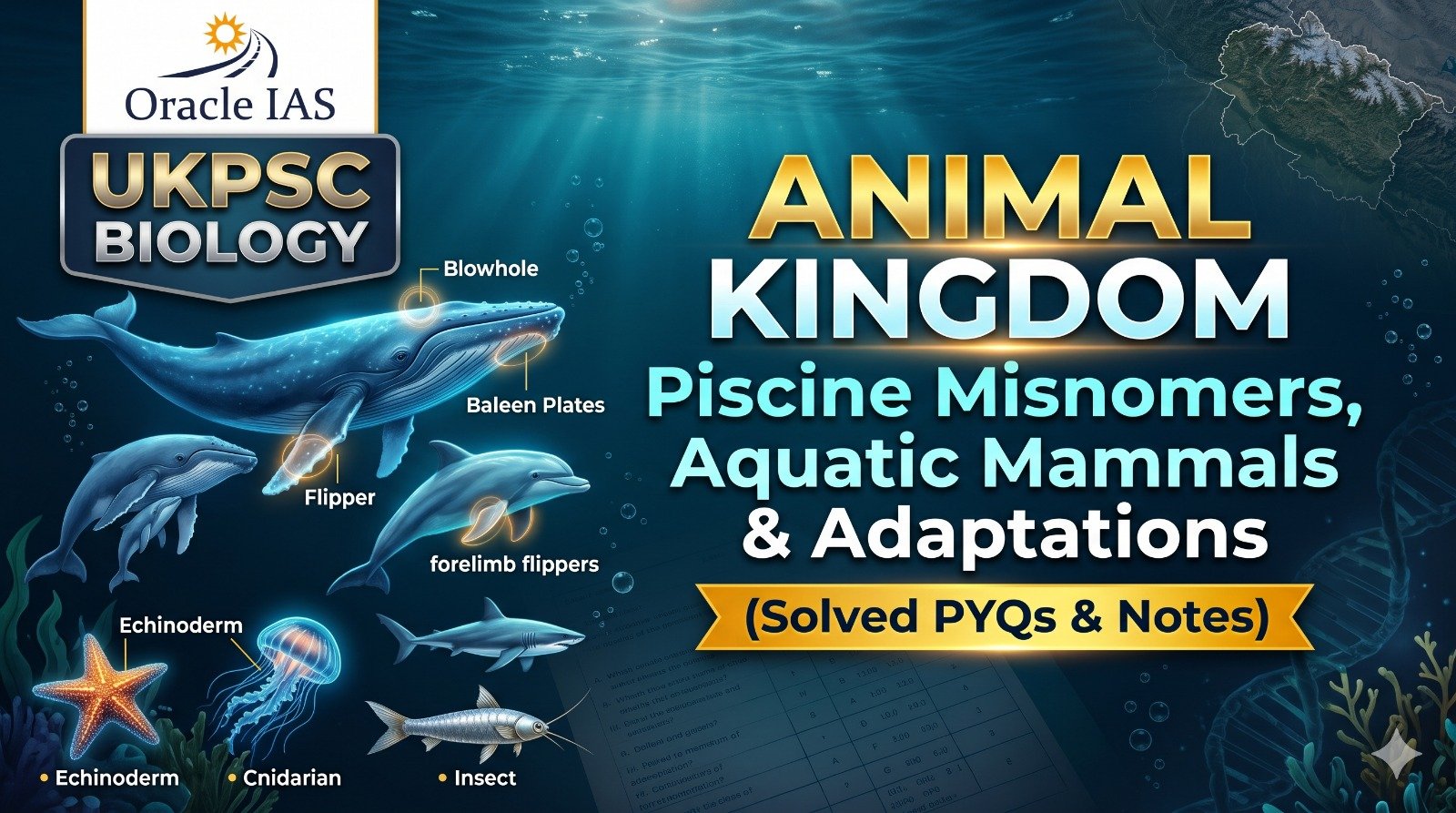
UKPSC Biology (Unit 6): Animal Kingdom, Piscine Misnomers, Aquatic Mammals & Adaptations
Part of the UKPSC General Science & Technology Revision Series.
1.High-Yield Micro-Notes
- Pisces vs. Common Zoological Misnomers: True fishes (super-class Pisces) possess a vertebral column, paired fins, two-chambered venous hearts, and breathe dissolved aquatic oxygen via vascularized gills (branchial respiration). In standard zoological taxonomy: Catfish is a true bony fish (Osteichthyes, order Siluriformes); Silverfish (Lepisma saccharina) is a wingless insect (Arthropoda); Crayfish is a freshwater decapod crustacean (Arthropoda); and Jellyfish (Aurelia) is a non-bilaterian diploblastic cnidarian/coelenterate.
- Aquatic Mammals & Evolutionary Adaptations: Seals are semi-aquatic carnivorous mammals belonging to the clade Pinnipedia (“fin-footed”), possessing thick subcutaneous blubber and flipper modifications. Dolphins and Whales (order Cetacea) are warm-blooded, lung-breathing mammals giving birth to live young and suckling via mammary glands; the Ganges River Dolphin (Platanista gangetica) was declared India’s National Aquatic Animal in 2009. Duck-billed platypus (Ornithorhynchus anatinus) and Echidna are egg-laying primitive mammals (Monotremata/Prototheria), whereas the Great Indian Bustard (Ardeotis nigriceps) is a critically endangered terrestrial grassland bird (class Aves).
- Molluscan Circulatory Peculiarities & Ectoderm Diffusion: The marine cephalopod Octopus possesses three hearts (two branchial hearts pumping deoxygenated blood through the gills and one systemic heart driving oxygenated blood to the tissues) and blue blood containing the copper-based respiratory pigment hemocyanin (unlike iron-based red hemoglobin). The freshwater cnidarian Hydra possesses a simple diploblastic tissue grade of organization lacking blood, blood vessels, and specialized respiratory organs, executing cellular gas exchange entirely through direct epidermal diffusion across its body wall.
- Cranial Kinesis, Transgenic Biotechnology & Chronobiology: While most vertebrate skulls have a fused, immobile upper jaw fixed to the neurocranium, Parrots exhibit prokinetic cranial kinesis (a mobile craniofacial hinge allowing voluntary upward and lateral movement of the upper beak/jaw to crack rigid nuts). Nocturnality (active during night hours) is an ecological behavioral adaptation seen in Mosquitoes, Bats (Chiroptera), and Owls (Strigiformes). In modern biotechnology, Dolly the Sheep (1996) gained historical acclaim as the world’s first mammal successfully cloned from an adult differentiated somatic cell (mammary epithelial cell nuclear transfer by Ian Wilmut).
2. Important facts you should know:
| Organism / Entity | Taxonomic Group / Category | Respiratory / Anatomical Feature | Distinctive Physiological / Physical Trait |
| Catfish | Class Osteichthyes (True Bony Fish) | Branchial respiration via Gills | Ray-finned fish; prominent sensory barbels (“whiskers”). |
| Silverfish (Lepisma) | Phylum Arthropoda (Class Insecta) | Tracheal system | Apterygote (wingless) insect feeding on starch and paper. |
| Crayfish | Phylum Arthropoda (Crustacea) | Gills within branchial chamber | Freshwater decapod crustacean with chelae (pincers). |
| Jellyfish (Aurelia) | Phylum Cnidaria / Coelenterata | Epidermal diffusion | Radial symmetry; stinging cnidocytes; medusa morphology. |
| Octopus | Phylum Mollusca (Cephalopoda) | Branchial hearts + Systemic heart (3 total) | Blue blood via copper-based hemocyanin respiratory pigment. |
| Hydra | Phylum Cnidaria (Hydrozoa) | Cutaneous epidermal diffusion | Avascular; lacks blood/hemolymph; regenerative diploblastic body. |
| Dolphin / Whale | Class Mammalia (Cetacea) | Pulmonary respiration (Lungs) | Viviparous; endothermic; Gangetic Dolphin is National Aquatic Animal. |
| Seal | Class Mammalia (Pinnipedia) | Pulmonary respiration (Lungs) | Flipper-modified limbs; marine carnivore insulated by blubber. |
| Great Indian Bustard | Class Aves (Otididae) | Lungs with air sacs | Heaviest flying grassland bird; Schedule-I protected avian species. |
3. Master Questions
Q1. Which of the following organisms bearing the vernacular suffix ‘fish’ is a taxonomically genuine vertebrate fish belonging to class Pisces?
[UKPSC Mains 2002-03] [Direct Fact]
(a) Silver fish
(b) Cray fish
(c) Jelly fish
(d) Cat fish
Q2. Which of the following groups of animals consists exclusively of organisms that are primarily nocturnal in their behavioural ecology?
[UKPSC UDA/LDA Pre 2003] [Direct Fact]
(a) House fly, Bedbugs, and Parrot
(b) Mosquito, Bats, and Owls
(c) Mosquito, Field Sparrow, and Deer
(d) Barn Owl, Fruit Bats, and Domestic Dogs
Q3. The marine fin-footed carnivore commonly designated as a ‘Seal’ belongs zoologically to the class:
[UKPSC UDA/LDA Pre 2003] [Direct Fact]
(a) Pisces (True Fishes)
(b) Aves (Birds)
(c) Reptilia
(d) Mammalia
Q4. The aquatic Ganges River Dolphin, declared India’s National Aquatic Animal in 2009, is taxonomically classified under the class:
[UKPSC RO/ARO Pre 2021] [Direct Fact]
(a) Amphibia
(b) Pisces
(c) Aves
(d) Mammalia
Q5. In the history of modern biological science and somatic cloning, ‘Dolly’, cloned successfully in 1996 at the Roslin Institute, was a:
[UKPCS Lower Pre 2021] [Direct Fact]
(a) Transgenic Cow
(b) Cloned Sheep
(c) Genetically Engineered Goat
(d) Cloned Primate
Q6. Which marine invertebrate organism possesses three functional hearts and circulates blue-colored blood utilizing the copper-rich pigment hemocyanin?
[UKPSC FRO/ACF Pre 2021] [Direct Fact]
(a) Basking Shark
(b) Antarctic Blue Whale
(c) African Elephant
(d) Octopus
Q7. True aquatic fishes extract dissolved oxygen gas from ambient water primarily through their:
[UKPSC Mains 2006] [Direct Fact]
(a) Cutaneous epidermal skin
(b) Dorsal spiracles
(c) Vascularized Gills
(d) Pectoral and caudal fins
Q8. Which of the following avian species possesses specialized cranial kinesis, allowing it to actively elevate and manipulate its upper jaw independently of its skull?
[UKPSC RO/ARO Pre 2016] [Direct Fact]
(a) Rock Pigeon
(b) Parrot
(c) Himalayan Griffon Vulture
(d) House Sparrow
Q9. Which of the following animals possesses a simple diploblastic tissue grade of organization and completely lacks blood or vascular fluid, yet performs aerobic respiration via diffusion?
[UKPCS Lower Pre 2010] [Direct Fact]
(a) Hydra
(b) Cockroach
(c) Earthworm
(d) Rohu Fish
Q10. Which of the following organisms is an avian species (bird) and is NOT classified as a mammal?
[UKPSC Polytechnic Lecturer 2015-16] [Direct Fact]
(a) Duck-billed Platypus
(b) Microchiropteran Bat
(c) Baleen Whale
(d) Great Indian Bustard
3. Master Explanations & Answer Key
- Ans. (d)
- Direct Answer: Catfish (order Siluriformes) is a true bony ray-finned fish (class Osteichthyes) possessing gills, fins, a vertebral column, and a two-chambered heart.
- Exam Trap / Distractor Alert: Common names ending in “-fish” are frequently non-piscine invertebrates: Silverfish is an apterygote insect (Arthropoda); Crayfish is a crustacean (Arthropoda); Jellyfish is a cnidarian; Starfish is an echinoderm; Cuttlefish is a mollusc.
- High-Yield Extra Facts: Catfish lack typical fish scales and are named for their prominent sensory whiskers (barbels), which contain chemo-receptive taste buds to navigate turbid benthic waters.
- Ans. (b)
- Direct Answer: Mosquitoes (insects), Bats (mammals), and Owls (birds) are nocturnal organisms that rest during daylight hours and forage, feed, and hunt at night.
- Exam Trap / Distractor Alert: Sparrows, parrots, and domestic dogs are diurnal or crepuscular animals; pairing diurnal avian species like sparrows or parrots with nocturnal animals makes those options incorrect.
- High-Yield Extra Facts: Nocturnal predatory birds like owls possess large tubular eyes packed with light-sensitive rod photoreceptors (with few color-sensitive cones) along with a reflective tapetum lucidum layer behind the retina.
- Ans. (d)
- Direct Answer: Seals are semi-aquatic marine mammals belonging to the suborder Pinnipedia (order Carnivora); they breathe air through lungs, maintain endothermic warm-blooded body temperatures, and nurse their young with milk.
- Exam Trap / Distractor Alert: Despite their streamlined, fish-like bodies and flippers, seals are not fish; their flippers are modified pentadactyl mammalian limbs, and they lack gills.
- High-Yield Extra Facts: Pinnipeds are divided into phocids (earless or true seals), otariids (eared fur seals and sea lions), and odobenids (walruses); they possess a thick subcutaneous vascularized fat layer called blubber for thermal insulation in freezing waters.
- Ans. (d)
- Direct Answer: The dolphin is a fully aquatic placental mammal belonging to the infraorder Cetacea (order Artiodactyla), breathing atmospheric air via a dorsal blowhole directly into lungs and nursing calves through mammary glands.
- Exam Trap / Distractor Alert: Dolphins do not belong to the class Pisces; they are warm-blooded homeotherms that lack gills and swim via vertical undulations of their horizontal tail fluke (unlike the lateral side-to-side tail motion of true fish).
- High-Yield Extra Facts: The Ganges River Dolphin (Platanista gangetica, locally called ‘Susu’) is functionally blind and navigates freshwater river systems using advanced ultrasonic echolocation; it serves as a keystone bio-indicator of freshwater river health.
- Ans. (b)
- Direct Answer: Dolly (July 5, 1996 – February 14, 2003) was a female Finnish Dorset sheep and the world’s first mammal cloned from an adult somatic cell using somatic cell nuclear transfer (SCNT).
- Exam Trap / Distractor Alert: Dolly was a somatic nuclear clone, not a transgenic animal modified with foreign recombinant DNA (though historical exam question banks occasionally use the term “transgenic” loosely when referencing her cloning milestone).
- High-Yield Extra Facts: Dolly was cloned by Sir Ian Wilmut and Keith Campbell at the Roslin Institute in Edinburgh, Scotland, proving that differentiated adult somatic cell nuclei retain complete genetic totipotency.
- Ans. (d)
- Direct Answer: An octopus (class Cephalopoda) possesses three hearts (two branchial hearts that pump blood through the gills and one systemic heart that circulates it through the body) and blue blood due to the copper-based metalloprotein hemocyanin.
- Exam Trap / Distractor Alert: Blue whales and sharks have red, iron-based hemoglobin blood; hemocyanin floats freely dissolved in molluscan and crustacean hemolymph rather than inside cellular corpuscles, turning blue upon oxygenation and clear/colorless when deoxygenated.
- High-Yield Extra Facts: When an octopus swims, its central systemic heart stops beating, which is why octopuses prefer crawling along benthic substrate to avoid rapid muscular exhaustion.
- Ans. (c)
- Direct Answer: Fishes extract dissolved oxygen from water through specialized respiratory organs called gills (branchiae), which feature primary and secondary gill lamellae with thin, highly vascularized membranes.
- Exam Trap / Distractor Alert: Gills operate on a counter-current exchange mechanism, where water flows over the lamellae in the opposite direction of capillary blood flow, maximizing oxygen extraction efficiency up to 80–90%.
- High-Yield Extra Facts: In bony fishes (Osteichthyes), gills are protected inside a branchial chamber beneath a bony protective flap called the operculum; cartilaginous sharks (Chondrichthyes) lack opercula and have open, exposed gill slits.
- Ans. (b)
- Direct Answer: Parrots (order Psittaciformes) possess kinetic skulls with a flexible synovial craniofacial hinge joint, enabling them to move their upper beak (maxilla) upward and laterally independent of the braincase.
- Exam Trap / Distractor Alert: In most mammals and avians, the maxilla is rigidly fused to the neurocranium (akinetic skull); parrots utilize upper jaw mobility to generate leverage for cracking tough seed hulls and gripping tree branches.
- High-Yield Extra Facts: This skull mobility, termed rhynchokinesis or prokinetic cranial kinesis, provides parrots with a specialized bite force comparable to large carnivores relative to their body mass.
- Ans. (a)
- Direct Answer: Hydra is a diploblastic freshwater cnidarian/coelenterate consisting of only two cellular layers (ectoderm and endoderm) separated by non-cellular mesoglea; it completely lacks blood, a circulatory system, and respiratory organs, carrying out gas exchange by direct diffusion.
- Exam Trap / Distractor Alert: Earthworms have a closed circulatory system with red hemoglobin dissolved in plasma; cockroaches have open hemolymph with colorless fluid; fishes have closed vascular systems with nucleated red blood cells.
- High-Yield Extra Facts: Hydra reproduces asexually via budding and exhibits extensive tissue regeneration through abundant unspecialized interstitial stem cells.
- Ans. (d)
- Direct Answer: The Great Indian Bustard (Ardeotis nigriceps) is a large, critically endangered terrestrial grassland bird belonging to the class Aves and family Otididae, not a mammal.
- Exam Trap / Distractor Alert: The Duck-billed platypus is a primitive egg-laying monotreme mammal; Bats are flying placental mammals (order Chiroptera); Whales are fully aquatic marine mammals (order Cetacea).
- High-Yield Extra Facts: The Great Indian Bustard is listed under Schedule-I of the Indian Wildlife (Protection) Act, 1972, and is classified as Critically Endangered on the IUCN Red List, with surviving populations concentrated primarily in the Desert National Park of Rajasthan.
Contact Oracle IAS:
Call/WhatsApp 9997453844 for details
Join Our Preparation program:

He is a bibliophile,accomplished writer and a fitness enthusiast.
- UKPSC Biology: Animal Kingdom, Piscine Misnomers, Aquatic Mammals & Adaptations (Solved PYQs & Notes) - November 16, 2026
- UKPSC Biology: Plant Kingdom, Morphology, Photosynthesis & Plant Physiology (Solved PYQs & Notes) - November 14, 2026
- UKPSC Biology: Biological Classification, Monera, Fungi & Plant Diversity (Solved PYQs & Notes) - November 12, 2026
 WhatsApp us