
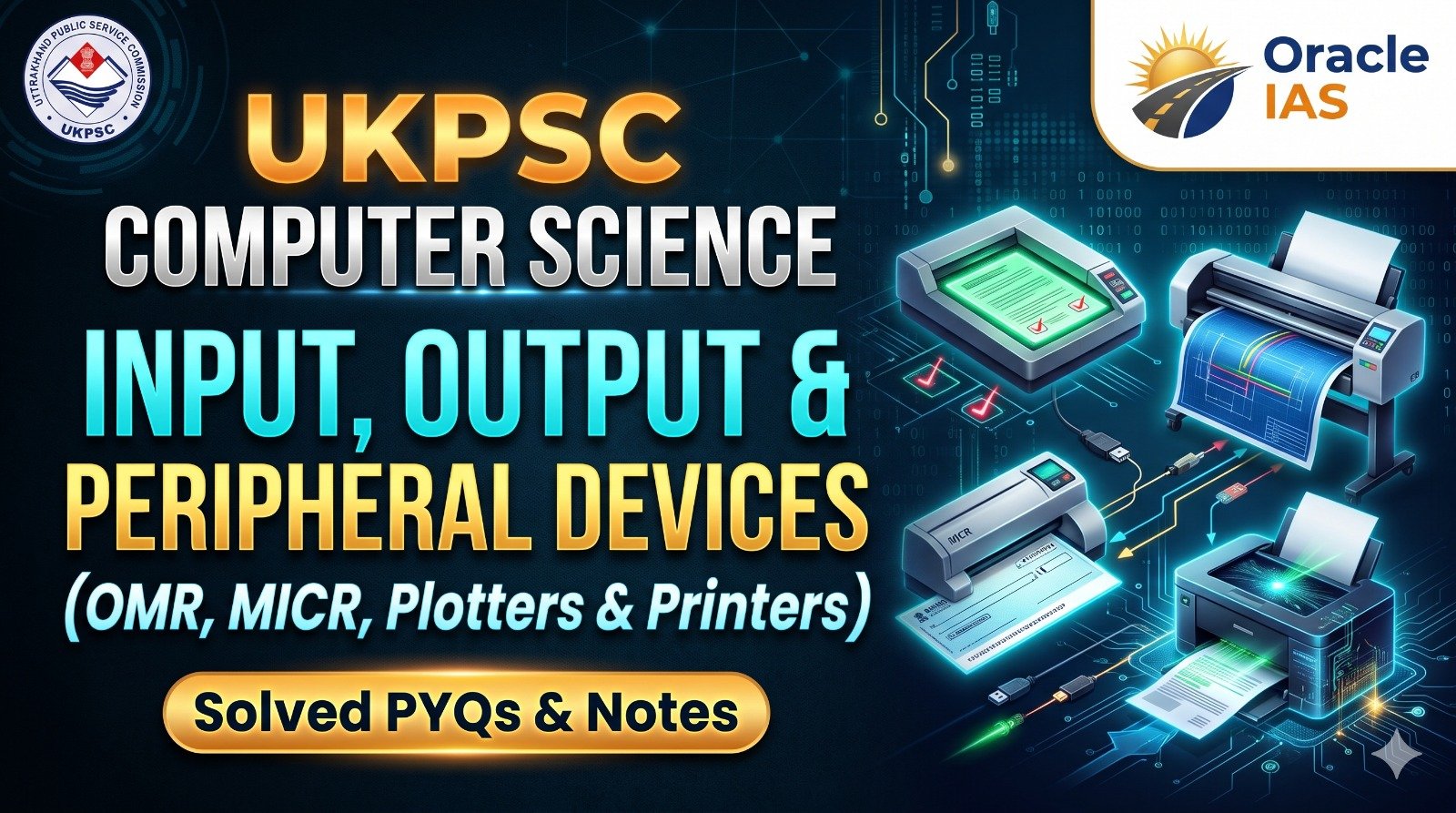
UKPSC Computer Science Unit 2: Input, Output & Peripheral Devices
Part of the UKPSC General Science & Technology Revision Series.
1.High-Yield Micro-Notes
- Peripheral Architecture & Classification: Peripherals are auxiliary hardware devices that connect to a computer system to facilitate human interaction and data input/output without forming part of the core CPU or primary memory bus. They fall into three functional categories:
- Input Devices: Translate human data or physical environmental stimuli into machine-readable digital binary signals (e.g., QWERTY keyboard, optical mouse, flatbed image scanner, trackball, digital graphics tablet, microphone, barcode reader).
- Output Devices: Translate processed binary data into human-perceptible analog, visual, or acoustic forms (e.g., CRT monitors, flat-panel TFT/LED displays, impact and non-impact printers, vector pen plotters, audio speakers).
- Input/Output (Hybrid) Devices: Serve bidirectional communication roles (e.g., interactive capacitive touchscreens, modems, external storage enclosures).
- Pointing & Visual Capture Devices:
- Optical Mouse: An input device using an optoelectronic sensor (LED paired with a digital image processor) to track positional movement across a flat surface, translating motion into cursor coordinates on screen.
- Visual Display Unit (VDU): Encompasses legacy Cathode-Ray Tube (CRT) monitors (which focus directed electron beams onto an internal phosphorescent glass screen within a vacuum tube) as well as modern flat-panel displays built with Light Emitting Diodes (LEDs) and Liquid Crystal Displays (LCDs).
- Printing Technologies & Mechanism Typology:
- Impact Printers: Characters or graphics are formed through mechanical striking against an inked ribbon.
- Dot-Matrix Printer: Operates using a printhead containing a grid array of hardened solenoid-driven pins (typically 9 or 24 pins) that strike an inked ribbon to form character patterns as discrete dot matrices. Characterized by low cost, multi-part carbon copy capabilities, and audible operational noise.
- Daisy Wheel Printer: Uses a rotating metal or plastic wheel with pre-cast letterforms along its petals to produce typewriter-quality text, but cannot print arbitrary graphics.
- Non-Impact Page Printers: Form text and imagery without physical striking against the paper.
- Laser Printer: A high-speed, high-resolution electro-photographic page printer. A laser beam discharges electrostatic charges on a rotating photoreceptor drum; negatively charged dry toner powder adheres to the discharged pattern and is transferred to paper, where it is permanently fused using heated pressure rollers (fuser assembly). Operates quietly at speeds typically ranging from 10 to over 50 pages per minute.
- Automated Data Recognition Systems:
- Optical Mark Recognition (OMR): Uses reflected light sensors to detect pencil or pen marks at predefined coordinates on standardized printed forms. Widely deployed for scoring objective multiple-choice competitive examination answer sheets and survey evaluations.
- Magnetic Ink Character Recognition (MICR): Uses magnetic ink (containing iron oxide pigment) to print standardized characters—specifically the E-13B font—at the bottom of commercial bank cheques. In banking clearing operations, an MICR reader magnetizes the ink and reads the resulting electromagnetic flux signals, allowing cheques to be processed even if obscured by stamps, folds, or manual signatures.
- Optical Character Recognition (OCR): Software algorithms that process scanned bitmap raster images of printed or handwritten text, converting pixel patterns into editable, searchable character encoding (such as ASCII or Unicode).
2. Important facts you should know:
| Peripheral Device | Direction / Role | Primary Operating Principle | Key Practical Deployment |
| Keyboard / Optical Mouse | Input Device | Mechanical/optoelectronic translation | Primary system user input and cursor control. |
| Flatbed Image Scanner | Input Device | Optical array digitization (CCD/CIS) | Captures physical documents as digital raster images. |
| Dot-Matrix Printer | Impact Output | Solenoid pin grid striking an inked ribbon | Continuous stationery; multi-ply carbon copies. |
| Laser Printer | Non-Impact Output | Electro-photographic dry toner fusing | High-speed, high-resolution office page printing. |
| OMR Scanner | Optical Input | Reflected light mark detection | Scoring multiple-choice exam answer sheets. |
| MICR Reader | Magnetic Input | Iron oxide magnetic ink flux detection | Automated routing and clearing of bank cheques. |
| Digital Plotter | Specialized Output | Vector pen/drum line-drawing mechanism | High-precision architectural blueprints and CAD schematics. |
3. Master Questions
Q1. Which of the following devices is classified as an output device and is NOT an input device?
[UKPSC Mains 2010-11 | UKPSC Mains 2006 | UKPSC Revenue Inspector 2023] [Direct Fact]
(a) Flatbed Optical Scanner
(b) Optical Computer Mouse
(c) Standard Alphanumeric Keyboard
(d) Desktop Laser Printer
Q2. An automated optical device designed to read and interpret pencil or dark ink marks placed within predefined bubble positions on examination answer forms is:
[UKPSC Mains 2006 | UKPSC AE 2012 | UKPSC AE 2007] [Direct Fact]
(a) Optical Mark Reader (OMR)
(b) Optical Machine Reader
(c) Magnetic Tape Scanner
(d) Punch Card Reader
Q3. In commercial banking operations, which automated character recognition technology is used on the bottom band of bank cheques to facilitate rapid clearing?
[UKPSC Pre 2011 | UKPSC Forest Ranger Pre 2015 | UKPSC CFO 2021] [Direct Fact]
(a) Optical Mark Recognition (OMR)
(b) Magnetic Ink Character Recognition (MICR)
(c) Barcode Recognition
(d) Voice Recognition Terminal (VRT)
Q4. A legacy Visual Display Unit (VDU) monitor that renders images by directing an electron beam onto a phosphorescent internal screen contains a:
[UKPSC Mains 2010-11] [Direct Fact]
(a) Hard disk platter
(b) Microprocessor bus
(c) Cathode-Ray Tube (CRT)
(d) Charge-Coupled Device
Q5. Which of the following hardware peripherals is classified as an impact printer that forms characters on paper by striking an array of pins against an inked fabric ribbon?
[UKPSC CFO 2021] [Direct Fact]
(a) Thermal Inkjet Printer
(b) Electro-photographic Laser Printer
(c) Dot-Matrix Printer
(d) Large-format Drum Plotter
Q6. An input peripheral device that captures physical photographs, printed documents, or text and converts them into digital raster data for computer storage is a:
[UKPCS Lower Pre 2016 | UKPSC AE 2007] [Direct Fact]
(a) Pen Plotter
(b) Thermal Printer
(c) Visual Monitor
(d) Image Scanner
Q7. Which of the following hardware devices is considered an external peripheral rather than an integral core component of the Central Processing Unit or system motherboard?
[UKPSC Regional Inspector 2022] [Direct Fact]
(a) Arithmetic Logic Unit (ALU)
(b) USB Pen Drive
(c) Primary System RAM
(d) Processor Control Unit (CU)
4. Master Explanations & Answer Key
- Ans. (d)
- Direct Answer: A Printer is an output device that produces physical hard copies of processed data; scanners, mice, and keyboards are input devices that send data to the computer.
- Exam Trap / Distractor Alert: Plotters, monitors, printers, and speakers are output devices; mice, keyboards, scanners, webcams, and microphones are input devices; interactive touchscreens function as dual input/output interfaces.
- High-Yield Extra Facts: Printers are classified by imaging technology into impact printers (dot-matrix, line printers) and non-impact printers (laser, inkjet, thermal, dye-sublimation).
- Ans. (a)
- Direct Answer: OMR stands for Optical Mark Reader (or Optical Mark Recognition), a technology that senses marks on paper by measuring differences in reflected light intensity between marked and unmarked positions.
- Exam Trap / Distractor Alert: OMR does not decode handwritten letters or words (which requires Optical Character Recognition, OCR); it checks for the presence or absence of a mark at calibrated physical coordinates.
- High-Yield Extra Facts: OMR systems are widely used in standardized test evaluation because they can read thousands of pre-printed answer sheets per hour with high accuracy.
- Ans. (b)
- Direct Answer: Commercial banks use MICR (Magnetic Ink Character Recognition) to read the routing numbers and cheque numbers printed on the bottom band of cheques.
- Exam Trap / Distractor Alert: OMR reads bubbles on exam answer forms; OCR reads printed alphanumeric text; MICR reads magnetic ink character fonts (E-13B or CMC-7) containing iron oxide particles.
- High-Yield Extra Facts: On Indian bank cheques, the MICR band contains a 9-digit numerical code divided into three parts: the first three digits indicate the City Code, the middle three indicate the Bank Code, and the final three indicate the specific Branch Code.
- Ans. (c)
- Direct Answer: Legacy visual display monitors use a Cathode-Ray Tube (CRT), an evacuated glass envelope containing electron guns that accelerate focused electron beams toward a phosphor-coated screen to illuminate pixels.
- Exam Trap / Distractor Alert: Flat-panel displays have replaced CRTs in modern computing using Liquid Crystal Displays (LCDs) with LED backlighting or Organic Light Emitting Diode (OLED) panels.
- High-Yield Extra Facts: CRT displays generate raster images using horizontal and vertical magnetic deflection coils (yokes) that steer electron beams line by line across the screen at refresh rates typically between 60 Hz and 85 Hz.
- Ans. (c)
- Direct Answer: A Dot-Matrix Printer is an impact printer that uses a moving printhead equipped with an array of electromagnetic pins (typically 9 or 24 pins) that strike an inked ribbon to imprint dots on paper.
- Exam Trap / Distractor Alert: Laser and inkjet printers are non-impact devices that do not strike the paper; dot-matrix printers remain in use for printing multipart forms with carbon paper copies (e.g., invoices, railway reservation counters).
- High-Yield Extra Facts: The resolution of a dot-matrix printer is measured in dots per inch (DPI), with output quality ranging from draft mode to Near Letter Quality (NLQ) mode.
- Ans. (d)
- Direct Answer: An Image Scanner is an input device that illuminates paper documents using a light source and captures the reflected image via a Charge-Coupled Device (CCD) or Contact Image Sensor (CIS) array, converting the document into a digital raster image.
- Exam Trap / Distractor Alert: A plotter produces vector graphics output; a scanner captures optical input from physical documents into a digital file.
- High-Yield Extra Facts: Optical scanners can capture imagery at resolutions typically spanning 300 to 2400 DPI (dots per inch) in 24-bit true color depth, often paired with OCR software to extract editable text from scanned pages.
- Ans. (b)
- Direct Answer: A USB Pen Drive is an external, removable secondary flash memory peripheral; the CPU, Control Unit, and primary motherboard RAM modules are internal core system components.
- Exam Trap / Distractor Alert: The processor (ALU, CU) and system memory are part of the core processing architecture; devices connected via external USB ports are classified as peripherals.
- High-Yield Extra Facts: USB pen drives connect via the Universal Serial Bus (USB) using the USB Mass Storage device class standard, transferring data across solid-state NAND flash memory cells.
Contact Oracle IAS:
Call/WhatsApp 9997453844 for details
Join Our Preparation program:

He is a bibliophile,accomplished writer and a fitness enthusiast.
- UKPSC Computer Science: Cybersecurity, Malware, IT Act 2000 & Cloud Computing (Solved PYQs & Notes) - November 28, 2026
- UKPSC Computer Science: Computer Networks, Data Transmission, OSI Model & Internet Protocols (Solved PYQs & Notes) - November 28, 2026
- UKPSC Computer Science: Programming Languages, Compilers & Database Systems (DBMS) (Solved PYQs & Notes) - November 28, 2026