
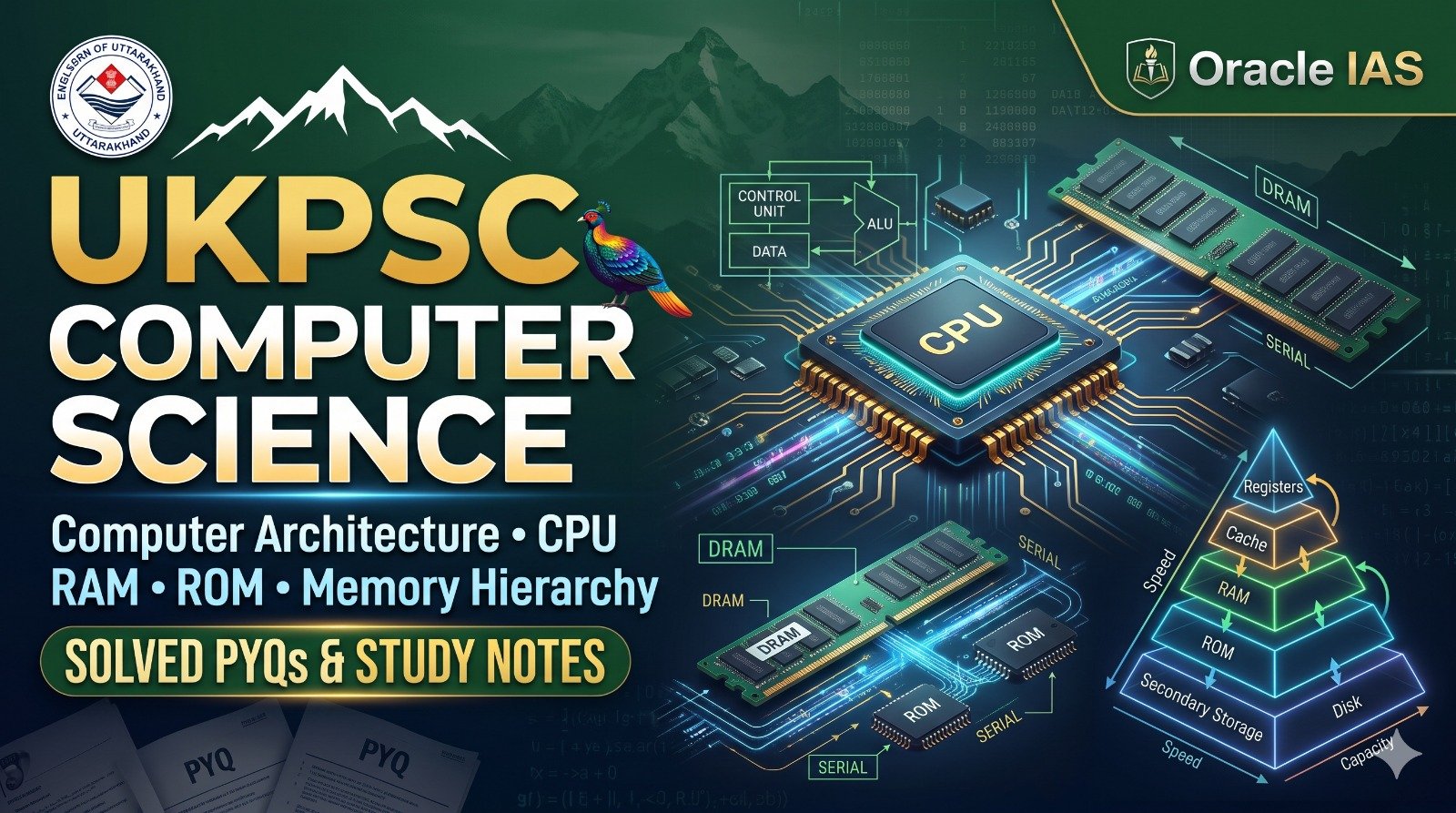
UKPSC Computer Science Unit 1: Fundamentals, Generations & Computer Architecture
Part of the UKPSC General Science & Technology Revision Series.
1.High-Yield Micro-Notes
- Historical Pioneers & Foundational Machines:
- Charles Babbage: Celebrated as the “Father of Computers” for designing the mechanical Difference Engine (1822) and the conceptual general-purpose Analytical Engine (1837), which introduced an input mechanism, arithmetic processor (“the Mill”), memory store (“the Store”), and output system using punched cards.
- Atanasoff-Berry Computer (ABC): Developed between 1937 and 1942 by John Vincent Atanasoff and Clifford Berry at Iowa State University; recognized as the first automatic electronic digital computing device incorporating binary arithmetic and regenerative capacitor memory.
- ENIAC (Electronic Numerical Integrator and Computer): Completed in 1945 at the University of Pennsylvania by J. Presper Eckert and John Mauchly; widely recognized as the world’s first general-purpose, fully electronic digital computer, containing over 17,000 thermionic vacuum tubes.
- Hardware Generations & Core Technologies:
- Pre-First Generation: Mechanical and electro-mechanical computing apparatus (e.g., Pascaline, Babbage’s engines, Hollerith tabulators, Harvard Mark-I).
- First Generation (1940–1956): Relied on Vacuum Tubes (thermionic valves) for computational circuits and magnetic drums for memory; programmed using low-level machine language (pure binary bits 0 and 1); characterized by large physical size, high electrical power consumption, and substantial heat generation (e.g., ENIAC, EDVAC, UNIVAC-I).
- Second Generation (1956–1963): Replaced vacuum tubes with Transistors (invented at Bell Labs in 1947 by Bardeen, Brattain, and Shockley); introduced magnetic core primary memory and assembly language using mnemonic operation codes (e.g., IBM 1401, IBM 1620).
- Third Generation (1964–1971): Adopted Integrated Circuits (ICs), fabricated by integrating multiple transistors, resistors, and capacitors onto single crystalline silicon semiconductor microchips via photolithography (pioneered by Jack Kilby and Robert Noyce); introduced small-scale and medium-scale integration (SSI and MSI), semiconductor primary RAM, and time-sharing operating systems (e.g., IBM System/360).
- Fourth Generation (1971–Present): Built around Microprocessors deploying Very Large Scale Integration (VLSI) and Ultra Large Scale Integration (ULSI), consolidating the Central Processing Unit onto a single silicon chip (e.g., Intel 4004 in 1971, Intel Pentium, Core series); gave rise to affordable personal microcomputers (PCs) and distributed computer networks.
- Fifth Generation (Present & Beyond): Focuses on Artificial Intelligence (AI), ultra-parallel processing, quantum computing, natural language processing, and advanced problem-solving using logic-based declarative programming languages (e.g., PROLOG, LISP).
- Central Processing Unit (CPU) Micro-Architecture: Regarded as the “Brain of the Computer”, the CPU coordinates data processing and execution across three integrated subunits:
- Arithmetic Logic Unit (ALU): Executes basic arithmetic calculations (addition, subtraction, multiplication, division) and logical comparisons (AND, OR, NOT, relational evaluations).
- Control Unit (CU): Directs internal data flow and execution timing. It fetches instructions sequentially from memory, decodes program instruction operation codes, and generates control signals to route operands between internal registers, the ALU, and input/output interfaces.
- Processor Registers: High-speed, low-capacity storage cells located directly on the processor die. The Program Counter (PC), also termed the Instruction Pointer (IP), holds the memory address of the next sequential machine instruction to be fetched and executed. A CPU machine cycle refers to the time taken to fetch, decode, execute, and store a basic instruction. Processor operational frequency is measured in Gigahertz (GHz), where 1 GHz represents one billion clock cycles per second.
- Motherboard, Power-On Self-Test & Digital Representation:
- Motherboard (System Board): The central printed circuit board (PCB) inside a computer chassis that provides physical sockets and traces connecting the CPU, RAM modules, expansion cards, chipset, and peripheral interfaces.
- Power-On Self-Test (POST): An initial diagnostic testing routine executed by the ROM-based BIOS immediately upon system boot, verifying functional integrity across the processor, system memory, keyboard, and storage controllers before loading the operating system into RAM.
- Digital Logic & Number Systems: Digital computers operate on the binary base-2 number system using two discrete voltage states representing binary digits: 0 and 1. In basic binary addition, $1 + 1$ yields 0 with a carry of 1 (representing binary value $10_2$, decimal 2). Logic circuits that can synthesize all other Boolean operations are called Universal Logic Gates (specifically NAND and NOR gates).
- Supercomputing Milestones: High-performance systems engineered for floating-point calculations in scientific modeling, climate forecasting, and nuclear physics. India’s first indigenous supercomputer was PARAM 8000, developed in 1991 under the leadership of Dr. Vijay Bhatkar at the Centre for Development of Advanced Computing (C-DAC), Pune.
2. Important facts you should know:
| Component / Technological Feature | Structural Definition | Key Function / Operational Metric |
| Central Processing Unit (CPU) | Primary microprocessor die | Directs instruction execution; integrates the ALU, CU, and registers. |
| Control Unit (CU) | Instruction management unit of CPU | Fetches and decodes instructions; generates sequencing and control signals. |
| Arithmetic Logic Unit (ALU) | Computational logic unit of CPU | Executes arithmetic arithmetic operations and binary logic decisions. |
| Program Counter (PC) | Dedicated internal processor register | Stores the memory address of the next sequential instruction to execute. |
| Clock Frequency (GHz) | Processor clock cycle rate | Millions/billions of clock cycles per second; determines internal execution speed. |
| Integrated Circuit (IC) | Photolithographic silicon microchip | Consolidates thousands to billions of transistors on a semiconductor substrate. |
| Universal Logic Gates | NAND and NOR circuits | Can be combined to construct any basic Boolean logic operation (AND, OR, NOT). |
| POST Routine | BIOS firmware diagnostic test | Executes initial hardware checks upon power-on before OS bootstrap. |
3. Master Questions
Q1. The operational clock speed of a modern computer microprocessor is typically measured in gigahertz (GHz), which indicates:
[UKPSC Pre 2024] [Direct Fact]
(a) Total display pixel density
(b) Screen image rendering resolution
(c) Processing cycle speed of electronic instruction execution
(d) Secondary magnetic storage capacity
Q2. In the architecture of the Central Processing Unit (CPU), the acronym ‘ALU’ stands for:
[UKPSC Pre 2004-05 | UKPSC RO/ARO Pre 2016] [Direct Fact]
(a) Algebraic Logic Unit
(b) Arithmetic Logic Unit
(c) Algebraic Local Unit
(d) Arithmetic Local Unit
Q3. The dedicated functional component of the CPU responsible for decoding program instructions and managing the transfer of data between main memory and the ALU is the:
[UKPSC Pre 2006-07 | UKPSC RO/ARO Mains 2016 | UKPSC AE 2012] [Direct Fact]
(a) Control Unit (CU)
(b) Primary Cache
(c) Read Only Memory
(d) Arithmetic Logic Unit
Q4. The Central Processing Unit (CPU) is traditionally referred to as the:
[UKPSC Pre 2006-07 | UKPSC Mains 2002-03 | UKPSC RO/ARO Pre 2022 | UKPSC CFO 2021] [Direct Fact]
(a) Heart of data input
(b) Brain of the computer
(c) Auxiliary memory repository
(d) Peripheral transmission gateway
Q5. Modern computer integrated circuit (IC) microchips are fabricated primarily from which semiconductor material?
[UKPSC Pre 2006-07 | UKPSC Pre 2011 | UKPSC FRO/ACF Pre 2021 | UKPSC Revenue Inspector 2023] [Direct Fact]
(a) Highly purified carbon
(b) Metallic boron
(c) Crystalline silicon
(d) Synthetic germanium
Q6. The historically renowned mechanical computing device conceived and designed by Charles Babbage in 1837, which incorporated an arithmetic mill and memory store, was called the:
[UKPSC RO/ARO Pre 2016] [Direct Fact]
(a) Electronic Abacus
(b) Analytical Engine
(c) Difference Calculator
(d) Universal Step Reckoner
Q7. Which electronic hardware components defined the second generation of digital computers, replacing bulky thermionic vacuum tubes?
[UKPSC RO/ARO Pre 2016] [Direct Fact]
(a) Vacuum diodes
(b) Discrete transistors
(c) Integrated circuits
(d) Very Large Scale Integration (VLSI) microprocessors
Q8. In binary base-2 digital arithmetic, performing the addition of binary digits $1 + 1$ produces:
[UKPCS Lower Pre 2010] [Direct Fact]
(a) 0
(b) 0 with a carry of 1
(c) 0 with no carry
(d) 1
Q9. Built during World War II at the University of Pennsylvania, which machine is recognized as the world’s first operational, general-purpose electronic digital computer?
[UKPSC Mains 2004-05] [Direct Fact]
(a) UNIVAC-I
(b) ENIAC
(c) EDVAC
(d) Colossus Mark-I
Q10. The specific internal processor register that stores the memory address of the next instruction waiting to be fetched and executed is the:
[UKPSC Junior Assistant 2022] [Direct Fact]
(a) Buffer Register
(b) Program Counter (PC)
(c) Memory Data Register
(d) Accumulator
Q11. The diagnostic firmware self-test routine initiated automatically by the system BIOS when a computer is powered on is designated as:
[UKPSC Junior Assistant 2022] [Direct Fact]
(a) POST (Power-On Self-Test)
(b) GHOST
(c) BOOT-TRAP
(d) HOT-PLUG
Q12. Which class of digital logic gates is designated as a “Universal Gate” because it can be combined to implement any basic Boolean function?
[UKPSC Revenue Inspector 2023] [Direct Fact]
(a) AND gate
(b) NAND gate
(c) NOT gate
(d) XOR gate
Q13. Integrated Circuits (ICs) were first introduced into digital computer systems during which hardware generation?
[UKPSC Revenue Inspector 2023] [Direct Fact]
(a) First Generation
(b) Second Generation
(c) Third Generation
(d) Fourth Generation
Q14. The primary circuit board inside a computer chassis that houses the CPU socket, RAM slots, and bus expansion interfaces is the:
[UKPSC Mains 2002-03] [Direct Fact]
(a) Expansion Board
(b) Motherboard
(c) Control Board
(d) System Terminal
Q15. India’s first indigenously designed supercomputer, unveiled in 1991 by C-DAC Pune, was named:
[UKPSC Pre 2011 | UKPSC Forest Ranger Pre 2012] [Direct Fact]
(a) Shubham
(b) PARAM 8000
(c) SX-2
(d) BBC-Micro
4. Master Explanations & Answer Key
- Ans. (c)
- Direct Answer: Microprocessor operating frequencies are measured in Gigahertz (GHz), representing billions of clock cycles per second and reflecting how rapidly the CPU can execute low-level machine instructions.
- Exam Trap / Distractor Alert: GHz measures clock frequency and internal processing throughput; it does not measure screen resolution (pixels) or primary/secondary storage capacity (bytes).
- High-Yield Extra Facts: While higher clock frequencies allow instructions to execute faster within a given microarchitecture, overall performance also depends on the number of physical cores, cache size, and Instructions Per Cycle (IPC).
- Ans. (b)
- Direct Answer: ALU stands for Arithmetic Logic Unit, the core execution subunit within the CPU that carries out elementary arithmetic calculations and Boolean logic evaluations.
- Exam Trap / Distractor Alert: The correct expansion uses “Arithmetic” and “Logic” (or Logical), not “Algebraic” or “Local.”
- High-Yield Extra Facts: The ALU uses binary adder circuits to perform subtraction, multiplication, and division via two’s complement arithmetic and shift operations.
- Ans. (a)
- Direct Answer: The Control Unit (CU) fetches instructions from memory, decodes their operation codes, and coordinates data routing between registers, memory, and the ALU.
- Exam Trap / Distractor Alert: The ALU performs arithmetic calculations; memory stores instructions and operands; the Control Unit generates the timing and control signals that coordinate instruction execution.
- High-Yield Extra Facts: Modern control units are implemented using either hardwired control logic (fixed combinatorial circuits designed for speed) or microprogrammed control logic (which interprets instructions via microcode stored in internal control ROM).
- Ans. (b)
- Direct Answer: The Central Processing Unit (CPU) is commonly termed the “brain of the computer” because it processes instructions, controls input/output operations, and manages system memory.
- Exam Trap / Distractor Alert: Memory stores data; power supplies provide electrical energy; the CPU performs the instruction decoding and logical computation.
- High-Yield Extra Facts: A basic CPU integrates the Control Unit, the Arithmetic Logic Unit, and internal registers (such as the Accumulator, Program Counter, and Instruction Register), connected via high-speed internal buses.
- Ans. (c)
- Direct Answer: Integrated Circuit (IC) microchips and modern microprocessors are manufactured on thin wafers of single-crystal silicon (Si), an abundant elemental semiconductor with an energy bandgap suitable for room-temperature operation.
- Exam Trap / Distractor Alert: Early point-contact transistors in the 1940s and 1950s used germanium (Ge); commercial semiconductor manufacturing shifted to silicon because it forms a stable protective thermal oxide ($SiO_2$) layer that facilitates planar photolithography.
- High-Yield Extra Facts: Silicon microchips are fabricated in cleanroom environments by doping silicon with group-13 elements (such as boron, to create p-type regions) and group-15 elements (such as phosphorus, to create n-type regions) to construct CMOS field-effect transistors.
- Ans. (b)
- Direct Answer: The Analytical Engine, designed by British mathematician Charles Babbage in 1837, is recognized as the historical mechanical forerunner of modern digital computers.
- Exam Trap / Distractor Alert: Babbage’s earlier Difference Engine (1822) was a mechanical calculator designed specifically to compute polynomial mathematical tables; the Analytical Engine was a general-purpose, programmable design incorporating loops, conditional branching, and memory.
- High-Yield Extra Facts: English mathematician Ada Lovelace wrote the first published algorithm intended for execution on Babbage’s Analytical Engine (to calculate Bernoulli numbers), earning her recognition as the world’s first computer programmer.
- Ans. (b)
- Direct Answer: Second-generation computers (spanning roughly 1956 to 1963) replaced vacuum tubes with discrete transistors, significantly reducing machine physical volume, power consumption, and operating failure rates.
- Exam Trap / Distractor Alert: First Generation = Vacuum Tubes; Second Generation = Transistors; Third Generation = Integrated Circuits (ICs); Fourth Generation = Microprocessors (VLSI/ULSI).
- High-Yield Extra Facts: Examples of second-generation mainframe computers include the IBM 1401 (widely adopted for commercial data processing) and the scientific IBM 1620.
- Ans. (b)
- Direct Answer: In binary base-2 addition, $1_2 + 1_2$ produces a sum bit of 0 and a carry bit of 1, forming the binary representation $10_2$ (equivalent to decimal 2).
- Exam Trap / Distractor Alert: Binary addition rules: $0 + 0 = 0$; $0 + 1 = 1$; $1 + 0 = 1$; $1 + 1 = 0$ (with carry 1); and $1 + 1 + 1 = 1$ (with carry 1).
- High-Yield Extra Facts: Half-adder digital circuits use an XOR gate to generate the sum bit and an AND gate to generate the carry bit.
- Ans. (b)
- Direct Answer: The ENIAC (Electronic Numerical Integrator and Computer), unveiled in 1945 by J. Presper Eckert and John Mauchly at the University of Pennsylvania, was the world’s first general-purpose, fully electronic digital computer.
- Exam Trap / Distractor Alert: The Atanasoff-Berry Computer (ABC) was electronic but not general-purpose; the British Colossus (1943) was electronic and programmable but specialized for cryptanalysis; ENIAC was the first general-purpose, high-speed electronic digital computer.
- High-Yield Extra Facts: ENIAC contained over 17,000 vacuum tubes, weighed roughly 30 metric tons, and drew approximately 150 kW of electrical power, operating with plugboards and function switches for program setup.
- Ans. (b)
- Direct Answer: The Program Counter (PC), also termed the Instruction Pointer (IP), is a dedicated processor register that holds the memory address of the next sequential instruction to be fetched and executed.
- Exam Trap / Distractor Alert: The Instruction Register (IR) holds the currently executing instruction; the Program Counter holds the address of the subsequent instruction and automatically increments with each instruction fetch.
- High-Yield Extra Facts: When executing branch, jump, or subroutine call instructions, the CPU writes the target jump address into the Program Counter, redirecting sequential program flow.
- Ans. (a)
- Direct Answer: When a computer system is turned on, the BIOS firmware executes an initial diagnostic routine called the Power-On Self-Test (POST) to verify that basic hardware components (CPU, RAM, system timer, keyboard controller) are functional before loading the OS.
- Exam Trap / Distractor Alert: If a critical hardware component fails during POST, the motherboard firmware emits audio beep error codes via an internal speaker or stops execution with an on-screen diagnostic code.
- High-Yield Extra Facts: Following a successful POST check, the BIOS locates the master boot record (MBR) or EFI system partition on the boot storage device to load the operating system bootloader into primary RAM.
- Ans. (b)
- Direct Answer: NAND and NOR gates are classified as Universal Logic Gates because any fundamental Boolean function (AND, OR, NOT, XOR, XNOR) can be implemented using combinations of only NAND or only NOR gates.
- Exam Trap / Distractor Alert: AND, OR, and NOT gates are basic logic gates, but they are not universal on their own; NAND and NOR gates can synthesize all other logic operations without additional gate types.
- High-Yield Extra Facts: Semiconductor fabrication facilities often produce uniform arrays of NAND gates to lower manufacturing costs, interconnecting them to construct processors and flash storage.
- Ans. (c)
- Direct Answer: Integrated Circuits (ICs) were introduced into commercial digital computers during the Third Generation (1964–1971), replacing individual discrete transistor circuits.
- Exam Trap / Distractor Alert: Third-generation systems used Small and Medium Scale Integration (SSI and MSI) chips; single-chip microprocessors using Very Large Scale Integration (VLSI) define the Fourth Generation.
- High-Yield Extra Facts: The introduction of ICs led to the development of minicomputers (such as the DEC PDP-8) and standardized mainframe computer families (such as the IBM System/360).
- Ans. (b)
- Direct Answer: The Motherboard (mainboard or system board) is the primary printed circuit board that connects internal computing components, including the CPU, primary RAM, expansion buses, storage controllers, and peripheral ports.
- Exam Trap / Distractor Alert: Auxiliary boards installed into PCI or PCIe slots are termed daughterboards or expansion cards; the primary host board is the motherboard.
- High-Yield Extra Facts: The motherboard contains system chipset controllers (historically divided into the Northbridge for memory/graphics and Southbridge for slower I/O, now largely integrated into the CPU die and unified Platform Controller Hubs).
- Ans. (b)
- Direct Answer: India’s first indigenous supercomputer was PARAM 8000, developed and built in 1991 by the Centre for Development of Advanced Computing (C-DAC) in Pune under the leadership of Dr. Vijay Bhatkar.
- Exam Trap / Distractor Alert: C-DAC was established after international export restrictions prevented India from purchasing Cray X-MP supercomputers; India developed the open-architecture, parallel-processing PARAM series in response.
- High-Yield Extra Facts: The PARAM family evolved through subsequent architectures, including PARAM 10000, PARAM Padma, PARAM Yuva, and recent National Supercomputing Mission (NSM) systems such as PARAM Siddhi-AI and PARAM Ananta
Contact Oracle IAS:
Call/WhatsApp 9997453844 for details
Join Our Preparation program:

He is a bibliophile,accomplished writer and a fitness enthusiast.
- UKPSC Computer Science: Cybersecurity, Malware, IT Act 2000 & Cloud Computing (Solved PYQs & Notes) - November 28, 2026
- UKPSC Computer Science: Computer Networks, Data Transmission, OSI Model & Internet Protocols (Solved PYQs & Notes) - November 28, 2026
- UKPSC Computer Science: Programming Languages, Compilers & Database Systems (DBMS) (Solved PYQs & Notes) - November 28, 2026
 WhatsApp us