UKPSC Physics: Heat, Thermodynamics & Thermal Physics
1. High-Yield Micro-Notes
- Thermal Properties & Conduction: Thermal conductivity (k) is an intrinsic material property; it depends strictly on the nature and physical composition of the material, not on dimensions like length or cross-sectional area (which determine overall thermal resistance, R = L / (k·A)). Materials lacking free valence electrons (e.g., silk, dry wood, glass, rubber) act as electrical and thermal insulators, whereas metals (copper, aluminum) and the human body conduct current.
- Thermal Anomalies & Phase Transitions: Water exhibits anomalous expansion between 0 °C and 4 °C; its density is maximum at 4 °C (1.000 g/cm³), while its volume is at a minimum. Converting 1 gram of ice at 0 °C to steam at 100 °C requires 716 calories in three stages: latent heat of fusion (80 cal) + sensible heating of water from 0 °C to 100 °C (100 cal) + latent heat of vaporization (536–540 cal).
- Fluid Dynamics & Pressure Dependencies: Under elevated pressure inside a sealed pressure cooker, the boiling point of water increases above 100 °C (typically to 120–121 °C), allowing food to cook faster due to higher sustained thermal energy. With rising temperature, the viscosity of liquids decreases (weakened intermolecular cohesive forces), whereas the viscosity of gases increases (accelerated molecular momentum exchange).
- Physiological Norms & Combustion Dynamics: Average resting human core body temperature is 37 °C (98.6 °F). Conventional batch pasteurization (LTLT method) heats raw milk to 62.8 °C (145 °F) for 30 minutes, followed by rapid chilling to halt pathogen growth. During domestic cooking, soot deposit blackening the exterior bottom of a cooking pan indicates incomplete fuel combustion caused by insufficient oxygen supply.
2. Facts you should know
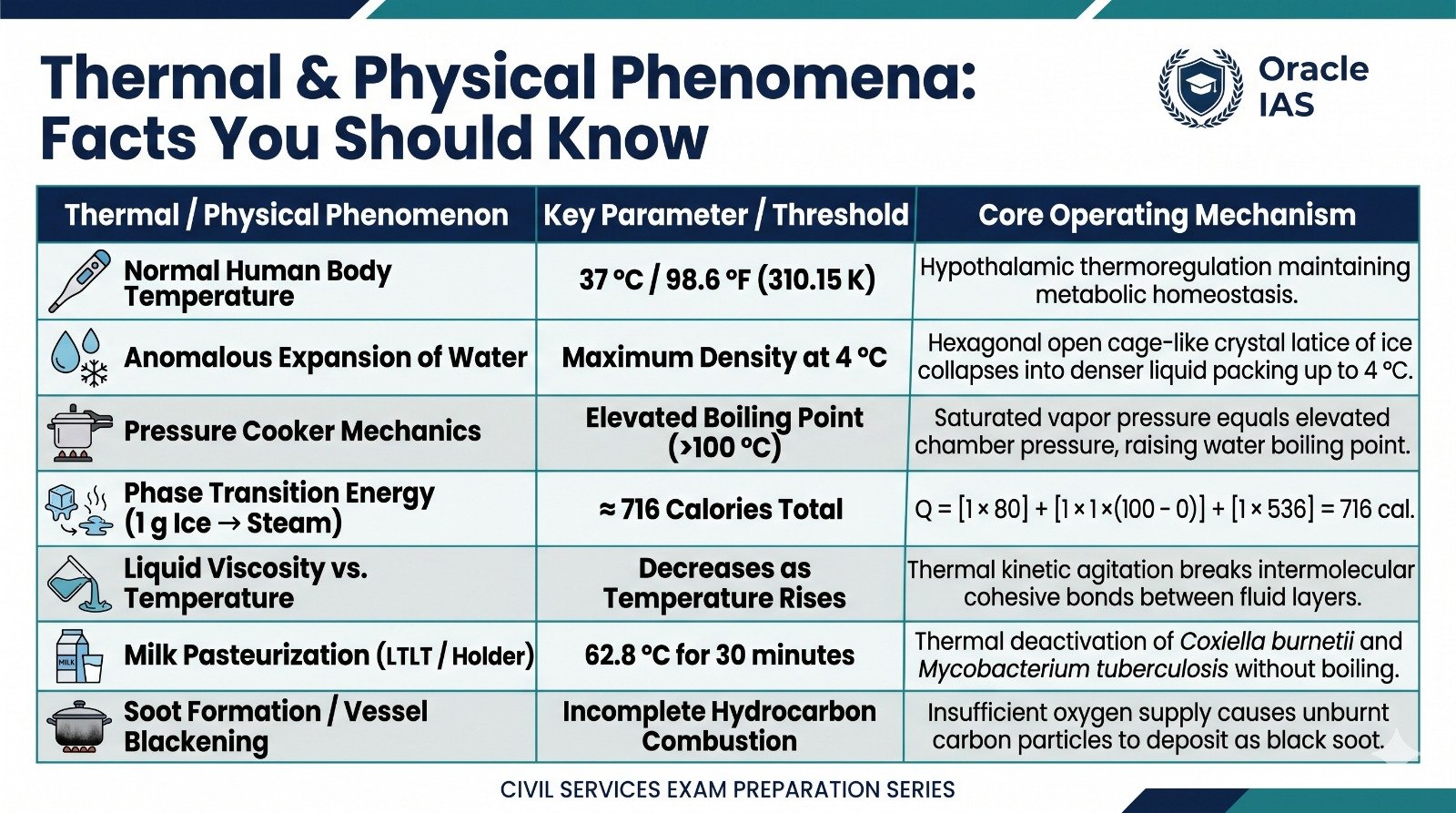
| Thermal / Physical Phenomenon | Key Parameter / Threshold | Core Operating Mechanism |
| Normal Human Body Temperature | 37 °C / 98.6 °F (310.15 K) | Hypothalamic thermoregulation maintaining metabolic homeostasis. |
| Anomalous Expansion of Water | Maximum Density at 4 °C | Hexagonal open cage-like crystal lattice of ice collapses into denser liquid packing up to 4 °C. |
| Pressure Cooker Mechanics | Elevated Boiling Point (>100 °C) | Saturated vapor pressure equals elevated chamber pressure, raising water boiling point. |
| Phase Transition Energy (1 g Ice → Steam) | ≈ 716 Calories Total | Q = [1 × 80] + [1 × 1 × (100 – 0)] + [1 × 536] = 716 cal. |
| Liquid Viscosity vs. Temperature | Decreases as Temperature Rises | Thermal kinetic agitation breaks intermolecular cohesive bonds between fluid layers. |
| Milk Pasteurization (LTLT / Holder) | 62.8 °C for 30 minutes | Thermal deactivation of Coxiella burnetii and Mycobacterium tuberculosis without boiling. |
| Soot Formation / Vessel Blackening | Incomplete Hydrocarbon Combustion | Insufficient air/oxygen intake yields unburnt carbonaceous soot particles (yellow flame). |
3. Master Questions
Q1. The thermal conductivity (k) of a metallic or composite rod is fundamentally determined by its:
[UKPSC RO/ARO Pre 2023] [Direct Fact]
(a) Total linear length
(b) Overall structural mass
(c) Cross-sectional surface area
(d) Chemical and physical nature of the material
Q2. The mean normal body temperature of a healthy human being is internationally standardized at:
[UKPSC Pre 2004-05] [Direct Fact]
(a) 37 °C
(b) 37 °F
(c) 98.4 °C
(d) 98.4 Kelvin
Q3. Which of the following substances behaves as an electrical insulator due to the absence of unbound free electrons?
[UKPSC RO/ARO Pre 2022] [Direct Fact]
(a) Refined Copper
(b) Natural Silk
(c) Human body
(d) Pure Aluminum
Q4. The low-temperature long-time (LTLT) holder method for milk pasteurization requires sustained heating at:
[UKPSC FRO/ACF Pre 2021] [Direct Fact]
(a) 54 °C for 30 minutes
(b) 62.8 °C for 30 minutes
(c) 72 °C for 32 minutes
(d) 100 °C for 10 minutes
Q5. As the ambient thermal temperature of a fluid is increased, the internal viscous resistance (viscosity) of a liquid:
[UKPSC Pre 2016] [Direct Fact]
(a) Increases steadily
(b) Decreases
(c) Remains completely invariant
(d) Fluctuates unpredictably regardless of molecular nature
Q6. What is the total quantity of thermal energy (in calories) required to convert 1 gram of solid ice at 0 °C into dry steam at 100 °C at standard atmospheric pressure?
[UKPCS Lower Pre 2010] [Direct Fact]
(a) 80 calories
(b) 336 calories
(c) 716 calories
(d) 620 calories
Q7. Food cooks noticeably faster inside an airtight pressure cooker primarily because:
[UKPSC Pre 2004-05 | UKPCS Lower Pre 2010] [Direct Fact]
(a) Radiative heat cannot escape through the sealed metal casing
(b) Trapped steam is inherently colder than boiling fluid
(c) High internal pressure raises the boiling point of water
(d) Water begins boiling at an abnormally lower temperature
Q8. Liquid water attains its maximum physical density and minimum specific volume at:
[UKPSC Polytechnic Lecturer 2015-16] [Direct Fact]
(a) 100 °C
(b) 4 °C
(c) 0 °C
(d) (-)4 °C
Q9. During domestic cooking over a gas or kerosene stove, if the outer bottom of the metal cooking vessel becomes coated with black soot, it signifies that:
[UKPSC Revenue Inspector 2023] [Direct Fact]
(a) The food items inside remain undercooked
(b) The fuel is undergoing incomplete combustion
(c) The fuel contains excess water content
(d) The fuel is undergoing 100% complete combustion
4. Master Explanations & Answer Key
- Ans. (d)
- Direct Answer: Thermal conductivity (k) is an intensive physical property governed solely by the material composition, crystal structure, and free electron/phonon density of the rod.
- Exam Trap / Distractor Alert: Do not confuse thermal conductivity (k) with thermal resistance (R) or thermal conductance; length (L) and cross-sectional area (A) alter total heat flow rate (Q/t = k·A·ΔT / L), but the intrinsic conductivity constant (k) remains invariant.
- High-Yield Extra Facts: Diamond possesses the highest thermal conductivity of any known bulk solid at room temperature (≈ 2000 W/m·K) via lattice phonon vibrations; among common metals, silver (≈ 429 W/m·K) and copper (≈ 398 W/m·K) lead.
- Ans. (a)
- Direct Answer: The normal physiological baseline core temperature of a healthy human being is 37 °C, equivalent to 98.6 °F (or 310.15 Kelvin).
- Exam Trap / Distractor Alert: Pay close attention to unit symbols; options offering 37 °F (freezing range) or 98.4 °C (near boiling water) are distractor traps designed to catch speed-reading errors.
- High-Yield Extra Facts: The clinical scale conversion formula is (C / 5) = (F – 32) / 9 = (K – 273.15) / 5; Celsius and Fahrenheit scales read the exact same numerical value at -40° (-40 °C = -40 °F).
- Ans. (b)
- Direct Answer: Natural silk is a protein-based non-metallic polymer lacking delocalized valence electrons or mobile ions, making it an electrical insulator.
- Exam Trap / Distractor Alert: The human body is a conductor of electricity due to aqueous electrolytic fluids containing dissolved sodium, potassium, and chloride ions; copper and aluminum are classic metallic conductors.
- High-Yield Extra Facts: Pure deionized distilled water is an insulator, but tap water readily conducts current due to dissolved mineral salts; mica is unique as an electrical insulator with high thermal conductivity.
- Ans. (b)
- Direct Answer: In the classic Low-Temperature Long-Time (LTLT) or Holder method, milk is heated to 62.8 °C (145 °F) for 30 minutes, followed by rapid cooling to below 10 °C.
- Exam Trap / Distractor Alert: The High-Temperature Short-Time (HTST) pasteurization method heats milk to 71.7 °C (72 °C) for 15 to 20 seconds, whereas Ultra-High Temperature (UHT) processing reaches 135–150 °C for 1 to 2 seconds.
- High-Yield Extra Facts: Pasteurization was pioneered in 1864 by French chemist Louis Pasteur to halt microbial fermentation; the process kills pathogenic bacteria like Coxiella burnetii, Salmonella, and Listeria without destroying milk proteins.
- Ans. (b)
- Direct Answer: As temperature rises, liquid viscosity decreases because increased thermal agitation expands intermolecular spacing and weakens cohesive forces between fluid layers.
- Exam Trap / Distractor Alert: The behavior of gases is the exact reverse: the viscosity of gases increases with temperature because higher temperatures accelerate molecular velocities, intensifying inter-layer momentum transfer.
- High-Yield Extra Facts: An ideal fluid possesses zero viscosity (inviscid) and zero compressibility; the SI unit of dynamic viscosity is Poiseuille (Pa·s), while the CGS unit is Poise (1 Pa·s = 10 Poise).
- Ans. (c)
- Direct Answer: The total heat required is approximately 716 calories: Latent heat to melt ice at 0 °C (80 cal) + Sensible heat to raise water from 0 °C to 100 °C (1 g × 1 cal/g·°C × 100 °C = 100 cal) + Latent heat of vaporization at 100 °C (≈ 536 cal) = 80 + 100 + 536 = 716 calories.
- Exam Trap / Distractor Alert: If the question asks only for converting ice at 0 °C to water at 0 °C, the answer is 80 calories; if it asks only to convert water at 100 °C to steam, it is ≈ 536 to 540 calories.
- High-Yield Extra Facts: The specific heat capacity of liquid water is exceptionally high (1 cal/g·°C or 4184 J/kg·K), which prevents rapid temperature swings in aquatic ecosystems and makes water an effective engine coolant.
- Ans. (c)
- Direct Answer: Sealed pressure cookers trap escaping steam, raising internal chamber pressure to around 2 atmospheres, which increases the boiling point of water from 100 °C to 120–121 °C.
- Exam Trap / Distractor Alert: Water does not boil faster or at a lower temperature inside a cooker; it boils at a higher temperature, transferring more thermal energy to the food per second.
- High-Yield Extra Facts: At high altitudes in the Himalayas (such as Badrinath or Kedarnath in Uttarakhand), reduced atmospheric pressure causes water to boil below 100 °C (around 88–92 °C), making cooking in open pots difficult without a pressure cooker.
- Ans. (b)
- Direct Answer: Liquid water reaches its maximum density (1.000 g/cm³ or 1000 kg/m³) at 4 °C due to anomalous thermal expansion.
- Exam Trap / Distractor Alert: Below 4 °C down to 0 °C, water expands instead of contracting, meaning solid ice at 0 °C is less dense (≈ 0.917 g/cm³) than liquid water, allowing ice to float.
- High-Yield Extra Facts: This anomalous expansion allows high-altitude lakes to freeze only at the surface during winter, leaving a 4 °C liquid water reservoir at the bottom that preserves aquatic life.
- Ans. (b)
- Direct Answer: Black soot on the exterior of cooking vessels is unburnt elemental carbon, indicating incomplete combustion of hydrocarbon fuel due to inadequate oxygen airflow.
- Exam Trap / Distractor Alert: Complete combustion of liquefied petroleum gas (LPG) produces carbon dioxide (CO₂) and water vapor (H₂O) with a clear blue, soot-free flame.
- High-Yield Extra Facts: Adjusting the burner’s air shutter vents admits more atmospheric oxygen, restoring a blue stoichiometric flame and stopping carbon soot buildup.
Contact Oracle IAS:
Call/WhatsApp 9997453844 for details
Join Our Preparation program:

He is a bibliophile,accomplished writer and a fitness enthusiast.
- UKPSC Physics: Heat, Thermodynamics & Thermal Physics (Solved PYQs & Notes) - October 15, 2026
- UPPCS Pre Revision #7: UP Districts, Divisions & Boundaries || Oracle IAS - October 14, 2026
- UKPSC Physics: Waves, Speed of Sound & Modern Particle Physics (Solved PYQs & Notes) - October 14, 2026