UKPSC Chemistry Unit 1: Physical Chemistry, States of Matter, pH Scale & Water Properties
1.High-Yield Micro-Notes
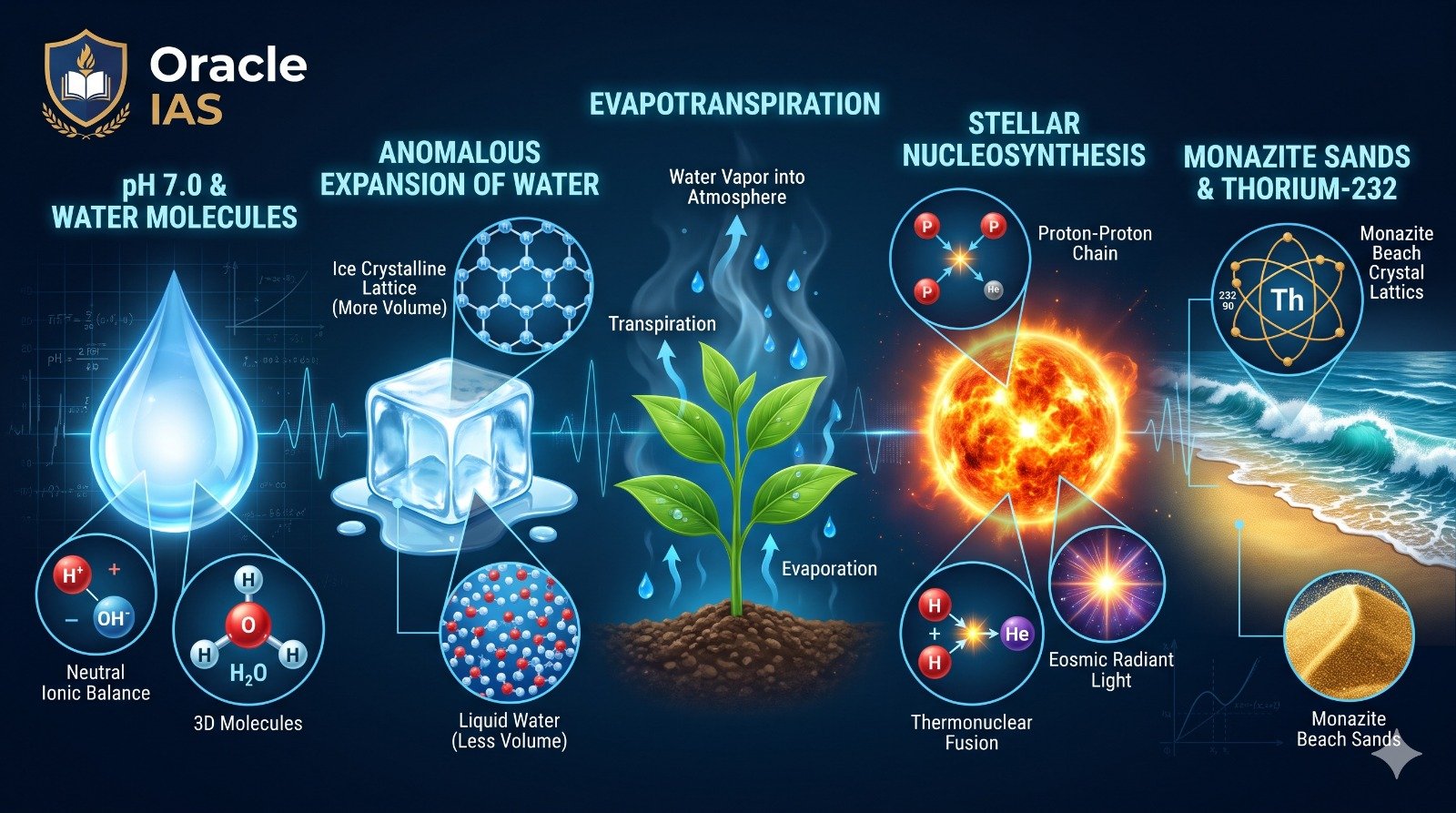
- Aqueous Equilibria & Neutrality: The pH scale, formulated in 1909 by S.P.L. Sørensen, defines hydrogen ion concentration as pH = -log₁₀[H⁺]. Pure neutral water at 25 °C dissociates equally into H⁺ and OH⁻ ions (each 10⁻⁷ mol/L), yielding an exact pH of 7.0. Solutions with pH < 7 are acidic, while those with pH > 7 are basic/alkaline.
- Thermal Anomalies & Phase Transitions of Water: Solid ice possesses an open, cage-like hexagonal crystal lattice held by hydrogen bonds, making it less dense (≈ 0.917 g/cm³) than liquid water. Consequently, when ice melts into water between 0 °C and 4 °C, its volume decreases while its density increases, reaching maximum density and minimum volume at 4 °C.
- Hydrological Dynamics & Water Purity: Distilled water is chemically pure H₂O produced through vaporization and condensation, free of dissolved mineral salts, suspended colloids, and microbes (making it ideal for chemical laboratories, storage batteries, and intravenous pharmaceuticals, though unsuitable for regular hydration due to absence of essential electrolytes). The biological release of water vapor into the atmosphere by vegetative biomass combined with soil evaporation is termed Evapotranspiration.
- Nuclear Energetics & Indian Mineral Reserves: Stars, including the Sun, derive their continuous core radiant energy from thermonuclear fusion, converting light hydrogen nuclei into heavier helium. India possesses the world’s largest known reserves of Thorium (roughly 25% of global deposits), primarily found in the coastal monazite beach sands of Kerala, Tamil Nadu, and Andhra Pradesh, which serves as the cornerstone fuel for Stage 3 of India’s Nuclear Power Programme.
2. Important facts you should know:
| Physical / Chemical Property | Key Metric / Phenomenon | Governing Mechanism / Real-World Implication |
| Pure Neutral Water | pH ≈ 7.0 (at 25 °C) | Equal ion product [H⁺][OH⁻] = 10⁻¹⁴; ionic balance between hydronium and hydroxyl ions. |
| Melting of Ice (0 °C to 4 °C) | Volume decreases (Density increases) | Collapse of open hexagonal hydrogen-bonded ice lattice into closely packed liquid state. |
| Distilled Water | Chemically pure H₂O (Conductivity ≈ 0) | Devoid of dissolved minerals/electrolytes; acts as a poor conductor of electricity. |
| Evapotranspiration | Plant transpiration + Soil evaporation | Major hydrological cycle pathway returning terrestrial surface moisture to the troposphere. |
| Stellar Nucleosynthesis | Thermonuclear Fusion | High-temperature fusion of light nuclei (Proton-Proton chain / CNO cycle) releasing immense energy. |
| Monazite Beach Sands | Thorium-232 phosphate mineral | Accounts for ~25% of global thorium reserves; concentrated heavily along the Kerala and Tamil Nadu coast. |
3. Master Questions
Q1. Under standard laboratory conditions (25 °C), the pH value of pure neutral water is:
[UKPSC Pre 2004-05] [Direct Fact]
(a) Approximately zero
(b) About 7
(c) 5 or less than 5
(d) 8.7 or above
Q2. Which radioactive actinide element, vital for advanced nuclear fuel cycles, occurs in exceptionally large deposits along the coastal placer sands of India?
[UKPSC Pre 2006-07] [Direct Fact]
(a) Plutonium
(b) Radium
(c) Thorium
(d) Enriched Uranium
Q3. The continuous release of radiant energy from the core of the Sun and distant stellar bodies is driven by:
[UKPSC Pre 2006-07] [Direct Fact]
(a) Thermonuclear Fusion
(b) Heavy element Nuclear Fission
(c) Highly exothermic chemical oxidation
(d) Pure gravitational contraction
Q4. When a block of solid ice undergoes melting into liquid water at 0 °C, its physical volume:
[UKPSC RO/ARO Mains 2016] [Direct Fact]
(a) Decreases
(b) Increases
(c) First decreases and then increases
(d) Remains unchanged
Q5. The combined physiological and hydrological mechanism through which terrestrial vegetation transfers liquid water from the soil into atmospheric moisture is termed:
[UKPSC RO/ARO Mains 2016] [Direct Fact]
(a) Condensation
(b) Precipitation
(c) Surface Runoff
(d) Evapotranspiration
Q6. Which of the following forms of water is chemically pure, completely demineralized, and free of dissolved mineral salts and volatile impurities?
[UKPSC AE 2012] [Direct Fact]
(a) Boiled water
(b) Distilled water
(c) Bottled mineral water
(d) Natural spring water
3. Master Explanations & Answer Key
- Ans. (b)
- Direct Answer: Pure water at 25 °C has a pH of approximately 7.0, representing exact neutrality where hydronium ion concentration equals hydroxide ion concentration ([H⁺] = [OH⁻] = 1.0 × 10⁻⁷ mol/L).
- Exam Trap / Distractor Alert: Natural rainwater is slightly acidic (pH ≈ 5.6) due to dissolved atmospheric carbon dioxide forming carbonic acid (H₂CO₃); acid rain is formally defined when precipitation pH drops below 5.6.
- High-Yield Extra Facts: The autoionization constant of water (Kw) increases with rising temperature; therefore, at higher temperatures (e.g., 60 °C), the neutral pH point shifts below 7.0, even though the water remains chemically neutral.
- Ans. (c)
- Direct Answer: India holds approximately 25% of the world’s thorium deposits, predominantly sequestered in the mineral monazite within coastal placer sands across Kerala, Tamil Nadu, Odisha, and Andhra Pradesh.
- Exam Trap / Distractor Alert: Natural thorium (Th-232) is fertile rather than fissile; it cannot sustain a chain reaction directly and must first absorb neutrons in a fast breeder reactor to transmute into fissile Uranium-233.
- High-Yield Extra Facts: In Homi Bhabha’s three-stage nuclear power roadmap, Stage 3 is engineered specifically to deploy Advanced Heavy Water Reactors (AHWRs) powered by the Thorium-232 / Uranium-233 fuel cycle.
- Ans. (a)
- Direct Answer: Stars produce their energy via nuclear fusion, primarily through the proton-proton chain reaction where four light hydrogen nuclei fuse into a single stable helium-4 nucleus with a net mass defect converted into energy (E = mc²).
- Exam Trap / Distractor Alert: Nuclear fission is the splitting of heavy atomic nuclei (such as U-235) utilized in terrestrial nuclear power stations, not in stellar cores.
- High-Yield Extra Facts: Fusion requires core temperatures exceeding 10–15 million Kelvin to overcome the repulsive electrostatic Coulomb barrier between positively charged protons; Hans Bethe was awarded the 1967 Nobel Prize in Physics for explaining stellar nucleosynthesis.
- Ans. (a)
- Direct Answer: When ice melts into water between 0 °C and 4 °C, its volume decreases because the rigid, open hexagonal crystal lattice of ice collapses into a more compact liquid molecular arrangement.
- Exam Trap / Distractor Alert: Most substances expand upon melting; water is anomalous. Liquid water reaches its minimum volume and maximum density (1.000 g/cm³) at 4 °C.
- High-Yield Extra Facts: Because ice has a lower density than liquid water (≈ 0.917 g/cm³), icebergs and ice cubes float with roughly 9/10ths of their bulk submerged and only 1/10th protruding above the water surface.
- Ans. (d)
- Direct Answer: Evapotranspiration encompasses the dual processes of direct physical evaporation from soil and open water surfaces coupled with biological transpiration through plant stomata into the atmosphere.
- Exam Trap / Distractor Alert: Condensation is the reverse phase change (water vapor turning into liquid droplets to form clouds/dew); precipitation describes condensed water falling as rain, snow, or sleet.
- High-Yield Extra Facts: Nearly 97–99% of the water absorbed by plant root networks is released back into the troposphere via stomatal transpiration, cooling the plant canopy and sustaining regional hydrological precipitation cycles.
- Ans. (b)
- Direct Answer: Distilled water is purified through thermal distillation (evaporation followed by condensation), removing dissolved mineral salts, heavy metals, suspended colloids, and biological contaminants.
- Exam Trap / Distractor Alert: Boiling water kills living biological pathogens (bacteria and cysts) but leaves non-volatile dissolved mineral salts and heavy metals behind; spring water and mineral water naturally retain dissolved calcium, magnesium, and bicarbonate ions.
- High-Yield Extra Facts: Distilled water has an electrical conductivity near zero because it lacks charge-carrying dissolved ions; drinking exclusively distilled water over extended periods is inadvisable because it lacks dietary minerals and can leach electrolytes from bodily tissues.
Contact Oracle IAS:
Call/WhatsApp 9997453844 for details
Join Our Preparation program:

He is a bibliophile,accomplished writer and a fitness enthusiast.
- UKPSC Chemistry: Organic Chemistry, Hydrocarbons, Fuels, LPG & Carbon Allotropes (Solved PYQs & Notes) - October 25, 2026
- UKPSC Chemistry: Inorganic Chemistry, Metallurgy, Alloys, Ores & Water Hardness (Solved PYQs & Notes) - October 25, 2026
- UKPSC Chemistry: Physical Chemistry, States of Matter, pH Scale & Water Properties (Solved PYQs & Notes) - October 25, 2026