UKPSC Physics: Gravitation, Fluid Properties, Escape Velocity & Astronomy
1. High-Yield Micro-Notes
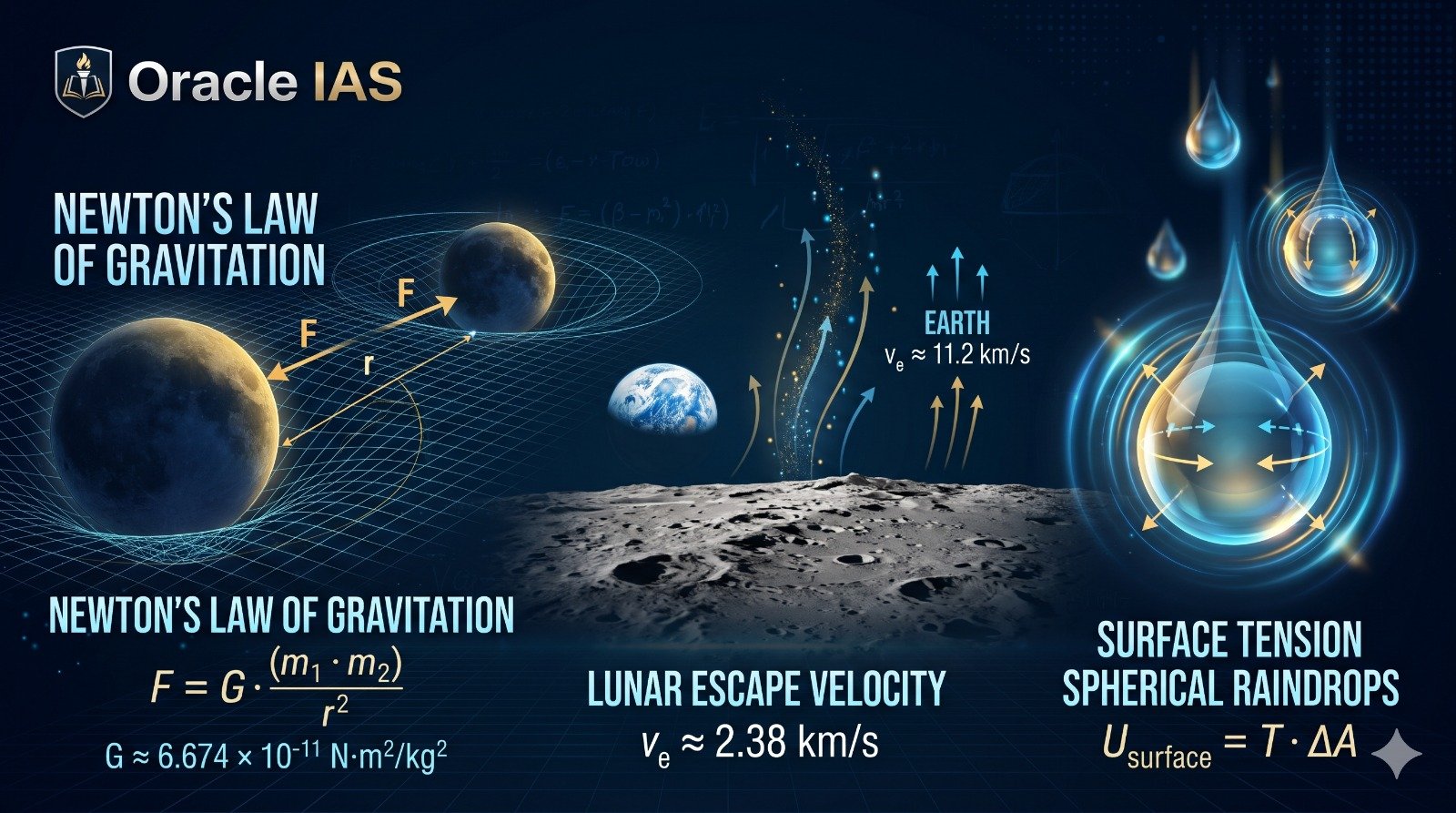
- Universal Law of Gravitation: Formulated by Sir Isaac Newton in 1687 (published in Philosophiae Naturalis Principia Mathematica), the law states that every particle attracts every other particle with a mutual force directly proportional to the product of their masses and inversely proportional to the square of the distance between their centers: F = G·(m₁·m₂) / r². The universal gravitational constant G ≈ 6.674 × 10⁻¹¹ N·m²/kg² is invariant across the entire cosmos.
- Planetary Atmospheres & Escape Velocity: Retention of an atmosphere around a celestial body requires its surface escape velocity (v_e = √(2·G·M / R) = √(2·g·R)) to exceed the root-mean-square (RMS) thermal velocity of ambient gas molecules (v_rms = √(3·R·T / M)). On the Moon, surface gravity is approximately one-sixth of Earth’s (g_moon ≈ 1.62 m/s²), resulting in a low escape velocity of only ≈ 2.38 km/s (compared to Earth’s 11.2 km/s). Solar heating accelerates lunar gas molecules beyond this escape threshold, causing them to dissipate into space and leaving the Moon without an atmosphere.
- Surface Tension & Drop Morphology: Surface tension (T = F / L) is the cohesive intermolecular property of liquids where surface molecules experience an unbalanced inward net attraction, causing the free surface layer to behave like an elastic stretched membrane. Because a sphere provides the absolute minimum surface area for a given volume, surface tension pulls falling raindrops and free liquid droplets into a spherical/circular shape.
2. Important facts you should know:
| Physical Law / Phenomenon | Governing Equation / Constant | Physical Mechanism / Impact |
| Newton’s Law of Gravitation | F = G·(m₁·m₂) / r² | Mutual attractive force; inverse-square field operating between all mass in the universe. |
| Universal Gravitational Constant (G) | G ≈ 6.674 × 10⁻¹¹ N·m²/kg² | Fundamental physical constant; first measured experimentally by Henry Cavendish (1798). |
| Lunar Escape Velocity | v_e ≈ 2.38 km/s (Earth ≈ 11.2 km/s) | Lower surface gravity allows thermalized gas molecules to boil off into space (no lunar atmosphere). |
| Spherical Raindrops (Surface Tension) | U_surface = T · ΔA (Minimizes A) | Cohesive hydrogen bonding draws liquid volume into minimum surface area (spherical geometry). |
3. Master Questions
Q1. The physical phenomenon responsible for falling raindrops naturally assuming a spherical or circular shape is:
[UKPSC Mains 2002-03] [Direct Fact]
(a) Principle of Surface Tension
(b) Law of Rotational Inertia
(c) Hooke’s Principle of Elasticity
(d) Conservation of Kinetic Energy
Q2. The Universal Law of Gravitation, which governs the mutual attraction between celestial bodies and masses across the universe, was propounded by:
[UKPSC RO/ARO Pre 2006 | UKPSC AE 2007] [Direct Fact]
(a) Johannes Kepler
(b) Galileo Galilei
(c) Sir Isaac Newton
(d) Nicolaus Copernicus
Q3. The Earth’s Moon possesses no substantial atmosphere primarily because:
[UKPSC AE 2013] [Direct Fact]
(a) The Moon exerts zero gravitational pull
(b) Its gravitational force is comparatively weak, resulting in an escape velocity lower than the thermal speed of gas molecules
(c) The Moon’s gravitational field is excessively high, crushing gases into the lunar crust
(d) Kinetic repulsion between gas molecules is uniquely amplified in lunar vacuum
4. Master Explanations & Answer Key
- Ans. (a)
- Direct Answer: Raindrops adopt a spherical shape due to surface tension, which pulls the liquid surface inward to minimize surface area for a given volume.
- Exam Trap / Distractor Alert: Viscosity resists fluid shear motion, while surface tension governs shape and boundary contraction; aerodynamic drag flattens very large falling drops into a teardrop or parachute shape near the ground, but surface tension remains the primary spherical shaping force.
- High-Yield Extra Facts: Surface tension of water decreases as temperature rises; adding surfactants (like soaps or detergents) lowers water’s surface tension, allowing it to penetrate fabric fibers and clean more effectively.
- Ans. (c)
- Direct Answer: Sir Isaac Newton formulated the Universal Law of Gravitation in 1687, demonstrating that gravitational attraction decreases with the square of the separation distance between two bodies.
- Exam Trap / Distractor Alert: Johannes Kepler formulated the three empirical laws of planetary orbital motion (elliptical orbits, equal areas in equal times, and T² ∝ a³), but Newton provided the dynamical physical explanation via gravity.
- High-Yield Extra Facts: Henry Cavendish experimentally measured the numerical value of the gravitational constant G in 1798 using a torsion balance; Albert Einstein expanded on Newtonian gravity in 1915 with General Relativity, describing gravity as the curvature of spacetime.
- Ans. (b)
- Direct Answer: The Moon’s weak surface gravity (about 1/6th of Earth’s) produces a low escape velocity of only 2.38 km/s; daytime solar heating raises gas molecule thermal speeds above this threshold, causing the atmosphere to escape.
- Exam Trap / Distractor Alert: The Moon does not have zero gravity—its surface gravitational acceleration is approximately 1.62 m/s²; it cannot retain an atmosphere because its escape velocity is lower than the thermal velocities of common gases (like oxygen, nitrogen, and water vapor).
- High-Yield Extra Facts: Earth retains its atmosphere because its escape velocity (11.2 km/s) is well above the average thermal speed of atmospheric gases; Jupiter’s immense escape velocity (≈ 59.5 km/s) allows it to retain even the lightest primordial gases, hydrogen and helium.
Contact Oracle IAS:
Call/WhatsApp 9997453844 for details
Join Our Preparation program:

He is a bibliophile,accomplished writer and a fitness enthusiast.
- UKPSC Physics: Gravitation, Fluid Properties, Escape Velocity & Astronomy (Solved PYQs & Notes) - October 23, 2026
- UPPCS Pre Revision #11: Architecture, Museums, Archives & Archaeological Sites of Uttar Pradesh - October 22, 2026
- UKPSC Physics: Modern & Nuclear Physics, Radioactivity, Fission & Fusion (Solved PYQs & Notes) - October 22, 2026