1. Introduction: Why Uttar Pradesh’s Heritage Matters
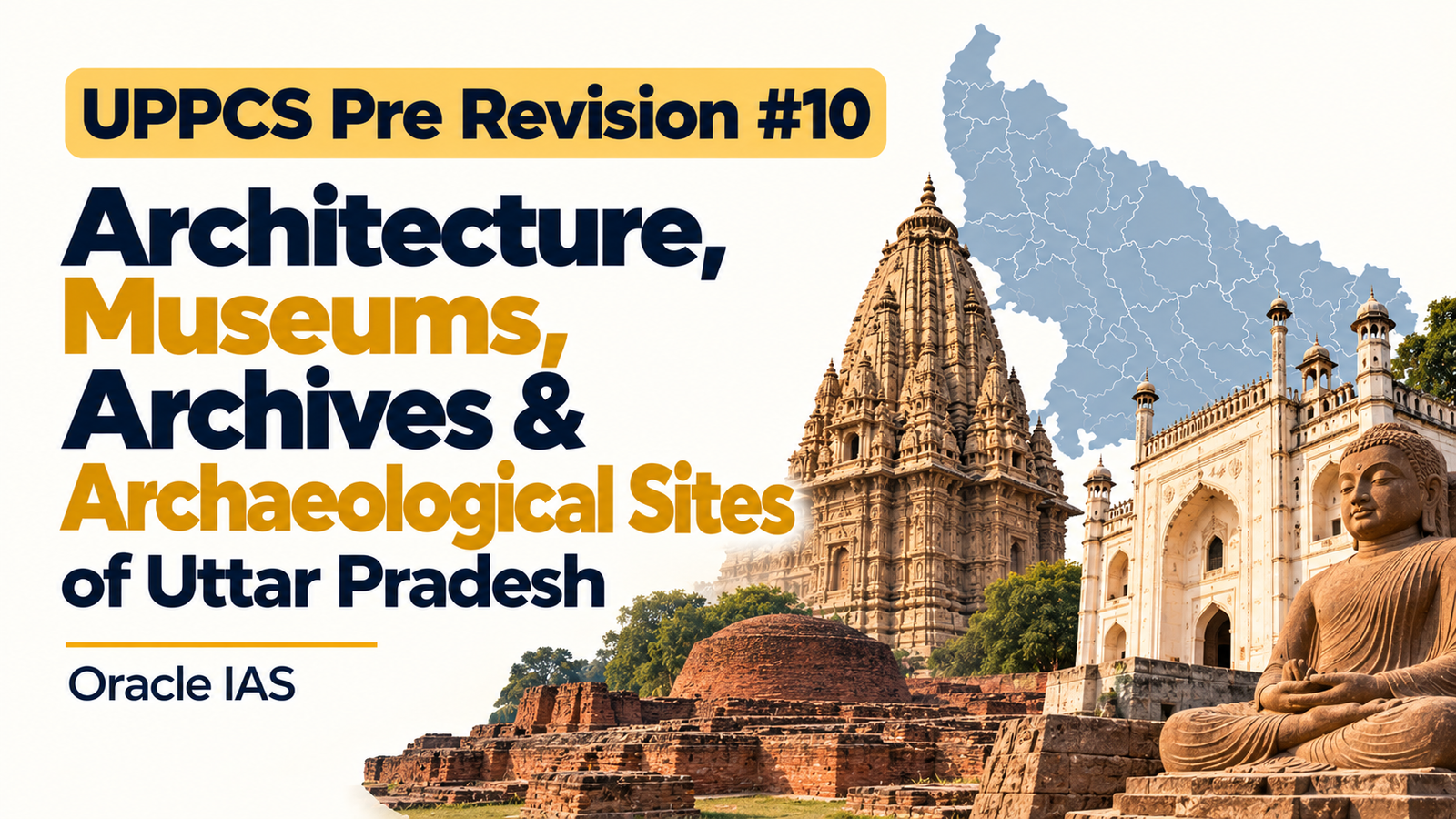
Uttar Pradesh preserves remains of several major historical periods—from ancient urban settlements and Buddhist monasteries to Gupta temples, medieval forts, Mughal monuments, Awadh architecture and colonial buildings.
For UPPCS Prelims, this topic is best prepared through four categories:
- Architecture and monuments: Identify the building, location, period, patron and distinctive feature.
- Museums: Match the institution with its city and important collection.
- Archives: Understand their role in preserving historical records.
- Archaeological sites: Associate excavated sites with ancient settlements, religious traditions and material remains.
A recurring examination pattern is to ask which monument belongs to which city, which architectural style is represented, or which museum houses an important sculpture or archaeological collection.
2. Architectural Heritage of Uttar Pradesh
2.1 Mughal architecture
The Agra region contains some of the most important surviving examples of Mughal architecture. Mughal buildings commonly use combinations of domes, arches, large gateways, gardens, geometric layouts, calligraphy, inlay work and red sandstone or white marble.
| Monument | Location | Important facts |
|---|---|---|
| Taj Mahal | Agra | Commissioned by Shah Jahan; built in memory of Mumtaz Mahal; celebrated for its white marble, symmetry and pietra dura inlay |
| Agra Fort | Agra | Major Mughal fort complex, substantially developed under Akbar; contains palaces, audience halls and other imperial structures |
| Fatehpur Sikri | Near Agra | Imperial city developed by Akbar; notable for its planned complex, gateways, palaces and religious buildings |
| Buland Darwaza | Fatehpur Sikri | Monumental gateway associated with Akbar’s victory over Gujarat |
| Panch Mahal | Fatehpur Sikri | Five-storeyed, pavilion-like structure |
| Tomb of Akbar | Sikandra, Agra | Mausoleum of Akbar; combines features associated with the Mughal architectural tradition |
| Itimad-ud-Daulah’s Tomb | Agra | Tomb commissioned by Nur Jahan for her father; noted for marble and pietra dura decoration |
| Jama Masjid | Fatehpur Sikri | Major congregational mosque within the imperial complex |
2.2 Awadh and Nawabi architecture
Lucknow’s historic architecture reflects the patronage of the Nawabs of Awadh. It combines monumental halls, domes, gateways, ornamental interiors and elements influenced by Persian, Mughal and European traditions.
| Monument | Patron / association | Key identification |
|---|---|---|
| Bara Imambara (Asafi Imambara) | Nawab Asaf-ud-Daula; construction began in 1784 | Famous for its great vaulted hall and Bhool Bhulaiya |
| Chhota Imambara (Hussainabad Imambara) | Nawab Muhammad Ali Shah; 1837–1842 | Ornamental interiors, chandeliers, decorative features and tombs |
| Rumi Darwaza | Nawab Asaf-ud-Daula’s period | Monumental gateway and a landmark of Lucknow |
| Asafi Mosque | Bara Imambara complex | Mosque associated with the Nawabi architectural complex |
| Shahi Baoli | Bara Imambara complex | Historic stepwell |
| Chattar Manzil | Lucknow | Palace complex associated with the Nawabs and later colonial use |
| Kaiserbagh complex | Lucknow | Palace and garden complex developed under Wajid Ali Shah |
| British Residency | Lucknow | Major site associated with the Revolt of 1857 and the siege of Lucknow |
2.3 Sharqi architecture of Jaunpur
Jaunpur developed as an important political and cultural centre under the Sharqi rulers. Its architecture is especially recognised for large gateways, imposing facades and distinctive mosque construction.
| Monument | Location | Significance |
|---|---|---|
| Atala Masjid | Jaunpur | Major example of Sharqi architecture |
| Jama Masjid | Jaunpur | Large mosque associated with the Sharqi architectural tradition |
| Lal Darwaza Masjid | Jaunpur | Important medieval mosque associated with the city’s Sharqi heritage |
2.4 Buddhist architecture
Uttar Pradesh is central to Buddhist heritage because several sites are associated with the life and teachings of Gautama Buddha.
| Site / monument | Location | Key association |
|---|---|---|
| Dhamek Stupa | Sarnath, Varanasi district | Associated with the place where Buddha delivered his first sermon |
| Chaukhandi Stupa | Sarnath | Traditionally associated with the meeting of Buddha and his first disciples |
| Ashokan Pillar remains | Sarnath | Associated with Ashoka’s patronage of Buddhism; the Lion Capital is preserved in the Sarnath Museum |
| Mahaparinirvana Temple | Kushinagar | Contains the reclining Buddha image associated with Mahaparinirvana |
| Ramabhar Stupa | Kushinagar | Traditionally identified with the cremation site of Buddha |
| Jetavana | Shravasti | Important Buddhist monastic site |
| Saheth and Maheth | Shravasti | Archaeological remains associated with ancient Shravasti and Buddhist traditions |
| Piprahwa | Siddharthnagar district | Archaeological site associated with ancient Kapilavastu traditions and Buddhist remains |
2.5 Ancient Hindu and Jain architecture
Uttar Pradesh has important temple remains from the Gupta period and later centuries. Several structures are particularly useful for questions on the evolution of temple architecture.
| Site / monument | Location | Historical significance |
|---|---|---|
| Dashavatara Temple | Deogarh, Lalitpur district | Important Gupta-period temple, associated with early Nagara-style temple architecture |
| Bhitargaon Temple | Bhitargaon, Kanpur Dehat district | Famous ancient brick temple, commonly associated with the Gupta period |
| Bateshwar temple complex | Near Bah, Agra district | Group of temples associated with the region’s Hindu religious heritage |
| Deogarh Jain temples | Deogarh, Lalitpur district | Important group of Jain temples and sculptures |
| Hastinapur | Meerut district | Ancient settlement with religious and archaeological significance, including Jain traditions |
| Kampilya | Farrukhabad district | Ancient site associated with Panchala and traditions relating to the Mahabharata |
| Ahichchhatra | Bareilly region | Archaeological remains associated with ancient Panchala |
| Chitrakoot | Chitrakoot district | Important religious landscape with temples, ghats and sacred sites |
2.6 Forts, palaces and military architecture
| Monument | Location | Why it matters |
|---|---|---|
| Jhansi Fort | Jhansi | Closely associated with Rani Lakshmibai and the Revolt of 1857 |
| Kalinjar Fort | Banda district | Strategic hill fort with a long history; associated with the Chandela region and later powers |
| Chunar Fort | Mirzapur district | Strategic fort overlooking the Ganga; associated with several medieval and early modern powers |
| Allahabad Fort | Prayagraj | Built by Akbar in the late sixteenth century; strategically located near the confluence |
| Ramnagar Fort | Varanasi | Palace-fort complex associated with the rulers of Banaras |
| Agra Fort | Agra | Major Mughal military and residential complex |
| Vijaygarh Fort | Sonbhadra district | Historic fort site associated with the region’s heritage |
2.7 Colonial architecture and the heritage of 1857
Colonial-era buildings in Uttar Pradesh reflect European architectural influences and the administrative and military history of British rule.
| Building / site | Location | Significance |
|---|---|---|
| British Residency | Lucknow | Central site of the 1857 siege of Lucknow |
| Allahabad High Court building | Prayagraj | Important institutional building of the colonial period |
| Old administrative and railway buildings | Lucknow, Prayagraj and other cities | Reflect colonial-era urban planning and public architecture |
| Khusro Bagh | Prayagraj | Mughal garden-tomb complex; also associated with events of 1857 |
| St. Joseph’s Cathedral and other historic churches | Prayagraj and other cities | Examples of colonial-era religious architecture |
Colonial architecture in the state includes Gothic, Neoclassical and Indo-Saracenic influences.
3. Museums of Uttar Pradesh
Museums preserve sculptures, inscriptions, coins, manuscripts, paintings, archaeological finds and other material evidence of the past. For UPPCS, learn the museum–city–collection relationship.
3.1 Important museums: location and speciality
| Museum | Location | Important collection / association |
|---|---|---|
| State Museum | Lucknow | Archaeological artefacts, sculptures, terracottas, coins, manuscripts, paintings, textiles and other cultural collections |
| Sarnath Archaeological Museum | Sarnath, Varanasi | Archaeological finds from Sarnath; particularly famous for the Lion Capital of Ashoka |
| Bharat Kala Bhavan | Banaras Hindu University, Varanasi | Art, sculpture, paintings, textiles, decorative arts and historical objects |
| Allahabad Museum | Prayagraj | Archaeological and historical collections, paintings and objects connected with India’s cultural and national history |
| Government Museum | Mathura | Major collection associated with the Mathura School of Art and ancient sculpture |
| Government Museum | Jhansi | Regional archaeological, historical and cultural collections |
| Kushinagar Museum | Kushinagar | Objects recovered from archaeological excavations, including Buddhist artefacts and sculpture |
| Government Buddha Museum | Kushinagar | Buddhist heritage and related collections |
| Archaeological displays / museums at major sites | Various locations | Objects and interpretation relating to individual archaeological sites |
3.2 Sarnath Archaeological Museum
The museum houses important finds from the Sarnath archaeological site. Its best-known object is the Lion Capital of Ashoka, discovered at Sarnath and now India’s National Emblem.
Key facts:
- Associated with the archaeological remains of ancient Sarnath.
- Contains sculptures and other artefacts connected with Buddhist art and religious history.
- The Lion Capital is an essential identification fact for Prelims.
- The original Lion Capital is a museum object; it should not be confused with the modern emblem used by the Government of India.
3.3 Government Museum, Mathura
Mathura was a major centre of ancient Indian sculpture. The museum is particularly useful for questions on the Mathura School of Art.
Important features of the Mathura artistic tradition:
- Strong use of locally available red sandstone, often described as mottled red sandstone.
- Production of Buddhist, Jain and Brahmanical images.
- Development of distinctive sculptural forms during the Kushan period and beyond.
- Important role in the history of anthropomorphic representations of the Buddha.
Mathura School versus Gandhara School
| Feature | Mathura School | Gandhara School |
|---|---|---|
| Main centre | Mathura, in present-day Uttar Pradesh | Ancient Gandhara region, mainly in present-day Pakistan and Afghanistan |
| Common material association | Red sandstone | Grey schist and other stone |
| Broad artistic influences | Indigenous Indian traditions, with multiple cultural influences | Strong Greco-Roman artistic influence alongside Buddhist themes |
| Subject matter | Buddhist, Jain and Brahmanical imagery | Particularly famous for Buddhist imagery |
| Exam caution | Do not describe it as exclusively Hindu or exclusively Buddhist | Do not assume every Buddha image belongs to Gandhara |
3.4 Bharat Kala Bhavan, Varanasi
Bharat Kala Bhavan is an important university museum with collections relating to Indian art and cultural history. It is useful for revision of paintings, sculpture, textiles, decorative arts and historical objects.
3.5 State Museum, Lucknow
The State Museum is located in Banarasi Bagh, Lucknow. Its broad collections include:
- Sculptures and archaeological artefacts.
- Terracotta objects and prehistoric tools.
- Coins and metal objects.
- Manuscripts, paintings and textiles.
- Decorative arts and cultural objects.
The range of collections makes it relevant to questions on archaeology, art history and the preservation of cultural heritage.
3.6 Allahabad Museum, Prayagraj
The Allahabad Museum is an important institution for the study of India’s historical and cultural heritage. Its collections include archaeological objects, sculpture, paintings and other historical material.
For examination purposes, remember its location in Prayagraj and its role as a major museum of the region. Avoid confusing it with the Allahabad Fort, which is a separate historical monument.
4. Archives and Libraries in Uttar Pradesh
4.1 Archives: Meaning and Importance
Archives preserve documentary records created by governments, institutions and individuals. They are essential for reconstructing administrative history, studying the freedom movement and understanding changes in land revenue, governance and society.
Important archival materials include:
- Government orders, official correspondence and administrative files.
- Historical reports, registers, maps and survey records.
- Documents relating to the colonial period and the freedom movement.
- Manuscripts and other historically significant records.
4.2 Uttar Pradesh State Archives
The Uttar Pradesh State Archives, headquartered in Lucknow, is an important institution for preserving the documentary heritage of the state.
4.3 Important Libraries of Uttar Pradesh
Libraries preserve books, manuscripts, newspapers, rare publications and other written materials. Historic libraries and major research libraries are important for the study of literature, history, religion and intellectual traditions.
| Library | Location | Importance |
|---|---|---|
| Maulana Azad Library | Aligarh Muslim University, Aligarh | Major university library with extensive printed and research collections |
| Sayaji Rao Gaekwad Library (Central Library) | Banaras Hindu University, Varanasi | Important academic and research library |
| Tagore Library | University of Lucknow, Lucknow | University library supporting teaching and research |
| Allahabad Public Library | Prayagraj | Historic public library, also known as Thornhill Mayne Memorial |
| Rampur Raza Library | Rampur | Renowned repository of rare manuscripts, Islamic learning, Persian and Arabic works, calligraphy and miniature paintings |
| Sarasvati Bhavan Library | Sampurnanand Sanskrit University, Varanasi | Important collection of Sanskrit manuscripts and works relating to Indian knowledge traditions |
| Government District Libraries | Various districts | Support public access to books, newspapers and other reading resources |
5. Important Archaeological Sites in Uttar Pradesh
5.1 Sarnath
Location: Near Varanasi.
Sarnath is one of the most important Buddhist archaeological sites in India.
Key associations:
- The Buddha’s first sermon after enlightenment.
- Dhamek Stupa and Chaukhandi Stupa.
- Remains associated with Ashoka’s patronage.
- Sarnath Archaeological Museum and the Lion Capital of Ashoka.
Prelims trap: Sarnath is associated with the first sermon, not the Mahaparinirvana.
5.2 Kushinagar
Location: Kushinagar district.
Kushinagar is traditionally identified as the place where Gautama Buddha attained Mahaparinirvana.
Important remains and sites include:
- Mahaparinirvana Temple.
- Ramabhar Stupa.
- Matha Kuar Shrine.
- Archaeological remains of ancient monasteries.
- Kushinagar Museum.
The district administration identifies the reclining Buddha image at the Mahaparinirvana Temple and Ramabhar Stupa among the area’s major heritage attractions
5.3 Shravasti
Location: Shravasti district.
Shravasti was an important ancient city and a major centre in Buddhist traditions. The archaeological area is commonly discussed through Saheth and Maheth.
- Saheth is associated with the Jetavana monastic complex.
- Maheth is associated with the remains of the ancient city.
- The site is important for Buddhist history and the archaeology of ancient urban settlements.
5.4 Kaushambi
Location: In the Prayagraj region.
Kaushambi was an important ancient urban and political centre. It is also significant in Buddhist history.
For Prelims, associate Kaushambi with:
- Ancient urban remains.
- Fortifications and archaeological evidence.
- Buddhist traditions and the history of ancient northern India.
Do not confuse the ancient site of Kaushambi with modern administrative boundaries without checking the wording of the question.
5.5 Piprahwa and the Kapilavastu region
Location: Siddharthnagar district.
Piprahwa is an important archaeological site associated with Buddhist remains and traditions concerning ancient Kapilavastu.
Questions can test the relationship between an archaeological site, its district and its broader historical association. Be cautious about treating every identification of ancient Kapilavastu as completely settled: archaeological and historical interpretations have been debated.
5.6 Sankisa
Location: Farrukhabad district.
Sankisa is associated with Buddhist tradition, including the account of the Buddha’s descent from the heaven of the Thirty-three Gods.
It forms part of the wider Buddhist heritage of Uttar Pradesh, alongside Sarnath, Shravasti, Kushinagar and Kaushambi.
5.7 Deogarh
Location: Lalitpur district, Bundelkhand region.
Deogarh is important for both Hindu and Jain heritage.
- The Dashavatara Temple is associated with the Gupta period and early North Indian temple architecture.
- The site also contains important Jain temples and sculptures.
- Its monuments help explain the development of religious architecture and sculptural traditions.
5.8 Bhitargaon
Location: Kanpur Dehat district.
Bhitargaon is known for its ancient brick temple, commonly associated with the Gupta period. It is an important example in the study of early temple architecture.
Remember it particularly for the use of brick in a surviving early temple structure.
5.9 Ahichchhatra
Location: Bareilly region.
Ahichchhatra is associated with ancient Panchala and is an important archaeological site for understanding early historic settlements in northern India.
It may be tested through its ancient political association rather than through a single famous monument.
5.10 Hastinapur
Location: Meerut district.
Hastinapur is associated with ancient Indian traditions and has archaeological importance. It is also an important centre in Jain religious traditions.
5.11 Sonbhadra’s rock-art and prehistoric heritage
Sonbhadra and adjoining parts of the Vindhyan region contain rock shelters and rock paintings of archaeological interest.
These remains are useful for questions on prehistoric art, the relationship between humans and their environment, and the evidence used to reconstruct early life.
Exam focus: Rock paintings and shelters are different types of evidence from monumental architecture. They may reveal hunting, animals, human figures and other aspects of prehistoric life, depending on the individual site.
5.12 Other sites worth recognising
| Site | District / region | Main association |
|---|---|---|
| Mathura | Mathura | Ancient city, sculpture and Mathura School of Art |
| Rajghat | Varanasi | Archaeological remains associated with the ancient settlement of Varanasi |
| Chunar | Mirzapur | Fort and wider historical landscape |
| Kalinjar | Banda | Historic hill fort and Bundelkhand heritage |
| Chitrakoot | Chitrakoot | Religious and cultural landscape |
| Barnawa | Baghpat | Site associated with the Mahabharata tradition of Lakshagraha |
| Kampilya | Farrukhabad | Ancient Panchala and epic traditions |
| Atranjikhera | Etah region | Important archaeological site associated with early historic material culture |
| Deogarh | Lalitpur | Gupta-period temple and Jain heritage |
6. UNESCO World Heritage Sites in Uttar Pradesh
For the cultural World Heritage properties located in Uttar Pradesh, remember these three:
| UNESCO World Heritage property | Location | Key identification |
|---|---|---|
| Taj Mahal | Agra | Mughal mausoleum commissioned by Shah Jahan |
| Agra Fort | Agra | Mughal fort-palace complex |
| Fatehpur Sikri | Near Agra | Planned imperial city developed under Akbar |
Contact:
Call/WhatsApp 9997453844 for details
Join Our Preparation program:

He is a bibliophile,accomplished writer and a fitness enthusiast.
- UPPCS Pre Revision #11: Architecture, Museums, Archives & Archaeological Sites of Uttar Pradesh - October 22, 2026
- UKPSC Physics: Modern & Nuclear Physics, Radioactivity, Fission & Fusion (Solved PYQs & Notes) - October 22, 2026
- UPPCS 2026 Revision Quiz #2 - October 21, 2026