
UKPSC Physics: Modern & Nuclear Physics, Radioactivity, Fission & Fusion
1. High-Yield Micro-Notes
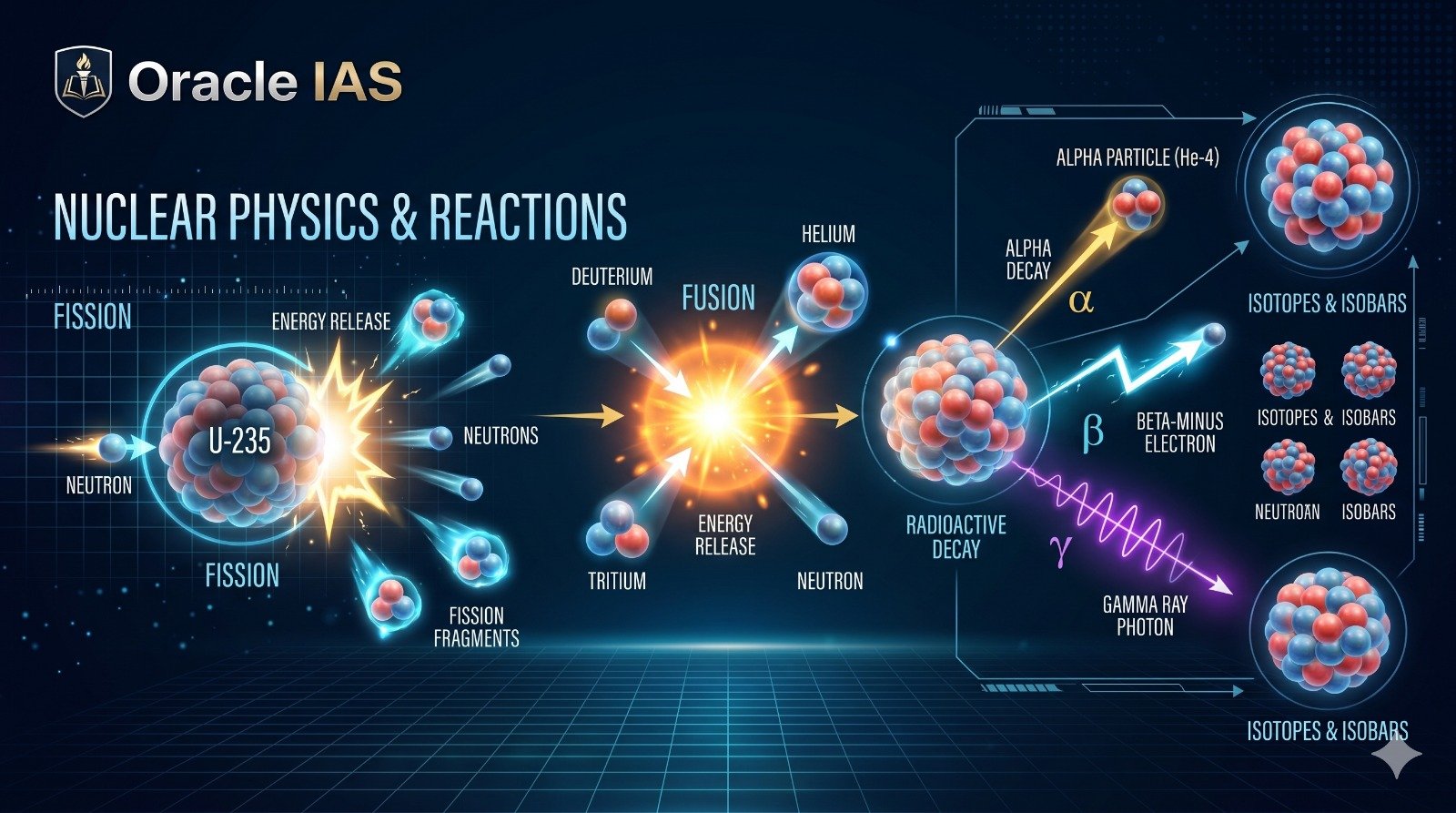
- Radioactivity & Emission Dynamics: Natural radioactivity was discovered in 1896 by French physicist Henri Becquerel (SI unit: Becquerel, Bq). Radioactive decay spontaneously emits three distinct types of radiation: alpha (α) particles (doubly ionized helium nuclei, ⁴₂He²⁺), beta (β) particles (high-speed nuclear electrons ⁰₋₁e⁻ or positrons ⁰₊₁e⁺), and gamma (γ) rays (high-frequency, massless electromagnetic photons). Protons are not emitted during standard radioactive decay series. Radioactivity is routinely detected and measured using a Geiger-Müller (G-M) counter.
- Nuclear Reactions (Fission vs. Fusion): Nuclear Fission involves splitting a heavy, unstable nucleus (e.g., Uranium-235, Plutonium-239) via low-energy thermal neutron bombardment into lighter fission products, releasing roughly 200 MeV per fission event along with 2 to 3 prompt neutrons. Fission powers commercial nuclear reactors and the uncontrolled chain reaction of the atomic bomb (theoretical discovery credited to Otto Hahn and Fritz Strassmann in 1938). Nuclear Fusion involves fusing light nuclei (such as Deuterium and Tritium) under extreme core temperatures and pressures to form a heavier helium nucleus. Fusion is the fundamental energy mechanism powering the Sun and all stars (via the proton-proton chain and CNO cycle) as well as the Hydrogen Bomb (thermonuclear weapon).
- Nuclear Reactor Fuels & Indian Context: Fissile isotopes that sustain thermal neutron fission include U-235, Pu-239, and U-233. Natural uranium contains roughly 99.3% fertile U-238 and only 0.7% fissile U-235. India’s pressurized heavy-water reactors (PHWRs) run on unenriched natural uranium (containing U-238 matrix with 0.7% U-235). India’s Fast Breeder Test Reactor (FBTR) at Kalpakkam, Tamil Nadu, was developed to utilize an indigenous unique mixed carbide fuel (plutonium-uranium carbide) and enriched uranium/U-233 systems to breed fissile material as part of India’s three-stage nuclear power program.
- Modern Physics & Quantum Concepts: Albert Einstein integrated time as the fourth dimension in spacetime within his Special (1905) and General (1915) Theories of Relativity. Tachyons are hypothetical subatomic particles postulated to travel continuously faster than the speed of light in vacuum (v > c). Quantum photon energy follows Planck’s equation (E = h·c / λ), meaning quantum energy is inversely proportional to wavelength; shorter ultraviolet wavelengths (e.g., 200–280 nm) carry significantly higher quantum energy than longer visible or near-UV wavelengths. In industrial and military chemistry, TNT (Trinitrotoluene) is a high-order chemical explosive, whereas Alfred Nobel invented dynamite in 1867 by stabilizing nitroglycerin in diatomaceous earth (kieselguhr).
2. Important facts you should know:
| Nuclear Term / Process | Core Definition / Constituent | Reaction Type / Energy Profile | Representative Real-World Example |
| Isotopes | Same Atomic Number (Z / Protons), Different Neutrons (A) | Nuclear structural classification | Hydrogen (Protium ¹H, Deuterium ²H, Tritium ³H); U-235 and U-238 |
| Isobars | Same Mass Number (A / Nucleons), Different Protons (Z) | Nuclear structural classification | ⁴⁰₁₈Ar, ⁴⁰₁₉K, and ⁴⁰₂₀Ca |
| Nuclear Fission | Splitting of heavy atomic nucleus via thermal neutrons | Exothermic chain reaction (≈ 200 MeV/event) | Commercial Nuclear Power Plants; Atomic Bomb (Otto Hahn, 1938) |
| Nuclear Fusion | Coalescence of light nuclei into a heavier nucleus | Thermonuclear fusion at millions of degrees | Stellar nucleosynthesis (Sun / Stars); Hydrogen Bomb |
| Alpha Decay | Emission of Helium-4 nucleus (⁴₂He²⁺) | Particulate decay: Z decreases by 2, A decreases by 4 | Decay of Uranium-238 into Thorium-234 |
| Beta (β⁻) Decay | Neutron converts to proton + electron + antineutrino | Particulate decay: Z increases by 1, A remains same | Carbon-14 decaying into Nitrogen-14 |
| Gamma (γ) Decay | De-excitation of metastable excited nuclear states | High-energy electromagnetic photon emission | Cobalt-60 cancer radiotherapy |
3. Master Questions
Q1. Spontaneous radioactive decay of unstable atomic nuclei never emits which of the following subatomic entities?
[UKPSC RO/ARO Pre 2023 | UKPSC RO/ARO 2023] [Direct Fact]
(a) Electrons (beta minus particles)
(b) Gamma rays
(c) Protons
(d) Helium nuclei (alpha particles)
Q2. The fissile/fertile fuel configurations utilized in the core of the Fast Breeder Test Reactor (FBTR) at Kalpakkam include:
[UKPSC Pre 2006-07] [Direct Fact]
(a) Enriched uranium / Plutonium-bearing fuel
(b) Unprocessed natural Thorium metal
(c) Pure chemical Tungsten rods
(d) Gasohol matrix
Q3. The working mechanism of the atomic fission bomb developed during the twentieth century relies fundamentally on the principle of:
[UKPSC Pre 2006-07] [Direct Fact]
(a) Controlled alpha-particle beam radiation
(b) Nuclear fission of heavy nuclei
(c) Thermonuclear fusion
(d) Spontaneous natural positron emission
Q4. The concept of physical time as the ‘fourth dimension’ unified with three-dimensional space was introduced to theoretical physics by:
[UKPSC Pre 2006-07] [Direct Fact]
(a) Sir Isaac Newton
(b) Albert Einstein
(c) Galileo Galilei
(d) Niels Bohr
Q5. In modern theoretical and quantum physics, the term ‘Tachyon’ refers specifically to:
[UKPSC Pre 2006-07] [Direct Fact]
(a) Hypothetical subatomic particles traveling at velocities greater than the speed of light
(b) Fission debris fragments originating inside heavy atomic nuclei
(c) Acoustic wave packets traveling faster than sound in ambient air
(d) Quantized amplitude units of crystal lattice vibration
Q6. Alfred Nobel, the Swedish chemist and industrialist who instituted the Nobel Prizes, gained worldwide historical acclaim for inventing:
[UKPSC Mains 2004-05] [Direct Fact]
(a) Dynamite
(b) RDX (Cyclonite)
(c) Supersonic Jet Engines
(d) Artificial Radioactivity
Q7. Atoms of chemical elements that possess the exact same number of nuclear protons but contain different numbers of neutrons are classified as:
[UKPSC UDA/LDA Pre 2003] [Direct Fact]
(a) Isotopes
(b) Isobars
(c) Isomers
(d) Isotones
Q8. A thermonuclear weapon, commonly designated as a Hydrogen Bomb, derives its explosive yield from:
[UKPSC APS Mains 2021] [Direct Fact]
(a) Uncontrolled nuclear fission chain reactions
(b) Artificial chemical disintegration
(c) Nuclear fusion of lighter hydrogen isotopes
(d) Natural background alpha radioactivity
Q9. Which specific uranium isotope is primarily used as the fissile fuel to sustain chain reactions in commercial thermal nuclear power stations?
[UKPSC Pre 2012] [Direct Fact]
(a) Uranium-233
(b) Uranium-234
(c) Uranium-235
(d) Uranium-239
Q10. According to quantum Planck relation (E = h·c / λ), which of the following electromagnetic radiation bands carries the highest quantum energy per photon?
[UKPSC Pre 2012] [Direct Fact]
(a) 320 nm to 400 nm
(b) 200 nm to 280 nm
(c) 280 nm to 320 nm
(d) 400 nm to 600 nm
Q11. Which of the following physical phenomena is NOT associated with nuclear fission?
[UKPSC Pre 2016] [Statement-Based]
(a) Thermal neutron-induced chain reaction
(b) Core stellar nucleosynthesis and energy generation in the Sun and stars
(c) Controlled electrical power generation inside commercial nuclear reactors
(d) Sudden rapid release of thermal and kinetic blast energy in an atomic bomb
Q12. In the International System of Units (SI), a length measurement of one Nanometer (nm) is equivalent to:
[UKPSC Pre 2016] [Direct Fact]
(a) 10⁻⁹ m
(b) 10⁻⁶ m
(c) 10⁻¹⁰ m
(d) 10⁻³ m
Q13. The continuous generation of stellar energy radiating from the core of the Sun is sustained by:
[UKPSC RO/ARO Mains 2006] [Direct Fact]
(a) High-yield nuclear fission
(b) Thermonuclear fusion
(c) Photoelectric surface ionization
(d) Cherenkov optical radiation
Q14. The phenomenon of natural radioactivity was discovered in 1896 by the French physicist:
[UKPSC CFO 2021] [Direct Fact]
(a) Irène Joliot-Curie
(b) Ernest Rutherford
(c) Marie Curie
(d) Henri Becquerel
Q15. Which of the following chemical formulations is an explosive nitro-compound?
[UKPSC APO 2015] [Direct Fact]
(a) DDT
(b) O₂
(c) TNT
(d) MRI
Q16. In global solid-state electronics and semiconductor fabrication, the element most commonly employed to manufacture integrated circuits and diodes is:
[UKPSC Regional Inspector 2022] [Direct Fact]
(a) Selenium
(b) Silicon
(c) Tin
(d) Iron
4. Master Explanations & Answer Key
- Ans. (c)
- Direct Answer: Naturally occurring radioactive decay series eject alpha particles (helium nuclei), beta particles (electrons or positrons), and gamma rays (electromagnetic photons); individual free protons are not emitted during natural radioactive decay.
- Exam Trap / Distractor Alert: Candidates often mistakenly assume beta particles are orbital electrons; beta particles are high-speed electrons created and expelled directly from the nucleus when a neutron converts into a proton.
- High-Yield Extra Facts: Alpha emission decreases the parent atomic number by 2 and mass number by 4; beta minus (β⁻) emission increases the atomic number by 1 while keeping mass number unchanged; gamma emission alters neither atomic nor mass number.
- Ans. (a)
- Direct Answer: The Fast Breeder Test Reactor (FBTR) at Kalpakkam, Tamil Nadu, was built using an indigenous plutonium-rich mixed carbide fuel (plutonium carbide + uranium carbide) and utilizes enriched uranium/fissile fuel configurations without requiring a neutron moderator.
- Exam Trap / Distractor Alert: Natural thorium (Th-232) is fertile, not fissile; it cannot sustain a chain reaction on its own until it absorbs neutrons and converts into fissile Uranium-233 within breeder blankets.
- High-Yield Extra Facts: The Indira Gandhi Centre for Atomic Research (IGCAR) is located at Kalpakkam; fast breeder reactors use liquid sodium (Na) as a coolant due to its high thermal conductivity and boiling point.
- Ans. (b)
- Direct Answer: The atomic bomb operates on the principle of prompt, uncontrolled nuclear fission, where heavy fissile nuclei (U-235 or Pu-239) split into lighter fragments upon capturing thermal neutrons.
- Exam Trap / Distractor Alert: Do not confuse the atomic bomb (pure nuclear fission) with the hydrogen bomb (which uses nuclear fusion triggered by an initial fission primary).
- High-Yield Extra Facts: German chemists Otto Hahn and Fritz Strassmann discovered nuclear fission in Berlin in December 1938; Lise Meitner and Otto Frisch provided the theoretical physical explanation and named the process “fission.”
- Ans. (b)
- Direct Answer: Albert Einstein introduced time as the dynamic fourth dimension in his 1905 Special Theory of Relativity, mathematically combining three spatial dimensions (x, y, z) and time (t) into a four-dimensional spacetime continuum.
- Exam Trap / Distractor Alert: Classical Newtonian mechanics treated time as an absolute, immutable quantity completely detached from physical three-dimensional space.
- High-Yield Extra Facts: German mathematician Hermann Minkowski developed the four-dimensional geometric formulation of spacetime in 1908, famously stating that space and time alone are doomed to fade away into mere shadows.
- Ans. (a)
- Direct Answer: A tachyon is a hypothetical class of faster-than-light (superluminal) subatomic particles whose velocity always exceeds the speed of light in vacuum (v > c).
- Exam Trap / Distractor Alert: Tachyons remain purely theoretical constructs and have never been experimentally observed; their existence would lead to causal paradoxes under special relativity.
- High-Yield Extra Facts: The term was coined in 1967 by physicist Gerald Feinberg; standard subatomic particles traveling slower than light are termed “bradyons” (or tardyons), while massless particles traveling at light speed (like photons) are called “luxons.”
- Ans. (a)
- Direct Answer: Swedish chemist Alfred Nobel patented dynamite in 1867 by absorbing volatile liquid nitroglycerin into porous diatomaceous earth (kieselguhr), creating a stable, shock-resistant commercial explosive.
- Exam Trap / Distractor Alert: RDX (Research Department Explosive / Cyclotrimethylenetrinitramine) was synthesized by Georg Friedrich Henning in 1898; Nobel established the Nobel Prizes in his 1895 will.
- High-Yield Extra Facts: Dynamite requires a blasting cap (detonator) containing a primary explosive such as mercury fulminate to trigger the secondary nitroglycerin detonation.
- Ans. (a)
- Direct Answer: Isotopes are atoms of the same chemical element that have the same number of protons (same atomic number Z) but different numbers of neutrons (different mass number A).
- Exam Trap / Distractor Alert: Isobars have the same mass number A but different atomic numbers Z (e.g., Argon-40 and Calcium-40); Isotones have the exact same neutron count (A – Z); Isomers share the same chemical formula but have different molecular structures.
- High-Yield Extra Facts: Hydrogen has three natural isotopes: Protium (¹H, zero neutrons), Deuterium (²H, one neutron), and Tritium (³H, two neutrons, radioactive with a half-life of ≈ 12.3 years).
- Ans. (c)
- Direct Answer: The Hydrogen bomb (thermonuclear bomb) derives its destructive energy from the uncontrolled nuclear fusion of hydrogen isotopes (Deuterium and Tritium) to form helium nuclei.
- Exam Trap / Distractor Alert: A hydrogen bomb relies on an internal primary fission atomic bomb to create the millions of degrees of temperature and gigapascals of pressure needed to trigger the secondary fusion core.
- High-Yield Extra Facts: The first thermonuclear device (Ivy Mike) was detonated by the United States in 1952; the theoretical layout is known as the Teller-Ulam configuration.
- Ans. (c)
- Direct Answer: Uranium-235 (U-235) is the primary naturally occurring fissile isotope that fissions easily upon capturing low-energy thermal (slow) neutrons in commercial nuclear reactors.
- Exam Trap / Distractor Alert: Uranium-238 (U-238) makes up over 99% of natural uranium ore, but it is fertile rather than fissile; it requires fast neutrons to split and typically absorbs neutrons to transmute into Plutonium-239.
- High-Yield Extra Facts: Commercial Light Water Reactors (LWRs) require enriched uranium containing 3% to 5% U-235, whereas Indian Pressurized Heavy Water Reactors (PHWRs) run directly on natural uranium (0.7% U-235) using heavy water (D₂O) as a moderator.
- Ans. (b)
- Direct Answer: According to the Planck-Einstein relation (E = h·ν = h·c / λ), photon energy is inversely proportional to wavelength; therefore, the shortest wavelength interval (200 nm to 280 nm, which falls in the shortwave Ultraviolet-C spectrum) possesses the highest energy per quantum.
- Exam Trap / Distractor Alert: Do not pick the highest numerical values (e.g., 400–600 nm); longer wavelengths correspond to lower frequencies and lower energy per quantum photon.
- High-Yield Extra Facts: 200–280 nm is the germicidal ultraviolet (UV-C) band, capable of damaging bacterial and viral DNA/RNA; wavelengths below 200 nm are absorbed by atmospheric oxygen (vacuum ultraviolet).
- Ans. (b)
- Direct Answer: Energy generation inside the Sun and stars occurs via nuclear fusion (the coalescence of hydrogen into helium), not nuclear fission.
- Exam Trap / Distractor Alert: Neutron-induced chain reactions, civil nuclear power stations, and atomic bombs are all driven by nuclear fission of heavy nuclei like U-235 and Pu-239.
- High-Yield Extra Facts: Hans Bethe proposed the carbon-nitrogen-oxygen (CNO) cycle and proton-proton chain mechanisms of stellar nuclear fusion in 1939, receiving the Nobel Prize in Physics in 1967.
- Ans. (a)
- Direct Answer: One nanometer (nm) equals 10⁻⁹ meters (one-billionth of a meter).
- Exam Trap / Distractor Alert: 10⁻⁶ m is one micrometer (micron, µm); 10⁻¹⁰ m is one Angstrom (Å); 10⁻¹² m is one picometer (pm); 10⁻¹⁵ m is one femtometer (fermi, fm).
- High-Yield Extra Facts: The typical carbon-carbon single bond length is approximately 0.154 nm (1.54 Å); human DNA double-helix width is about 2 nm.
- Ans. (b)
- Direct Answer: The primary energy source of the Sun is thermonuclear fusion occurring in its high-temperature core, where hydrogen nuclei fuse into helium via the proton-proton chain.
- Exam Trap / Distractor Alert: The Sun does not burn chemical fuel or split uranium atoms; four hydrogen protons fuse into one helium-4 nucleus, with the missing mass (mass defect Δm ≈ 0.7%) converted into radiant energy via E = Δm·c².
- High-Yield Extra Facts: The Sun’s core temperature is estimated at approximately 15 million Kelvin, providing the kinetic energy needed for protons to overcome mutual electrostatic Coulomb repulsion.
- Ans. (d)
- Direct Answer: French physicist Henri Becquerel discovered natural radioactivity in 1896 while investigating the phosphorescent properties of uranium potassium sulfate salts on wrapped photographic plates.
- Exam Trap / Distractor Alert: Marie and Pierre Curie isolated the new radioactive elements Polonium and Radium in 1898, but the initial discovery of radioactivity was made by Becquerel.
- High-Yield Extra Facts: Becquerel shared the 1903 Nobel Prize in Physics with Marie Curie and Pierre Curie; the SI derived unit for radioactivity is the Becquerel (1 Bq = 1 nuclear decay per second; 1 Curie ≈ 3.7 × 10¹⁰ Bq).
- Ans. (c)
- Direct Answer: TNT (Trinitrotoluene, C₇H₅N₃O₆) is a yellow nitroaromatic crystalline compound widely used as a high explosive in industrial blasting and military munitions.
- Exam Trap / Distractor Alert: DDT (Dichlorodiphenyltrichloroethane) is a synthetic organochlorine insecticide; MRI (Magnetic Resonance Imaging) is a medical diagnostic imaging modality; O₂ is diatomic atmospheric oxygen gas.
- High-Yield Extra Facts: TNT was first synthesized in 1863 by German chemist Julius Wilbrand; because of its relative insensitivity to shock and friction, explosive yields of nuclear detonations are measured in equivalent “tons of TNT” (1 ton of TNT ≈ 4.184 × 10⁹ Joules).
- Ans. (b)
- Direct Answer: Silicon is the semiconductor element most widely used to manufacture microchips, diodes, transistors, and integrated circuits, accounting for over 90% of global semiconductor production.
- Exam Trap / Distractor Alert: Germanium was used in the earliest point-contact transistors, but silicon quickly replaced it due to its wider bandgap (1.1 eV vs. 0.67 eV), stable silicon dioxide (SiO₂) native insulating layer, and higher thermal operating threshold.
- High-Yield Extra Facts: Ultrapure electronic-grade silicon requires a purity of 99.9999999% (“nine nines”), refined using the Siemens process and purified into single-crystal ingots via the Czochralski crystal growth method.
Contact Oracle IAS:
Call/WhatsApp 9997453844 for details
Join Our Preparation program:

He is a bibliophile,accomplished writer and a fitness enthusiast.
- UKPSC Physics: Modern & Nuclear Physics, Radioactivity, Fission & Fusion (Solved PYQs & Notes) - October 22, 2026
- UPPCS 2026 Revision Quiz #2 - October 21, 2026
- UPPCS Pre Revision #10: UP Freedom Fighters & Personalities - October 21, 2026
 WhatsApp us