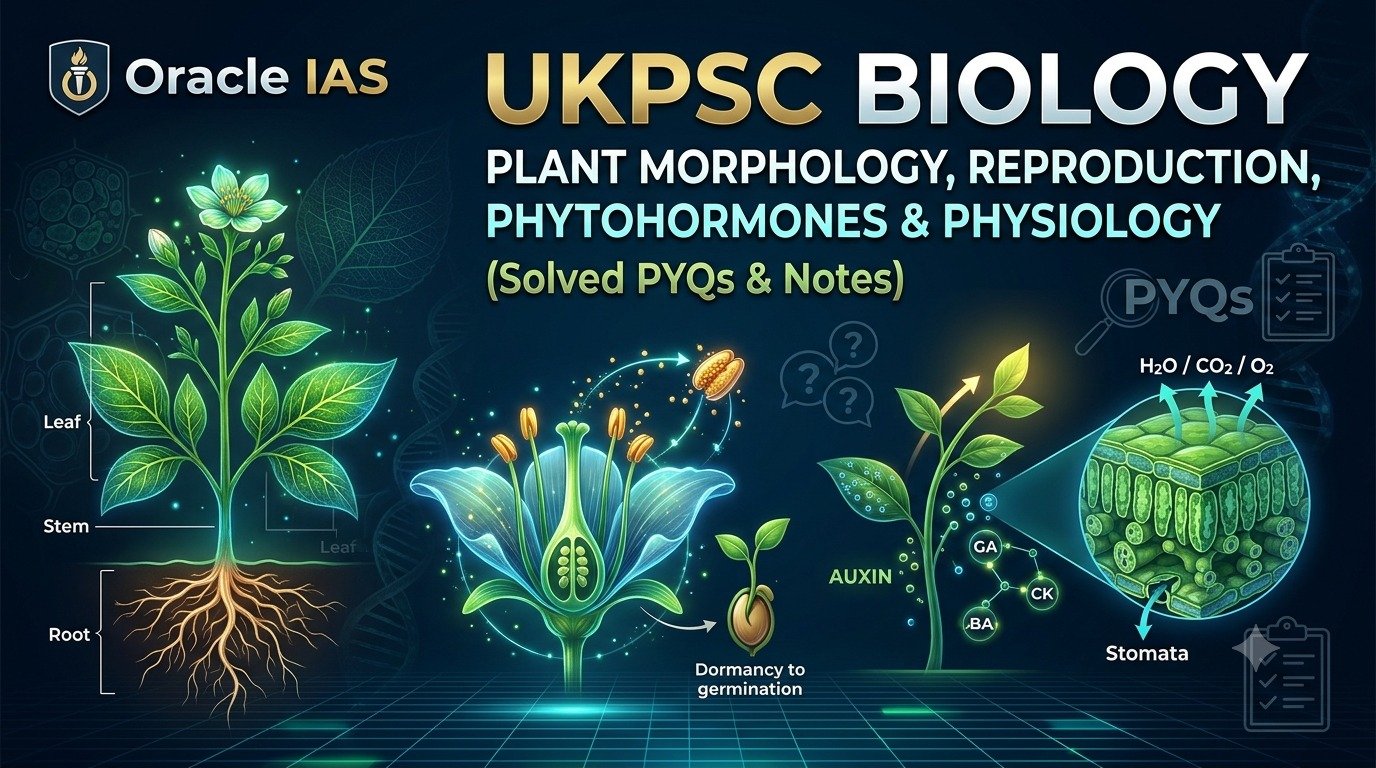
UKPSC Biology (Unit 7): Plant Morphology, Reproduction, Phytohormones & Physiology
Part of the UKPSC General Science & Technology Revision Series.
1.High-Yield Micro-Notes
- Root Morphology & Water Uptake: Standard plant roots anchor the plant, store assimilates, and absorb moisture and mineral nutrients; roots do not participate in photosynthesis (except specialized assimilatory roots like Tinospora and Trapa). Soil water absorption occurs primarily via unicellular root hairs located exclusively in the zone of maturation. Modified taproots that store food include conical Carrot (Daucus carota), fusiform Radish (Raphanus sativus), and napiform Turnip (Brassica rapa); in contrast, Ginger (Zingiber officinale) is an underground modified stem (rhizome) bearing nodes and internodes.
- Floral Embryology & Morphological Botany: Post-fertilization developmental fates: Ovules develop into seeds, while the ovary wall matures into the fruit pericarp. A single wheat grain is botanically a caryopsis (a dry, indehiscent, single-seeded fruit where the pericarp is fused with the seed coat). Gymnosperms lack an ovary (as well as style and stigma), which leaves their ovules naked on megasporophyll cones and prevents true botanical fruit formation. Asexual vegetative budding is a reproductive mode in unicellular ascomycete Yeast (Saccharomyces) and freshwater Hydra.
- Photosynthetic Photolysis & Gaseous Exchange: In oxygenic photosynthesis, light-driven photolysis of water (2H₂O → 4H⁺ + 4e⁻ + O₂↑, catalyzed by the oxygen-evolving complex with Mn²⁺ and Cl⁻ ions at Photosystem II) is the exclusive source of oxygen gas evolved into the atmosphere, while absorbed atmospheric Carbon Dioxide (CO₂) is fixed into carbohydrates.
- Plant Hormones, Agro-Biofuels & Plant Chemistry: Cytokinins (e.g., zeatin, kinetin) are phytohormones that promote active cell division (cytokinesis), delay leaf senescence, and overcome apical dominance. Ethylene (gas) and Acetylene (released from calcium carbide, CaC₂) are widely used for the artificial ripening of green climacteric fruits. The anti-malarial alkaloid Quinine is extracted from the dried stem bark of the Cinchona tree (Cinchona officinalis). The National Biodiesel Mission prioritized Jatropha (Jatropha curcas) as the primary tree-borne oilseed for commercial biodiesel production. Leguminous crops like Peas (Pisum sativum) maintain symbiotic atmospheric nitrogen-fixing bacteria (Rhizobium leguminosarum) inside root nodules. Citrus fruits like lemons contain high concentrations of Citric Acid (C₆H₈O₇). Vertebrate bones and teeth are composed primarily of the inorganic mineral hydroxyapatite, a complex crystalline lattice of Calcium Phosphate [Ca₃(PO₄)₂].
2. Important facts you should know:
| Botanical Specimen / Entity | Morphological Identity / Chemical Nature | Core Biological Role / Characteristic |
| Ginger (Zingiber officinale) | Underground modified stem (Rhizome) | Food storage and vegetative propagation via axillary buds at nodes. |
| Wheat Grain | Simple dry indehiscent fruit (Caryopsis) | Pericarp fused with the seed testa; provides starchy endosperm. |
| Seed vs. Fruit Origin | Seed from Ovule; Fruit from Ovary | Post-fertilization transformation of angiosperm female reproductive organs. |
| Root Hairs | Unicellular extensions of epiblema | Located in zone of maturation; maximizes surface area for water absorption. |
| Photolysis of Water | 2H₂O → 4H⁺ + 4e⁻ + O₂↑ (at PS-II) | Primary photochemical source of molecular oxygen during photosynthesis. |
| Cytokinins | Adenine-derived phytohormones | Promotes cytokinesis/mitosis; works with auxins to direct organogenesis. |
| Quinine | Quinoline alkaloid | Harvested from stem bark of Cinchona; antimalarial therapeutic against Plasmodium. |
| Jatropha (Jatropha curcas) | Non-edible oilseed shrub (Euphorbiaceae) | Transesterification of seed oil produces commercial biodiesel. |
| Bone & Tooth Mineral | Calcium Phosphate / Hydroxyapatite | Provides structural compressive strength to vertebrate skeletal tissues. |
3. Master Questions
Q1. Which of the following edible culinary vegetables is anatomically classified as an underground modified stem rather than a storage root?
[UKPSC APS Mains 2017] [Direct Fact]
(a) Carrot
(b) Radish
(c) Turnip
(d) Ginger
Q2. The primary inorganic chemical compound that forms the mineral matrix of vertebrate bones and enamel of human teeth is:
[UKPSC FRO/ACF Pre 2019] [Direct Fact]
(a) Calcium Sulfate
(b) Calcium Phosphate
(c) Calcium Chloride
(d) Calcium Borate
Q3. Asexual vegetative reproduction via asymmetric cellular ‘budding’ occurs naturally in:
[UKPSC Revenue Inspector 2023] [Direct Fact]
(a) Amoeba
(b) Yeast (Saccharomyces)
(c) Plasmodium
(d) Leishmania
Q4. Which combination of hydrocarbon gases is used commercially for the accelerated artificial ripening of raw climacteric fruits?
[UKPSC APO 2021] [Direct Fact]
(a) Ammonia and Carbon dioxide
(b) Ethane and Ammonia
(c) Methylene and Carbon dioxide
(d) Ethylene and Acetylene
Q5. The antimalarial alkaloid medication Quinine is extracted from which anatomical part of the Cinchona tree?
[UKPSC Pre 2002-03 | UKPSC RO/ARO Pre 2006 | UKPSC APS Mains 2017 | UKPSC RO/ARO Pre 2023] [Direct Fact]
(a) Stem bark
(b) Petals of mature flowers
(c) Ripened fleshy fruit
(d) Foliar leaves
Q6. In flowering angiosperms, following successful double fertilization, the seed develops directly from the:
[UKPSC FRO/ACF Pre 2021] [Direct Fact]
(a) Surrounding Ovary wall
(b) Developing Embryo
(c) Fertilized Ovule
(d) Degenerating Embryo sac
Q7. The majority of subterranean soil moisture absorbed by vascular plants is taken up through:
[UKPSC APS Mains 2017] [Direct Fact]
(a) The apical embryonic zone
(b) The terminal growing point
(c) Root hairs in the zone of maturation
(d) The zone of cellular elongation
Q8. During oxygenic photosynthesis, the molecular oxygen (O₂) gas released into the atmosphere originates from:
[UKPSC APS Mains 2017 | UKPSC Combined SES 2021] [Direct Fact]
(a) Atmospheric Carbon dioxide (CO₂)
(b) Water (H₂O) via light photolysis
(c) Hexose sugar reserves
(d) Pyruvic acid intermediates
Q9. Which of the following is NOT a physiological function performed by typical terrestrial plant root systems?
[UKPSC Mains 2006] [Direct Fact]
(a) Performing Photosynthesis
(b) Absorption of soil capillary water
(c) Uptake of inorganic mineral nutrients
(d) Providing physical anchorage in soil
Q10. Under India’s National Biodiesel Mission, which tree-borne oilseed plant was prioritized as the principal agricultural crop for commercial biodiesel production?
[UKPSC Forest Ranger Pre 2012] [Direct Fact]
(a) Lantana camara
(b) Brassica juncea (Mustard)
(c) Jatropha curcas
(d) Actinidia deliciosa (Kiwi)
Q11. Which of the following cultivated field crops hosts symbiotic atmospheric nitrogen-fixing bacteria (Rhizobium) within its root nodule tissues?
[UKPSC Revenue Inspector 2023] [Direct Fact]
(a) Common Wheat (Triticum)
(b) Lowland Paddy (Oryza)
(c) Field Maize (Zea mays)
(d) Garden Pea (Pisum sativum)
Q12. Which anatomical structure present in angiosperms is absent in gymnosperms, leaving their mature seeds naked and exposed on sporophylls?
[UKPSC AE 2013] [Direct Fact]
(a) Embryonic tissue
(b) Nutritional Endosperm
(c) Megasporangiate Ovule
(d) Enclosing Ovary
Q13. The class of phytohormones responsible for stimulating active cell division (cytokinesis) and cell differentiation in plant shoots and roots is:
[UKPSC AE 2013] [Direct Fact]
(a) Cytokinins
(b) Abscisic Acid (ABA)
(c) Indole-3-acetic acid (IAA)
(d) Ethylene
Q14. From a botanical perspective, a harvested grain of cereal wheat (Triticum aestivum) is a:
[UKPSC Constable 2021] [Direct Fact]
(a) Naked seed
(b) Single-seeded fruit (Caryopsis)
(c) Modified fleshy fruit
(d) Entire multi-seeded inflorescence
Q15. The organic acid present in high concentrations in fresh lemon and lime citrus juice, responsible for its low pH and sour taste, is:
[UKPSC Personal Assistant 2019] [Direct Fact]
(a) Malic Acid
(b) Citric Acid
(c) Lactic Acid
(d) Tartaric Acid
4. Master Explanations & Answer Key
- Ans. (d)
- Direct Answer: Ginger (Zingiber officinale) is an underground modified storage stem termed a rhizome, recognized morphologically by the presence of nodes, internodes, scale leaves, and dormant axillary buds.
- Exam Trap / Distractor Alert: Carrot, radish, and turnip are true storage taproots, not stems; roots lack distinct nodes, internodes, and scale leaves.
- High-Yield Extra Facts: Turmeric, lotus, and canna also form rhizomes; potato is an underground stem tuber, whereas sweet potato (Ipomoea batatas) is an adventitious storage root.
- Ans. (b)
- Direct Answer: The primary mineral component of vertebrate skeletal bones and dental enamel is Calcium Phosphate, predominantly organized as crystalline hydroxyapatite [Ca₁₀(PO₄)₆(OH)₂].
- Exam Trap / Distractor Alert: While calcium carbonate is the main constituent of molluscan shells and pearls, vertebrate bones are composed of calcium phosphate deposited on a fibrous collagen protein matrix.
- High-Yield Extra Facts: Tooth enamel is the hardest biological substance in the human body, consisting of roughly 96% mineralized calcium phosphate; fluoridation converts hydroxyapatite into fluoroapatite, increasing acid resistance against dental caries.
- Ans. (b)
- Direct Answer: Asexual reproduction via budding is characteristic of the unicellular fungus Yeast (Saccharomyces cerevisiae), where a daughter cell emerges as an asymmetric cellular protrusion from the parent cell.
- Exam Trap / Distractor Alert: Amoeba reproduces by binary fission; Plasmodium reproduces via multiple fission (schizogony); Leishmania divides through longitudinal binary fission.
- High-Yield Extra Facts: Multicellular budding also occurs in simple invertebrates like Hydra; yeast chains formed by incomplete detachment of successive buds are termed pseudomycelia.
- Ans. (d)
- Direct Answer: Gaseous Ethylene is the natural plant hormone responsible for fruit ripening; Acetylene gas (generated by treating commercial calcium carbide with ambient moisture: CaC₂ + 2H₂O → C₂H₂ + Ca(OH)₂) is widely used as an industrial ripening agent.
- Exam Trap / Distractor Alert: Using industrial calcium carbide for fruit ripening is banned under the Food Safety and Standards Authority of India (FSSAI) regulations because commercial-grade carbide often contains toxic traces of arsenic and phosphorus hydrides.
- High-Yield Extra Facts: Ethylene is unique as the only naturally occurring gaseous plant hormone; it stimulates the breakdown of chlorophyll, softens pectin in cell walls, and converts starch into sweet soluble sugars in climacteric fruits like bananas and mangoes.
- Ans. (a)
- Direct Answer: Quinine is a therapeutic alkaloid extracted from the dried stem bark of evergreen trees belonging to the genus Cinchona (family Rubiaceae), native to the Andean forests of South America.
- Exam Trap / Distractor Alert: Quinine is extracted specifically from the stem bark, not from the flowers, leaves, or roots; Artemisinin, another antimalarial compound, is extracted from the leaves of the sweet wormwood plant (Artemisia annua).
- High-Yield Extra Facts: Quinine was the first effective clinical treatment against Plasmodium falciparum malaria; its stereoisomer quinidine is used in modern clinical medicine as a Class-IA antiarrhythmic cardiac agent.
- Ans. (c)
- Direct Answer: In angiosperm floral development, the fertilized ovule matures into a seed, while the surrounding ovary wall thickens to form the fruit wall (pericarp).
- Exam Trap / Distractor Alert: Remember the developmental pairing: Ovule → Seed; Ovary → Fruit; Integuments of ovule → Seed coat (Testa and Tegmen).
- High-Yield Extra Facts: Parthenocarpy is the development of a fruit without prior fertilization of the ovule, producing seedless fruits such as commercial bananas and seedless grapes.
- Ans. (c)
- Direct Answer: Most soil water and dissolved mineral solutes are absorbed through microscopic root hairs, which are tubular unicellular extensions of epiblema epidermal cells located exclusively in the zone of maturation.
- Exam Trap / Distractor Alert: The zone of elongation drives longitudinal root growth into soil, and the embryonic meristematic zone drives cell division; neither zone possesses root hairs or carries out water absorption.
- High-Yield Extra Facts: Root hairs increase the effective absorptive surface area of root systems hundreds of times, taking up water via osmosis driven by transpiration pull through xylem conduits.
- Ans. (b)
- Direct Answer: Atmospheric oxygen evolved during photosynthesis comes exclusively from the photolytic splitting of water (H₂O), not from carbon dioxide; demonstrated experimentally using the oxygen-18 (¹⁸O) isotopic tracer technique by Ruben, Randall, and Kamen (1941).
- Exam Trap / Distractor Alert: Carbon dioxide supplies carbon and oxygen atoms to build carbohydrate hexose rings and water, but none of the released gaseous diatomic O₂ originates from CO₂.
- High-Yield Extra Facts: Photolysis of water occurs on the lumen side of the thylakoid membrane at Photosystem II (PS-II), requiring an inorganic catalytic cluster of four Manganese (Mn) ions and Calcium (Ca²⁺).
- Ans. (a)
- Direct Answer: Typical plant roots are subterranean, non-green organs that lack chloroplasts and cannot conduct photosynthesis; photosynthesis is carried out primarily by chlorophyllous mesophyll tissues in leaves.
- Exam Trap / Distractor Alert: Typical terrestrial roots do not photosynthesize; rare exceptions include aerial epiphytic roots like the green velamen roots of orchids and the assimilatory roots of Taeniophyllum and Tinospora.
- High-Yield Extra Facts: In addition to anchorage and nutrient absorption, roots synthesize plant hormones such as cytokinins and transport them upward through the xylem to stimulate shoot development.
- Ans. (c)
- Direct Answer: Jatropha curcas (physic nut, family Euphorbiaceae) was designated as the primary tree-borne oilseed under the National Biodiesel Mission because its seeds contain 30–40% non-edible oil that converts into biodiesel via transesterification.
- Exam Trap / Distractor Alert: Lantana camara is an invasive alien weed of forest ecosystems; Brassica (mustard) yields edible cooking oil, making it unsuitable for fuel diversion; Kiwi is an edible fruit vine.
- High-Yield Extra Facts: Another non-edible indigenous tree-borne oilseed used for biodiesel in India is Karanja (Pongamia pinnata); Jatropha can grow on degraded wastelands with minimal irrigation requirements.
- Ans. (d)
- Direct Answer: Garden peas (Pisum sativum) belong to the leguminous family Fabaceae; their root nodules house symbiotic nitrogen-fixing Rhizobium leguminosarum bacteria, which convert atmospheric N₂ into ammonia.
- Exam Trap / Distractor Alert: Cereals like wheat, paddy, and maize are non-leguminous monocots that do not form Rhizobium root nodules; paddy fields rely on cyanobacteria (Anabaena azollae) and Azospirillum for biological nitrogen inputs.
- High-Yield Extra Facts: The symbiotic nitrogen-fixation reaction is catalyzed by the oxygen-sensitive enzyme nitrogenase, protected from atmospheric oxygen degradation by the pink oxygen-scavenging pigment leghemoglobin.
- Ans. (d)
- Direct Answer: Gymnosperms lack an enclosing ovary; their ovules are borne naked and exposed directly on the surface of megasporophyll scale leaves, meaning gymnosperms produce naked seeds rather than true fruits.
- Exam Trap / Distractor Alert: Gymnosperms possess functional embryos, haploid endosperm, and ovules; it is the ovary (and the resulting fruit) that is absent in gymnosperms.
- High-Yield Extra Facts: The term Gymnosperm derives from the Greek gymnos (naked) and sperma (seed); common examples include conifers such as Pinus, Cedrus deodara (the Deodar cedar of the Himalayas), and Cycas.
- Ans. (a)
- Direct Answer: Cytokinins are adenine-derived plant hormones that stimulate cytokinesis (cell division) in roots, shoots, and axillary buds, working with auxins to regulate plant organogenesis.
- Exam Trap / Distractor Alert: Auxins (IAA) promote cell elongation and apical dominance; Gibberellins promote stem internode elongation and seed germination; Abscisic Acid (ABA) is a growth inhibitor that promotes dormancy and stomatal closure.
- High-Yield Extra Facts: In plant tissue culture, a high cytokinin-to-auxin ratio promotes shoot differentiation, while a low cytokinin-to-auxin ratio induces root formation.
- Ans. (b)
- Direct Answer: A wheat grain is a simple, dry, indehiscent fruit known botanically as a caryopsis, in which the outer fruit wall (pericarp) is fused with the underlying seed coat (testa).
- Exam Trap / Distractor Alert: While colloquially referred to as “seeds,” grains of the grass family (Poaceae/Gramineae, including wheat, rice, and maize) are true single-seeded fruits.
- High-Yield Extra Facts: The edible wheat grain consists of three primary components: the outer protective bran layer (pericarp + aleurone), the starchy endosperm (approx. 83% of grain weight), and the lipid- and vitamin-rich embryo (wheat germ).
- Ans. (b)
- Direct Answer: Lemons and limes (Citrus limon) contain high concentrations of Citric Acid (C₆H₈O₇, typically 5% to 8% of juice weight), which produces their low pH (approx. 2.2 to 2.6) and sour taste.
- Exam Trap / Distractor Alert: Malic acid is the primary organic acid in unripe apples; Tartaric acid is found in tamarind and grapes; Lactic acid forms in sour curd and fermented dairy products.
- High-Yield Extra Facts: Citric acid is an intermediate in cellular aerobic respiration via the Krebs cycle (Tricarboxylic Acid / TCA cycle); it is used commercially as an acidulant and natural preservative in food and beverage manufacturing.
Contact Oracle IAS:
Call/WhatsApp 9997453844 for details
Join Our Preparation program:

He is a bibliophile,accomplished writer and a fitness enthusiast.
- UKPSC Biology: Plant Morphology, Reproduction, Phytohormones & Physiology (Solved PYQs & Notes) - November 17, 2026
- UKPSC Biology: Animal Kingdom, Piscine Misnomers, Aquatic Mammals & Adaptations (Solved PYQs & Notes) - November 16, 2026
- UKPSC Biology: Plant Kingdom, Morphology, Photosynthesis & Plant Physiology (Solved PYQs & Notes) - November 14, 2026